


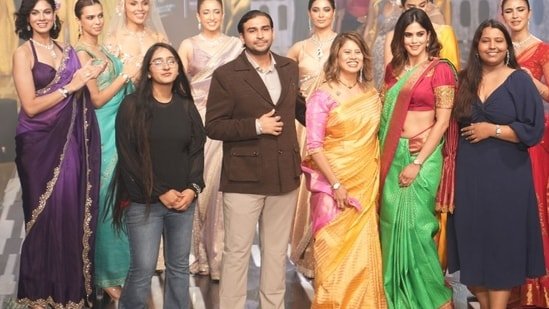
Mysore, a city renowned for its palaces, silk, and deeply rooted traditions, has been transformed into a fashion destination by designer Jayanthi Ballal. In an exclusive interview with HT Lifestyle, Jayanthi spoke about her journey as the founder of Mysore Fashion Week, which has helped nurture a fashion culture in Mysore. While celebrating the 8th edition of Mysore Fashion Week from March 13 to 15, 2026, Jayanthi Ballal proved that style and creativity can thrive far beyond the major metropolitan fashion circuits. With nearly three decades in the fashion industry, Jayanthi’s journey has been shaped by resilience, patience and a deep love for the city she calls home.

A dream that began in Mysore
Jayanthi Ballal’s career began as a designer in 1997, nearly three decades ago. At that time, the opportunities for fashion designers in Mysore were limited. “Back then, Mysore was a tier-two city and nearly 28 years ago it felt like a glorified village,” she recalls. “I always wanted to do fashion shows after finishing college, but there was no guidance, no mentoring or internships available,” said Ballal.
However, instead of waiting for opportunities to come her way, Ballal began creating them herself. She started training college students in modelling and using them to present her designs. “That’s where it all began,” she said. “Today we see supermodels everywhere, but at that time we had to connect with local people. Training students and showcasing garments through them helped build that connection.” “I wanted to do something for my city,” she highlighted.
Bringing fashion to a heritage city
Introducing modern fashion platforms to such a culturally rooted city came with its own set of challenges. “Mysore is known for its heritage, and people here are quite conservative,” Ballal explains. “If I showcased only Western garments, people wouldn’t connect with it. So I focused on designs rooted in tradition,” highlighted Ballal. She incorporated heritage elements into her work so that the audience could emotionally connect with the designs. “Here, people connect fashion with culture and tradition. When they feel that connection, they support it,” Ballal mentioned.
Before launching the full-fledged fashion week, Ballal organised several solo shows over the years and later experimented with a two-day fashion extravaganza to understand audience interest. “I wanted to see whether Mysore would accept back-to-back designer showcases like a real fashion week,” she said. The positive response encouraged her to formally establish Mysore Fashion Week.
Struggles and scepticism
Speaking about her early struggles, Ballal highlighted that launching the event was far from easy. However, sponsorships were difficult to secure, and convincing professional models to travel to Mysore was another challenge. “When we approached supermodels initially, many of them didn’t even know where Mysuru was,” Ballal added.
“Travel was also complicated at the time. There wasn’t a proper highway like today. It used to take four to five hours from Bengaluru airport to reach Mysore. There were also doubts about whether the organisers would be able to pay models,” said Ballal.
“In fact, models were hesitant to come because they weren’t sure if payments would be made or not,” added Ballal.
However, social media gradually helped the event gain visibility, and Facebook played a crucial role. “Models from Bengaluru started posting about the show online, and that helped create awareness,” highlighted Ballal.
Mysore Fashion Week
Today, Mysore Fashion Week has grown into a recognised event in the regional fashion circuit. After a pause during the pandemic, the platform is now hosting its eighth edition. Auditions for models are now conducted in cities including Delhi, Mumbai and Bengaluru, attracting hundreds of aspiring participants. “In Delhi alone, we had nearly 300 people turning up for auditions,” Ballal highlighted. “Most of them were professional models, above 5 ‘8”, eager to walk the runway,” she added.
The event has also hosted several well-known designers over the years, including Riyaz Ganji, Bhargavi Kunam, Jagan Kumar and Rosy Ahluwalia. Past editions have also featured designers like Archana Kochhar.
Celebrating Indian craftsmanship
At the heart of Jayanthi’s design philosophy lies a deep respect for traditional Indian textiles. “Tradition always stands out. You can wear many western outfits, but when someone appears in a sari, everyone notices,” said Ballal.
Her work primarily focuses on South Indian textiles, especially Kanjivaram silk sarees. “I mostly work with handloom Kanjivarams and incorporate jewellery-inspired designs into the garments,” she explains. Many of her designs also feature the mythical two-headed bird Gandabherunda, a symbol associated with the Mysore royal heritage. “It is part of the Mysore Palace emblem, and I use it as a motif in my collections,” she said. Other recurring inspirations include elephants, temple jewellery and the city’s spiritual and cultural symbols. “I always try to keep the heritage of Mysuru alive through my work.”
Future of Mysore Fashion Week
Looking ahead, Jayanthi Ballal hopes to elevate Mysore Fashion Week to new heights in the years to come. Her long-term vision is to invite some of India’s biggest fashion designers to showcase their work in the city. “One day I would love to have designers like Manish Malhotra, Anita Dongre or Sabyasachi Mukherjee presenting their collections at the finale,” she said.
Advice for the next generation designers
Amidst working for Mysore Fashion Week, Ballal also ensures to create opportunities for emerging designers and often interacts with students and interns. Jayanthi believes creativity combined with persistence is the real formula for success. “Many young people today expect overnight success because of social media,” she said. “But building a brand takes time.”
