


History rarely announces itself with the courtesy of a headline. More often it arrives as an image, a photograph, a gesture, a moment of such concentrated symbolic weight that it renders a thousand analytical paragraphs redundant.
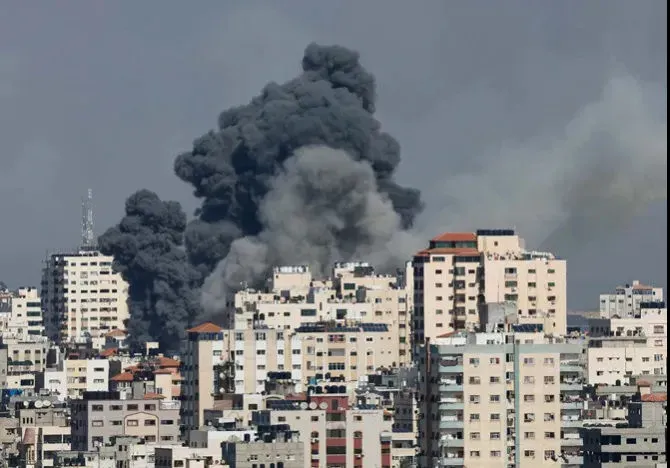
The current conflict in West Asia, now entering its third week, has produced two such images. Placed side by side, they constitute perhaps the most devastating commentary on the gap between assumed power and actual power that this century has yet produced.
The first: Iranian President Masoud Pezeshkian walking through the streets of Tehran during Quds Day, his first public appearance since the American and Israeli strikes of February 28 that killed Supreme Leader Ayatollah Khamenei and reshaped the Middle East in ways still not fully reckoned with.
Rain falling. Explosions audible in the middle distance. People gathering around him, shaking hands, taking photographs, pressing close with the instinctive human need to confirm that leadership is still present and breathing. Not fear in that crowd. Something closer to its opposite.
The second: Israeli Prime Minister Benjamin Netanyahu, making his first press conference thirteen days into the war. Not in the Knesset. Not before the Israeli public in any physical sense. On a screen, from an undisclosed location, broadcast to journalists who could not ask a follow-up question, he did not wish to answer. The most sophisticated military in the Middle East, backed by the full weight of American airpower, and its leader communicating via Zoom.
These are not merely contrasting images. They are competing arguments about the nature of power, and one of them is winning.
What Thucydides Actually Said
The Athenian historian’s most famous formulation, that the strong do what they can and the weak suffer what they must, has been deployed as a licence, a comfort, and a strategic instruction manual by great powers for twenty-five centuries. The United States and Israel carried it into this conflict as a foundational assumption.
Iran was cash-starved, sanctioned to exhaustion, its regime brittle and its population allegedly restless for liberation. The strikes would decapitate the leadership, destroy the nuclear infrastructure, and the Islamic Republic would do what the weak are supposed to do: collapse under the weight of demonstrated superiority.
What Thucydides wrote, however, was not an endorsement. It was a warning. His History of the Peloponnesian War is a chronicle of the catastrophe of how Athens and Sparta, each convinced of its superior strength and the inevitability of the other’s submission, spent three decades destroying not only each other but the entire edifice of Greek civilisation. The maxim is prophetic, not prescriptive. The strong did what they could. The weak suffered what they must. And both were ruined.
The error made in this conflict was not merely military. It was the more fundamental error of misreading what constitutes power in the twenty-first century and of confusing an adversary’s economic weakness with its strategic fragility.
The Anatomy of Miscalculation
Graham Allison, in his indispensable Destined for War: Can America and China Escape Thucydides’s Trap?, identifies the recurring cognitive failure of dominant powers: they tend to measure relative strength in terms of the capabilities they themselves possess and value, rather than in terms of what the challenger has actually built. They see hardware and model hardware. They see budgets and model budgets. They do not always see doctrine, will, and the institutional memory of asymmetric resistance accumulated over decades.
Iran has spent forty-five years since 1979 building a military posture oriented around precisely one strategic contingency: conventional confrontation with a technologically superior adversary. While the United States constructed carrier strike groups optimised for blue-water dominance, Iran distributed thousands of ballistic missiles designed to overwhelm layered defences through volume and unpredictability.
While Israel perfected air supremacy, Iran buried its programme across hundreds of hardened underground facilities, a dispersal that no single strike package, however sophisticated, can neutralise in an opening salvo.
The sanctions that were supposed to produce strategic submission produced instead strategic adaptation. Tehran built an alternative trade architecture with Beijing through barter arrangements outside the dollar system, deepened military resupply ties with Moscow, and sustained a network of regional proxies that require minimal central funding to remain operationally relevant.
Washington spent months cutting Iran’s access to the global economy. Iran spent years building an economy calibrated to wage regional war without global access. The two projects were not equivalent. Only one was preparing for this specific moment.
Most critically, and most consequentially, the intelligence assessments confused regime unpopularity with regime fragility. There is a profound and historically documented difference between a population that resents its government and a population that will welcome foreign bombs as liberation.
The French did not greet the Nazi occupation as deliverance from the Third Republic. The Vietnamese did not interpret American firepower as an invitation to embrace Washington’s preferred political arrangement. You cannot bomb a population into revolution against their own state. You can only bomb them into defending it.
Robert Caro, in The Passage of Power his magisterial study of Lyndon Johnson’s assumption of the presidency in the hours after Kennedy’s assassination describes a fundamental principle of crisis leadership: in moments of national emergency, the leader must be physically visible.
Not virtually present, not digitally proximate, but present in the full corporeal sense that communicates to a frightened public that the system has not collapsed and that someone is bearing the weight of events in real time. Johnson understood this at the level of instinct. He rushed before cameras in Dallas because he grasped that the perception of leadership is, in a crisis, inseparable from leadership itself.
Pezeshkian’s walk through rain-soaked Tehran streets, with explosions audible overhead and his Supreme Leader freshly dead, was a masterclass in exactly this principle. The Iranian presidency is a subordinate office within the Islamic Republic’s constitutional architecture. He did not need to walk those streets. He chose to. And that choice communicated, with a precision no communiqué could achieve, that the Islamic Republic had not been decapitated, that it had absorbed the most devastating strike in its history and remained in the streets among its people.
Netanyahu’s Zoom appearance communicated the inverse. Whether the security concerns that kept him from public view were legitimate is, for the purposes of political analysis, almost beside the point. The optics transmitted fear.
A nation deploying the most advanced military assets in the region, operating with American intelligence and logistical support, had a prime minister whose physical location was classified information. The contrast was not lost on the audiences that matter most: the Arab street, the Global South capitals watching the conflict calibrate their own positioning, and the domestic Israeli public absorbing the gap between promised victory and visible reality.
The War That Has No Exit Sign
The Strait of Hormuz remains effectively closed. Oil markets have recorded swings of historic magnitude. Ballistic missiles continue reaching Israeli territory. And Iran, battered, bled, its supreme leadership destroyed, continues fighting. This is not the outcome that the Thucydidean calculus predicted.
It is the outcome that Thucydides’ own history should have warned against. Power is relational, not absolute. You are only as strong as your adversary is genuinely weak. And when you have fundamentally misread the nature of that weakness, when you have confused economic constraint with strategic incapacity, regime unpopularity with civilian surrender, leadership decapitation with institutional collapse, all the hardware in the world delivers you not to victory but to a quagmire wearing victory’s clothing.
America and Israel boarded what they believed was a one-way flight to Iranian capitulation. They have landed, instead, in a region on fire, with an adversary more dangerous, wounded than intact, and no exit strategy visible on any horizon.
Thucydides was not wrong about the strong doing what they can. He was simply more honest than his readers about where that story ends.
(The Author is Executive Editor, Rising Kashmir)
