


When did an international style like Art Deco become part of Delhi’s everyday visual landscape?

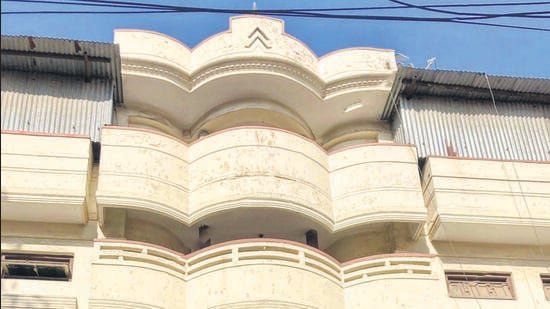
Delhi began seeing buildings in the Art Deco style in the early 1940s, when Sir Sobha Singh developed Sujan Singh Park, designed by architect Walter Sykes George, to house officers during the Second World War. These apartments fused Lutyens-style archway entrances with curving Deco balconies and signature “eyebrows.” In contrast to the open verandahs typical of the Capital’s earlier homes, the upper floors featured longer enclosed windows. George appears to have drawn from European housing schemes while adapting them to local materials such as exposed brick.
Completed in 1945, the apartments were partly leased out under a government order that allowed flats not required for official use to be rented to people of “good position and social status in life.” During Partition, Sobha Singh also opened the complex to families fleeing from Pakistan until they found more permanent accommodation, as researchers from the “Deco in Delhi” project note.
In its earliest phase, Deco in Delhi appeared largely in government buildings or residences commissioned by Indian princes. One modest mansion on Tilak Marg gained a different kind of historical significance when it came to be known as “Insaf ki Kothi.” BR Ambedkar lived there after being appointed India’s first law minister, from 1947 to 1951. The house originally belonged to the Raja of Kanika in present-day Odisha. An ornamented metal gate leads to a carefully profiled boundary wall, beyond which stands a Streamline Moderne building distinguished by its elegant eyebrow ledges.
While architects such as George introduced the style, it was a group of architects from Bombay who helped popularise a more Indianised version of Deco in Delhi. Firms such as Master, Sathe and Kothari designed notable buildings including Kota House and several grand residences. Their work created a visible stylistic link between Bombay and Delhi and helped establish Deco as the most fashionable architectural language of the time.
Business, merchant and industrialist families soon adopted Deco elements in their own homes, particularly when building large city mansions for extended families. Neighbourhoods such as Daryaganj, Chandni Chowk, Pusa Road, Sundar Nagar and Karol Bagh became known for these residences.
The spatial layout of these homes remained deeply Indian, but the formal drawing room often carried an international air. Terrazzo floors and cladding introduced colour and glamour. Facades welcomed modernist abstraction with insignias, geometric motifs and stylised ornamentation that reflected global design trends.
A striking feature of many Deco residences was the staircase. Often spiral or helical, or designed as a continuous flowing form, the stair became the heart of the house. Emphasis was placed on horizontal movement rather than vertical height. Balusters were frequently replaced with brickwork clad in terrazzo. Terrazzo and wood, the two most widely used materials, allowed for seamless joinery and smooth finishes.
Another characteristic Deco detail was typography. House names were cast in terrazzo or mounted onto facades – a design gesture popularised by cinemas and hotels of the 1940s that still survives on many homes today.
The row houses of Daryaganj and Kamla Nagar were equally colourful but more strongly Indian in character. Many featured central courtyards, multi-storey living and prominent staircases. Their ornamentation often reflected religious beliefs or political sentiment, particularly the ideals of swaraj. The house has always been a site of identity, and many homeowners expressed the spirit of a newly independent nation on their facades, adding slogans such as “Jai Hind” or even the national flag.
In this search for identity, houses such as Charan Bhawan in Model Basti and the so-called Unchi Kothi of Ballimaran – literally translating to “the tallest house” – stand out.
Now most Deco buildings lie in purgatorial space where their modernity, to the common eye, looks more outdated than futuristic. Many villages and residential pockets of Delhi have Deco strewn all over. Details of Deco have permeated deeply into popular culture, but its distinct time period remains its biggest shortcoming.
It is both tragic and telling that these residences became some of Delhi’s earliest aspirational markers of modernity. Even at a time when nationalist sentiment was at its height, Art Deco found its place in the city. It offered a language that was modern, glamorous, and connected Delhi to a wider international world of design and ideas.
Today, it requires a city-wide campaign to get Deco recognised as an essential typology of Independent India – where Deco houses were part of an international culture embraced by culturally aware Indians.
This article draws upon the research of the “Deco in Delhi” project by founder Geetanjali Sayal and research coordinator Prashansa Sachdeva.
