


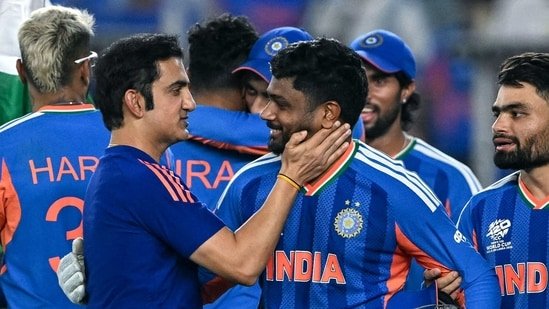
One of the biggest drivers of India’s ruthless white-ball dominance under Gautam Gambhir has been a clear shift in mindset, with the head coach instilling a strict “trophy over milestone” policy inside the dressing room. For Gambhir, there is little room to celebrate personal landmarks, winning matches and lifting trophies matter far more than missed centuries.
The policy, however, did not emerge only after India’s historic T20 World Cup triumph last Sunday in Ahmedabad. Speaking at the India Today Conclave, Sanju Samson revealed that the rule had been made clear to every player much earlier, when Gambhir took charge of the Indian team during the white-ball tour of Sri Lanka in July 2024. Since then, players have largely adhered to the team-first philosophy.
Yet Samson admitted that he came close to breaking that mindset during India’s victorious T20 World Cup campaign.
The India opener, who went on to win the Player of the Tournament award for his outstanding batting performances, revealed that the thought of a personal hundred did cross his mind, before he quickly checked himself.
“Those were constant conversation points that we wrote down in team meetings since the Sri Lanka series (in 2024) when Gambhir and Suryakumar took over,” Samson said. “From that moment, it was clear there was no place for personal milestones. That is how our character got aligned.
“Yes, there is a conscious effort. But when people say that I missed out on three hundreds, I feel I made a much bigger contribution. I won’t say I never thought about those hundreds. As a human being, I also thought that ‘Ek hundred ho jaye toh mazaa aa jayega. (It would be fun to score one century)’ You definitely think about it.
“But then I told myself, ‘How did you score so many runs?’ So I respected the process and kept playing my shots. The only thought was what the team needed from me at that moment.”
Samson fell agonisingly short of a century on multiple occasions during the tournament, finishing unbeaten on 97 against the West Indies cricket team in Kolkata, before being dismissed for 89 in both the semifinal against England and the final against New Zealand.
The Kerala batter, who was not part of the playing XI in four of India’s first five matches, eventually ended the tournament with 321 runs, including three half-centuries, to cap off a remarkable campaign.
