


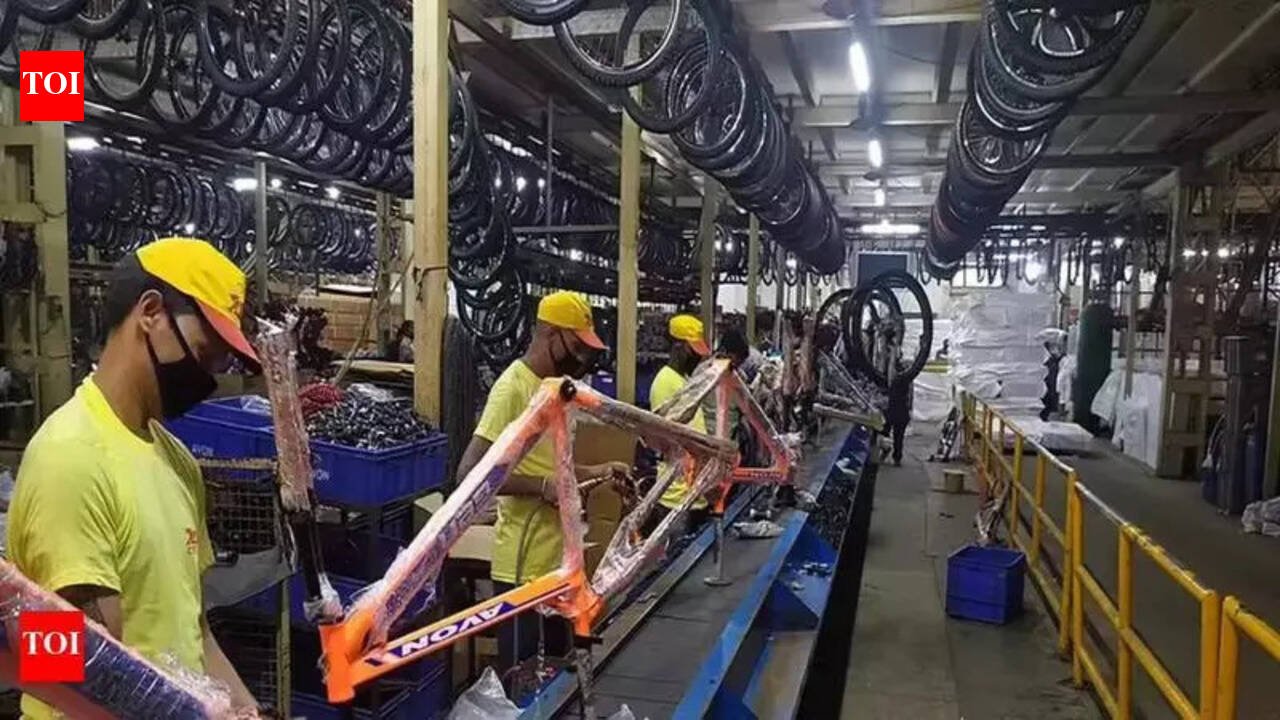
Chandigarh: The Progressive Punjab Investors’ Summit revealed an industrial irony: while Punjab produces around 90% of India’s cycles for elite global markets, the bicycle industry currently stands at a critical crossroads. On the home turf, cycling still battles a “social taboo” and safety risks that hinder daily mobility. To reinvent the sector, industry leaders proposed a shift towards high-tech e-mobility and Swiss-inspired “tandem bikes”, including quads and five-person “quints”, to transform the cycling experience.The session, titled ‘Bicycles and e-Bikes – parts to platform’, underscored that Punjab’s massive industrial base, consisting of over 400 component-producer MSMEs and over 100 medium and large producers, is the reason India stands as the world’s largest bicycle-producing nation. Rakhi Gupta Bhandari, Punjab’s principal secretary of food processing, suggested that the cycle industry should look to the Swiss model of tandem bikes to change the domestic narrative. “People ride tandem bikes—triplet, quad or quint,” she noted, suggesting such bikes could be manufactured in Punjab to promote a new cycling culture. She added that the fact that Punjab’s bicycles were exported to Europe and the US already “speaks volumes about the quality of the products.” Referring to the current chaos on Indian roads and the vulnerability of those on two wheels, Bhandari emphasised a necessary shift in mindset: “The cyclist should be the king of the road,” emphasising the need for safer cycling. She added that a bicycle should be promoted as a “premium and fashionable” choice. Onkar Singh Pahwa, chairman and managing director of Avon Cycles, detailed the the state’s legacy. “Punjab has a strong legacy in bicycle and bicycle parts value chain… which makes India the largest bicycle-producing nation in the world,” he said. Highlighting the state’s self-reliance, he noted, “More than 90% of the bicycles, more than 97% of bicycle components, in the country are produced in Punjab. Only a few parts like bicycle locks are made in Aligarh. Even the tyre-tubes are made locally in the state.” However, Onkar Pahwa emphasised that the industry must evolve because “in today’s market, customers don’t just buy a bicycle, they buy safety, durability, comfort, and increasingly electric-assisted performance.” He revealed that the sector is already diversifying, stating, “Apart from bicycles, we are producing electric mobility products like e-bikes and e-scooters. Recently, we started producing fitness equipment, including home gyms. The market is no longer 1 dimensional.” Despite this global success, the summit highlighted that while the Dutch prime minister famously travels on a bicycle, Indian cyclists face a lack of road safety and a persistent social stigma. To combat this, the roadmap involves a shift towards full e-mobility platforms, focusing on the high-tech bikes with motors, batteries, and controllers. Sanjeev Pahwa, managing director of Ralson (India) Limited, noted that post-Independence India was in desperate need of a cheap and reliable mode of transport. It was then that the enterprising spirit of Ludhiana’s families, many of whom migrated from Pakistan, stepped in to fill the void and steer the city into an industrial hub. “The bicycle industry was seeded by families who migrated from Pakistan and steered Ludhiana into an industrial hub,” Pahwa recalled. He noted that the early 1950s marked the era when the production of the iconic “black bicycles” began, alongside the local manufacturing of bicycle tyres and tubes. BOX: CYCLE INDUSTRY AT CROSSROADS Tracing the cycle industry’s roots, Sanjeev Pahwa, managing director of Ralson (India) Limited, observed that the cycling sector currently stands at a crossroads, with a reducing number of people in the country still utilising the bicycle for daily mobility. “The challenge for us now is to reinvent the industry,” Pahwa stated, noting that the bicycle transitioned from a mere means of transport into a tool for sports, leisure, health, and relaxation. He emphasised that the modern customer’s needs shifted towards “global quality”, with a demand for the same standards found in the US and Europe. To meet this, he suggested: “We need to go premium, invest in R &D, and use more advanced materials. We should look at high-end e-bikes and e-scooters as there is a lot of import dependency for the electric components.”
