


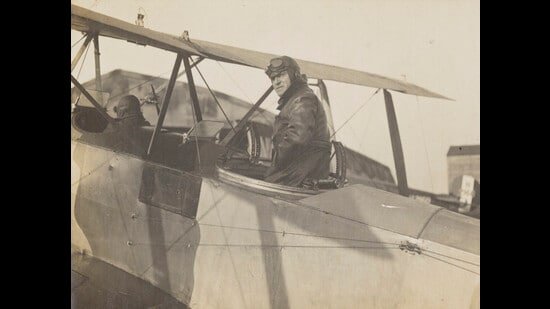
When shooting from a small, open-top aircraft, it is advisable not to hold on to anything. That way, the arms stay clear of the fuselage and vibrations do not blur the photograph. “If one’s right leg is tied to the seat with a scarf or a piece of rope, it is possible to work in perfect security and to move freely in all directions.”
That’s Alfred Buckham, describing how he took his remarkable aerial photographs, in an interview with Amateur Photographer magazine in 1929.
If that sounds insanely risky (please don’t try any of it, anywhere), it was.
“My journey nearly came to an abrupt conclusion over Buenos Aires,” Buckham said, in another interview, this time with London’s Morning Post, in 1933. As he drew back out of a window, the door of the airplane cabin swung open. “The safety catch was broken.”
This was what it took to capture some of the world’s first aerial views.
The small craft of the time were little more than sheets of canvas stretched over wooden frames. The cameras were large, bulky and far from effective unless used very precisely.
None of which bothered Buckham. He was just delighted he could pick an occupation that allowed him to combine his loves of flying and photography. He would go on to build a legacy that won him fame, a reputation as a daredevil, and numerous awards.
The Morning Post commissioned him to write a series of articles about his adventures, because people wanted to know just how he captured these images.
It would have delighted him to know that, 70 years after his death, more than 100 of his pictures, along with personal objects such as letters, photos and travel journals, are on display at the National Galleries of Scotland until April 19, in a show titled Alfred Buckham: Daredevil Photographer.
“He was very proud of what he achieved. Some of his mishaps in the air were most definitely accidental, but none of his photographs were — because he put so much time and care into crafting the perfect aerial view,” says exhibition curator Louise Pearson.
It helped that heights didn’t scare him.
Buckham began his career as a photographer in London in 1905, after some failed experiments with painting. As a Royal Air Force pilot, he went on to survive nine crash landings during World War 1, and serve as the first head of aerial reconnaissance for the Royal Navy.
After the war, he became determined to make history with his images. And he did.
In a spectacular 1918 photograph, Scotland’s Forth Bridge spans a slender river, with its three magnificent steel arches in clear but minute view. In others, volcanic craters send up smoke in Guatemala and Mexico.
“As if resentful of being photographed, (it) suddenly cast a cloud of choking, sulphurous gas upon us, an unpleasant experience which engendered greater caution in the next approach,” Buckham told The Morning Post, describing a day spent capturing images of Mexico’s active Popocatepetl volcano.
A SHOT ABOVE THE REST
Aerial photography predates the aircraft by quite a bit, but it was the aircraft that revolutionised it, of course.
Rewinding a little, the first aerial view of Boston was captured from a hot-air balloon, in 1860. Inventors of that era also attached box cameras to kites and strapped miniature lenses to pigeons to produce hazy, dreamlike views.
The earliest known “aeroplane images” were taken by French cinematographer LP Bonvillain while on board one of the world’s earliest flights, a craft piloted by Wilbur Wright in 1909, just six years after the first-ever flight (which was really just a 12-second lurch in literal terms, and a giant leap forward, if there ever was one, in every other way).
Back to aerial photography, it became a more-precise tool by the dawn of World War 1, used by armies, geologists, surveyors and urban planners too.
This did mean battling freezing temperatures in open aircraft, and enduring frequent sprays of engine oil as one leaned over to take one’s shot. The cameras were placed under incredible strain too. Buckham’s was fitted with a large viewfinder and leather bellows reinforced with cardboard or aluminium, to withstand the fierce winds at high altitudes.
Carefully handwritten notes on the backs of his images explain what it took to capture each frame. A 1920 photograph titled The Thunderstorm captures spectacular cloud formations against dramatic sunlight. Amid the blinding flashes and booming thunder, the aircraft would plunge into deep air pockets, Buckham wrote. Immediately after the shot was taken, he and the pilot experienced an electric jolt, he adds.
The artistic end-products owed much to his skilful photographic manipulation too.
Buckham made effective use of a technique called combination printing to add elements such as clouds or even a plane, from other negatives in the same reel. Take the 1920 image of Edinburgh. “Through technical analysis, we see that he used a tiny pinprick to mark out where he would add the aeroplane. I like to think he was putting together a darkroom jigsaw,” says Pearson.
He would selectively print parts of a negative using an enlarger, then combine it with other prints, to create and recreate multiple versions of the same scene, each paired with a different sky or an added element. Sometimes, as a finishing touch, he used watercolours on the final print to soften the areas where two negatives met.
“It’s a really interesting moment to study Buckham’s photographs because we are all becoming much more used to questioning what we see,” Pearson says. “However, I think he would have been horrified by AI. He only ever used his own negatives to create his finished prints.”
Buckham died in 1956, aged 76, having lived a life of adventure, exhibited his work widely, and joined the Royal Photographic Society.
“(The) unpleasing circumstances are mostly forgotten, or only serve to add spice to the remembrance,” he told The New York Times in 1930. “Ah! One was a rare daredevil in those days!”
(To view more images from the exhibition, click here)
