


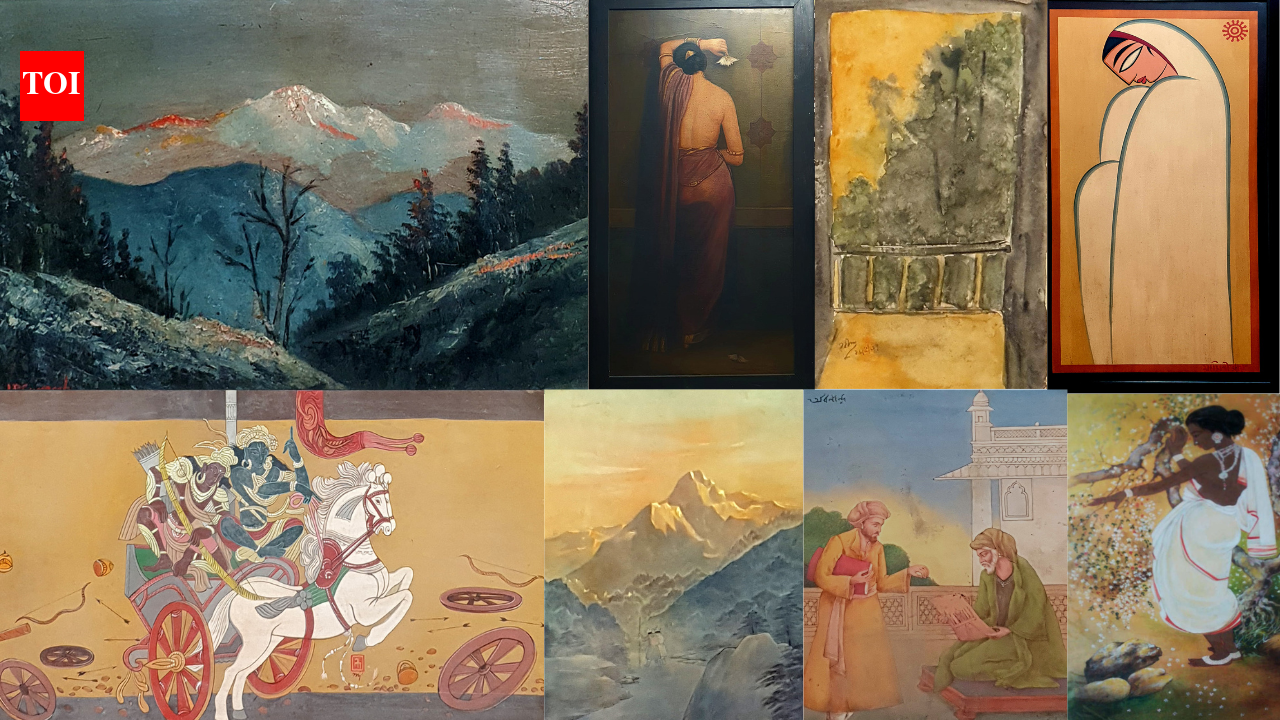
Amid growing concerns over fake artworks flooding the market, a Kolkata gallery has unveiled a landmark exhibition that uses advanced scientific technology to authenticate paintings by some of Bengal’s greatest artists.Chitrakoot Art Gallery has opened an exhibition of 23 authenticated masterpieces by Bengal masters, each verified through a cutting-edge technique known as Raman Fingerprint Technology (RaFiTech). Developed in collaboration with researchers from the Indian Institute of Science Education and Research (IISER) Kolkata, the method uses Raman spectroscopy to identify the unique molecular signatures of pigments used in paintings.The exhibition, featuring works by Rabindranath Tagore, Abanindranath Tagore, Gaganendranath Tagore, Nandalal Bose, Jamini Roy, Hemen Mazumdar, J. P. Gangooly, Ganesh Pyne and Debiprasad Roy, is on display at the Chitrakoot Art Gallery at Presidency Court on Gariahat Road and will run until March 27, said Prabhas Kejriwal, who curated the show.For decades, authentication of artworks in India has largely depended on expert opinion, provenance records or stylistic analysis — methods that often leave room for debate. The new Raman spectroscopy-based approach offers a scientific alternative by analysing the chemical composition of pigments without damaging the artwork.The technology works by directing a narrow laser beam onto selected points of a painting. The pigment molecules scatter the light in distinctive patterns, known as Raman wave numbers, which act like chemical fingerprints. These signatures are then compared with global pigment databases that document when specific pigments were first manufactured and widely used.“In the art market, authenticity has often rested on subjective judgments. RaFiTech introduces an objective scientific method,” said Prakash Kejriwal, eminent art connoisseur and owner of Chitrakoot Art Gallery, who spearheaded the initiative.According to Professor Soumyajit Roy of IISER Kolkata’s EFAML Materials Science Centre, the technique can distinguish pigments used decades or even centuries apart. “Each artist tends to use a particular palette of pigments and techniques. That combination creates a unique fingerprint,” Roy explained. “Because the method is non-invasive, the artwork remains completely untouched.”The research team has already secured seven patents related to the technology, making it one of India’s most advanced innovations in art authentication.Researchers say the method can also detect inconsistencies that might indicate forgery. If a pigment identified in a painting was manufactured only after the artist’s lifetime, the work immediately raises doubts about authenticity.Trisha Chakraborty, an IISER researcher associated with the RaFiTech laboratory, said the technology allows scientists to compare pigment profiles across different works attributed to the same artist. “If two paintings do not share key pigment signatures typical of that artist’s palette, it suggests that at least one of them may not be genuine,” she said.Art experts believe the development could significantly transform India’s art market, where disputes over authenticity have frequently undermined confidence among collectors and institutions.By combining art history with scientific analysis, the Chitrakoot exhibition offers visitors a rare opportunity to see how modern technology is helping protect the legacy of Bengal’s most celebrated artists while restoring trust in the art world.
