


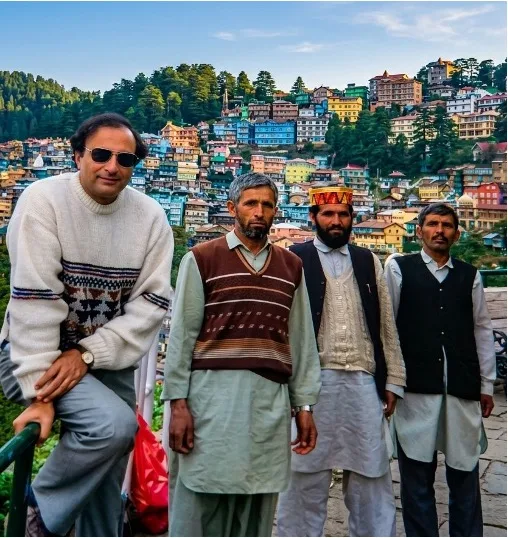
On the 13th of April, 1993, we departed Jammu in a special coach bound for the mountain air of Shimla. As we crossed into the heart of Punjab, the world outside our windows erupted in the vibrant rites of Baisakhi.
The roadside was a kaleidoscope of colour, with crowds adorned in their finest traditional attire. Our journey through Jalandhar and Ludhiana was unhurried, punctuated by frequent stops for tea and lunch; the rhythmic pace of the road meant we did not reach the gates of Shimla until the stroke of midnight.
This was my maiden voyage to the “Queen of Hills.” Despite the late hour, our hosts had secured rooms in an impeccable hotel—warm, quiet, and pristine. To my profound astonishment, the entire staff, from the attendants to the Manager, were Kashmiri, most hailing from my own jurisdiction of Dooru Shahbad.
It seemed word of our arrival had travelled faster than our coach; they were in a state of high readiness, receiving us with a familial warmth that transcended professional duty. Exhausted, we bypassed a formal dinner for a hurried cup of tea and crispy snacks. From my bed, I watched the lights of Shimla glitter through the dark silhouettes of the pines, looking for all the world like a scattering of pearls across the valley.
A Kashmiri Morning in the British Capital
I woke the next morning to the crisp air of the mountains and a breakfast that felt like a homecoming: steaming Noon Chai topped with thick cream, fluffy omelettes, and handmade parathas dripping with butter. Surrounded by my own townsfolk, the hotel felt less like a commercial establishment and more like a home away from home.
Before our Gypsy whisked us away toward the landscapes of Kufri, I insisted on a walk through the main markets. Shimla’s history as the Summer Capital of the British Raj is etched into every stone. Developed in the likeness of Murree, the town remains a testament to British engineering, most notably the Kalka-Shimla Railway.
It is a little-known historical truth that the backbone of this scenic marvel was formed by Kashmiri and Balti hands. These settlers were often driven to these heights by necessity—some fleeing the hardships of Begaar (forced labour), others escaping the economic shifts in the pashmina trade.
Beyond the architecture, Shimla is a city of political ghosts. It was here, at the Retreat, that the Shimla Agreement was signed in 1972. Thinking of the eventual fates of the signatories made the serene mountain air feel heavy with the irony of history.
The Guardians of the Trail and a Literary Legacy
Our primary host was Mr. Mohd Yousuf Rather of Zamalgam, Dooru Shahbad, the head of the Kashmiri Labourers’ Union. He provided a sobering account of the difficulties faced by our labourers in the far-flung reaches of Himachal. He spoke of Noorpur, a town where Kashmiri-speaking settlers have lived since pre-Partition days, when migrant labourers travelled the distance from Kulgam to Punjab on foot.
It was during these discussions—later enriched by insights from Aziz Pathan of Agnoo Zamalgam, another union leader settled in Himachal—that a remarkable historical connection emerged. It is said that the ancestors of the legendary novelist Saadat Hasan Manto hailed from Dooru Shahbad.
As skilled labourers, they travelled this very path to Noorpur in Himachal, eventually descending to Amritsar and finally to West Punjab in undivided India. To think that the roots of one of the subcontinent’s greatest writers were nourished by the same soil as the labourers I was sent to document added a layer of solemnity to our mission.
Though my tight schedule prevented me from visiting Noorpur—a regret I still carry—the spirit of that “Kashmir away from home” was felt everywhere. Our task—a census of the migrant labourers of Dooru Shahbad, documenting their wages, work hours, and plight—was completed and promptly submitted to the District Collector and the Labour Commissioner.
A Legacy of Hospitality
The care we received remains vivid in my memory. Mr. Ismail, a young manager from Mantapura, Dooru, treated us to coffee and ice cream at the prestigious Holiday Home Himachal. Another gentleman guided us through the historic Old Post Office and the winding “down-ways” of the city.
At a gathering of the Kashmiri community, I was presented with Himachal shawls and small souvenirs. These were not mere tokens; they were expressions of love and respect for their brothers from back home. Today, it is heartening to know that Mr. Yousuf has settled back in his village of Zamalgam with his progeny, having finally passed the “guard” of the Shimla union to the next generation.
(The writer is a former member of the administrative service. Email [email protected])
