


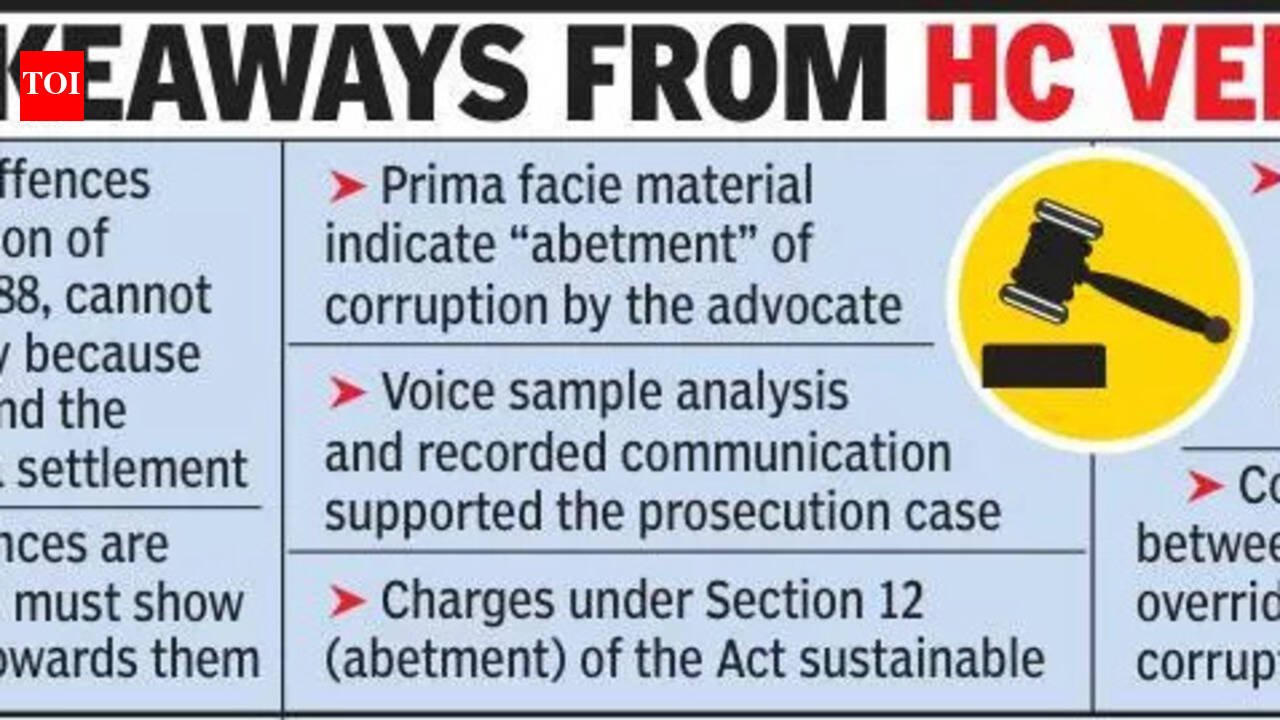
Nagpur: Nagpur bench of the Bombay High Court recently refused to quash a corruption case against a lawyer holding that offences under Prevention of Corruption Act, 1988, cannot be nullified solely because the complainant later entered into a compromise with the accused in the case. The lawyer was accused of demanding money on behalf of police officers to secure better jail facilities for a detainee. An FIR was registered in 2018 by Anti Corruption Bureau (ACB) in Akola. Justice Urmila Joshi-Phalke rejected petitioner’s argument that proceedings be terminated because the complainant subsequently filed an affidavit claiming the allegations were made in confusion and that he had no objection to the FIR being quashed. The judge noted that quashing the FIR would undermine the seriousness of corruption offences under special statutes.The HC also allowed the prosecution before the Special Court in Akola to proceed.The case arose from a complaint filed by a dentist from Murtizapur whose son was arrested in a rape case in 2018. According to him, police officers allegedly demanded money through the petitioner-lawyer in exchange for providing improved facilities to the complainant’s son while he was in custody. Investigators alleged that the demand initially stood at Rs5 lakh but was later negotiated down to Rs1.25 lakh. During a verification exercise conducted by ACB, recorded conversations between the complainant and the advocate suggested payment was meant for police officers associated with the probe. The Judge noted that the communications indicated an attempt by the lawyer to persuade the complainant to arrange the money, which prima facie amounted to “abetment” under Section 12 of the Prevention of Corruption Act. While examining legal provisions invoked in the case, the court observed the applicant was not a “public servant”, and therefore offences under Sec 7 and 15 of the Act were not attracted. Relying on precedents of the Supreme Court, the court reiterated that corruption offences affect public interest and must be treated with seriousness. Quoting the apex court, the judgment noted that corruption is a “malaise… all-pervading in every walk of life”, and that constitutional courts must show “zero tolerance” towards it.The judgment further emphasised ethical expectations from members of the legal profession. Describing advocacy as a service-oriented and “noble” profession, court said lawyers are expected to maintain highest standards of honesty and integrity in their dealings with clients and the justice system.“Consulting a lawyer should help individuals avoid problems and reduce financial losses, and not otherwise,” the court observed while reflecting on the duties expected of advocates.
