


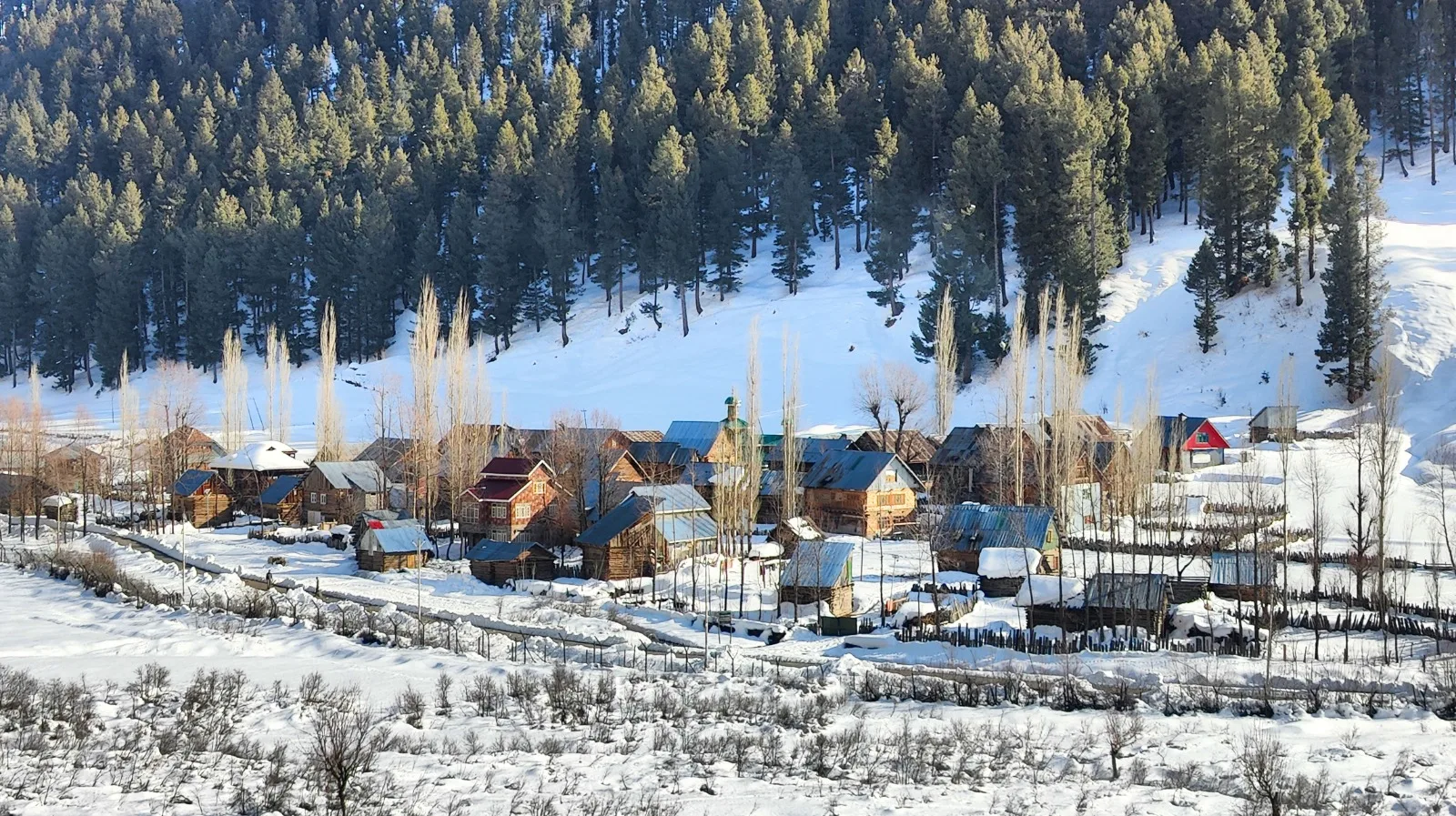
We observed unusual February conditions in the remote Himalayan valley Gurez Valley in north Kashmir is normally one of the first regions to close and one of the last to reopen during winter. Heavy snowfall at Razdan Pass usually cuts the valley off for months, leaving the landscape buried under deep snow until early spring.
This February, however, the valley told a slightly different story. Setting out from Srinagar early in the morning, we travelled north toward Bandipora and further toward the Razdan Pass, the mountain gateway that leads into the remote Gurez region. The journey itself offered the first small reminder of the wilderness that defines this part of Kashmir.
As the road climbed toward Razdan Pass, winter conditions returned. The pass itself was still covered in snow, with icy sections on the road and frozen slopes stretching across the surrounding mountains.
Razdan Pass, at over 11,000 feet, remains one of the most dramatic transitions in the region, from the forests of north Kashmir into the vast, open valley of Gurez.
Descending from the pass, the landscape opens dramatically. Below, the Kishanganga River cuts through the valley, its edges frozen in places as it winds through snow-covered fields and villages.
We paused briefly in Dawar, the main settlement of the valley, before continuing further ahead to Sheikhpora village where we planned to stay the night.
Sheikhpora remains one of the quieter corners of Gurez, where daily life continues at a slower rhythm through the winter months. Our stay was at a small local homestay where the warmth of a wood stove and simple home-cooked food offered a welcome contrast to the cold outside.
Later in the evening, just outside the village, we spotted a fox moving near the edge of the settlement. According to locals, the fox is a regular winter visitor to Sheikhpora, often seen moving quietly around the village in search of food. Earlier enroute, near Bandipora, a jackal briefly crossed the road before disappearing into the forest.
Wildlife sightings like these are not uncommon in the Gurez region, where the surrounding mountains remain largely undisturbed.
But what stood out most during the journey was the condition of the winter itself.
While Gurez had received snowfall earlier in the season, unusually warm weather had already begun melting parts of the snow cover. By February standards, the valley felt noticeably milder than what travellers familiar with the region would normally expect.
Snow still covered large parts of the landscape, but roads remained accessible and sunlight had already begun softening sections of the valley floor.
For those who regularly travel through the Himalayas, these observations are increasingly significant. Mountain ecosystems depend heavily on seasonal snowfall patterns. Snowpack plays a crucial role in regulating water systems, feeding rivers and sustaining agriculture across downstream regions.
When winters shift, even slightly, the impact can extend far beyond the mountains themselves.
Journeys like this therefore serve not just as travel experiences but also as opportunities to observe how Himalayan landscapes are evolving.
Gurez Valley continues to remain one of Kashmir’s most remarkable high-altitude regions, a place defined by dramatic terrain, quiet villages and strong connections between people and their environment.
As we left the valley the following morning under bright sunshine, the snow along the road had already begun to melt in patches, a small but noticeable reminder that winters here may not always behave the way they once did.
For travellers who spend time in the Himalayas year after year, such moments offer an important perspective: the mountains are changing, and paying attention to those changes has never been more important.
