


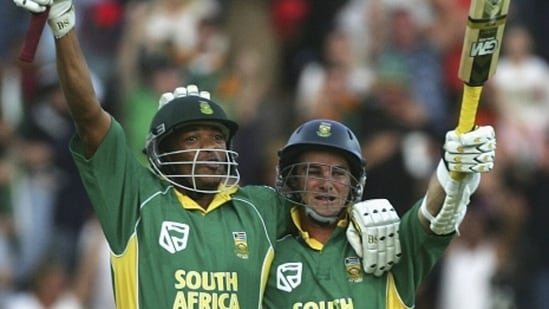
As Graeme Smith took his seat to answer a few questions from the media, he couldn’t help but let out a laugh when told, “My CBSE Class 10 board exams got ruined,” because the night before, he and his South African team had achieved the impossible. That word gets thrown around a lot in cricket, especially when a world record is involved. A 25-ball century, six sixes in an over, or reverse sweeps for six are all incredibly difficult feats, but not impossible. Perhaps Virat Kohli’s 50 ODI centuries, or Sachin Tendulkar’s 100 hundreds, come close to that territory. But even those pale in comparison to March 12, 2006 – 20 years ago – when South Africa chased down Australia’s colossal target to script the greatest ODI victory of all time. Australia 434. South Africa 438. IMPOSSIBLE!
Think of some of the greatest ODI matches ever played. The semi-final between South Africa and Australia seven years earlier, when they fought tooth and nail in the 1999 Cricket World Cup. Or the final of the 2019 Cricket World Cup, when even a Super Over could not separate New Zealand and England. New Zealand overcoming South Africa in the Auckland semi-final of the 2015 Cricket World Cup is right up there as well. The Proteas are everywhere.
And yet, none of these quite match what unfolded in Johannesburg that evening. Yours truly had an exam the next day. Who cared? Herschelle Gibbs was playing the innings of his life. Remember, this was the mid-2000s. Only six T20Is had been played worldwide prior to that. The first-ever T20 World Cup was still a year away, and the Indian Premier League was still a good two years away from its debut. Back then, humdingers were far and new. A successful chase of 250 was reason enough for a celebration. And here were the Australians and the South Africans producing something extraordinary. Until that night, the highest ODI total was 398, scored by Sri Lanka against Kenya. That record had stood for a decade before Australia breached the 400-mark for the first time. Barely two hours later, even that milestone was shattered. It was the ODI equivalent of a team scoring 400 in today’s T20Is.
It remains a classic
Even today, that game refuses to be overshadowed, despite the avalanche of statistics and records produced in T20 cricket. Think about it. Only once in the past two decades has another match featured both teams scoring 400-plus – the India vs Sri Lanka ODI in 2009 in Rajkot. As thrilling as that clash was, it didn’t come close. Since that 872-run juggernaut, more than 2500 ODIs have been played, yet the 400-mark has been breached only 30 times, making for just 1.2 percent of all team totals. Even today, only five ODI totals have surpassed South Africa’s 438, including their own 439. South Africa have also featured in eight 400-plus totals, the most by any team, one more than India.
It is remarkable in more ways than one. While T20s have evolved from 180 considered a winning total to 250 no longer safe, in ODIs, 400 still remains the threshold considered good enough to win. The nature and flow make it so. Two new balls and the reduced threat of reverse swing have made life easier for batters, but an ODI innings still allows room for stability. Overs 25 to 35 often becomes a rebuilding phase, where a team rocked early can steady itself and still push towards a competitive total. Amid all the debate surrounding the future of ODI cricket, this balance is precisely what keeps the format relevant.
A backstory no less than a TV show
Gibbs, the star with 175, later revealed in his biography that he was hungover until barely an hour before the start of the match. The night before, he had gone out drinking and, by his own admission, consumed a little more alcohol than he would have liked. Yet it hardly mattered. Gibbs upstaged Ricky Ponting’s breathtaking 164 and proceeded to dismantle every bowler in sight. Mick Lewis bore the brunt of the assault, conceding 113 runs in his 10 overs — an unwanted record that stood for the next 17 years.
And then there was the Punter. Not too long after playing an innings which he later defined as one of his finest knocks ever, Ponting could be heard throwing tables and chairs in the dressing room out of sheer rage, the ‘most angry’ he had ever been. The Australian dressing room had been celebrating and singing during the mid-innings interval. In contrast, a deathly silence hung over the South African change room. By the end of the contest, the tables had well and truly turned. The Aussies of the mid-2000s weren’t used to losing.
ODI cricket has produced plenty of high-scoring games since. It even came close to touching 500 when England finished on 498 against the Netherlands, or when they smashed 481 against rivals Australia. Yet stories from those games are rarely retold with the same awe. Even last year, when Australia piled up 431 at Mackay, the cricketing world hoped for a thriller, if not an encore of Johannesburg. Instead, the match fizzled out long before it could turn into a classic.
That match, that evening, was different.
Even in 2026, it holds a special place in the pantheon of ODI cricket.
