


By Dr (Prof) Mukti Kanta Mishra
India stands at a crossroads where economic growth meets environmental responsibility. As the country pushes toward a $5 trillion economy by 2027, the education system must evolve to give young people not only knowledge, but practical skills and a strong commitment to sustainability.
This integration addresses unemployment rates hovering around 7-8% among graduates while tackling climate vulnerabilities that affect agriculture, water resources, and urban infrastructure. Policies like the National Education Policy 2020 emphasize vocational training, yet they fall short without embedding sustainable practices, risking a workforce unprepared for green transitions.
The imperative of skill development
Skill development develops applied employability skills from theory learned through one’s course of study in an engineering or management program. In order to do this, many engineering and management curriculums have hands on labs (for example – CNC Programming and Machining) allowing the student to learn how to professionally operate a Computer Numerical Control machine used in manufacturing with extremely high accuracy. This acquisition of a higher degree of technical expertise provides an immediate means of employment in manufacturing-related fields such as automotive and aerospace.The development of Artificial Intelligence in Material Science also included courses on how to use algorithms to apply optimal resource allocation techniques to predictively model waste reduction. These factors help to develop problem-solving skills and encourage innovative thinking to align with India’s Government ‘Atmanirbhar Bharat‘ or self-reliance initiative. In the absence of this type of focus, education remains unconnected to market demand and continues to create a digital economy with skills deficiencies.
Embedding sustainability in learning
Sustainability education builds awareness of global problems like climate change and shrinking resources. Programs based on the Sustainable Development Goals include modules on affordable clean energy and responsible consumption. For example, a Water Resource Management course teaches conservation methods, pollution control, and integrated watershed planning, and gives hands-on practice in monitoring water quality and designing efficient irrigation systems.
This method of teaching helps students understand how humans impact ecological systems, allowing students to form solutions to India’s problem with water scarcity where more than 600 million people live in either high or very high/extreme stress situations.
Synergizing skills and sustainability
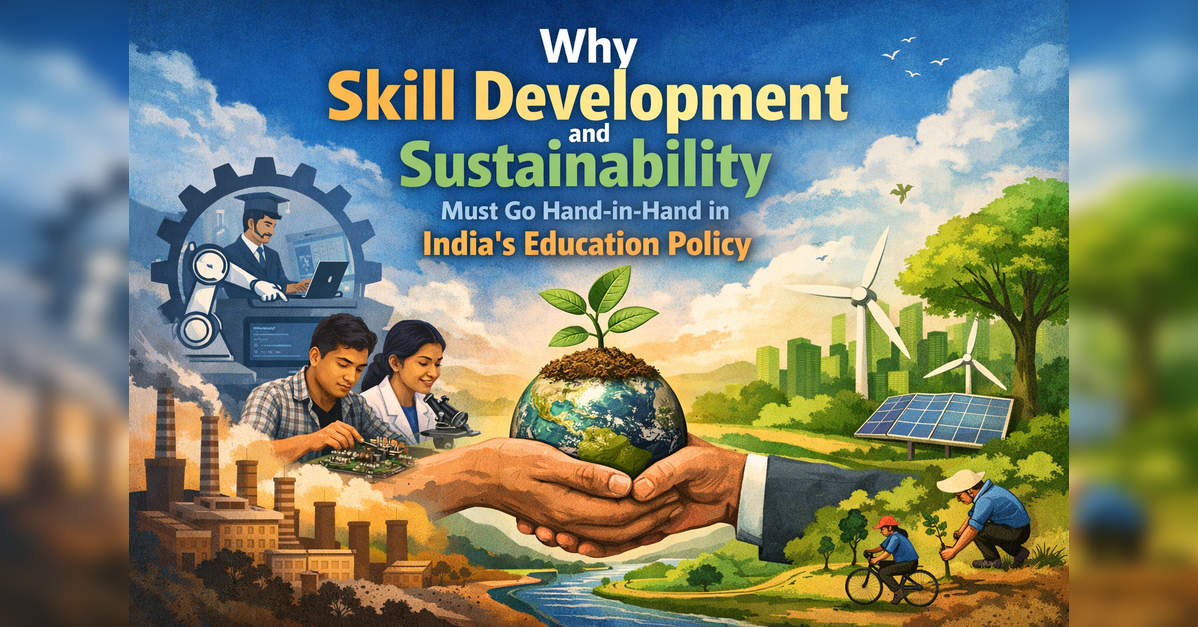
When the development of skills and sustainability intersects within curricula; that is when true progression will occur. An example of this convergence is illustrated through the Climate Change, Sustainability and Organisations course, which merges theoretical dialogue and practical applications into execution. Through the course modules, we will explore how different sectors (agriculture, energy, etc.) have experienced and will continue to face the consequences of climate change through collective experiences of climate-induced migration and disaster response.
Students will have the opportunity to create an action plan utilizing the Integrated Reporting Framework through real-world examples such as sustainable supply chains within the manufacturing sector. Students will develop their skills in strategic planning and creating partnerships, equipping them to be leaders in the movement of organizations to net-zero emissions.
As an example of a renewable energy track, the Solar Thermal Engineer for Industrial Process Heat program will provide learners with technical expertise in the design of solar thermal systems for heating applications, combining engineering capabilities with sustainable innovation. Through these integrated models, students will be able to develop the capacity to create resilient communities and economies holistically.
Policy synergies: Forging inclusive and sustainable growth
The goals of India’s educational policy should include the development of interdisciplinary coursework as well as partnerships between institutions of higher education and industry; both initiatives would be supported through financial incentives. Combining the delivery of vocational education with content linked to the UN Sustainable Development Goals (SDG) will encourage young people to become the engines of inclusive economic growth. This synergy will improve employability. More importantly, it will benefit the environment and contribute to a sustainable future for everyone.
By Dr (Prof) Mukti Kanta Mishra is the President, Centurion University of Technology and Management, Odisha.
DISCLAIMER: The views expressed are solely of the author and ETEDUCATION does not necessarily subscribe to it. ETEDUCATION will not be responsible for any damage caused to any person or organisation directly or indirectly.
