


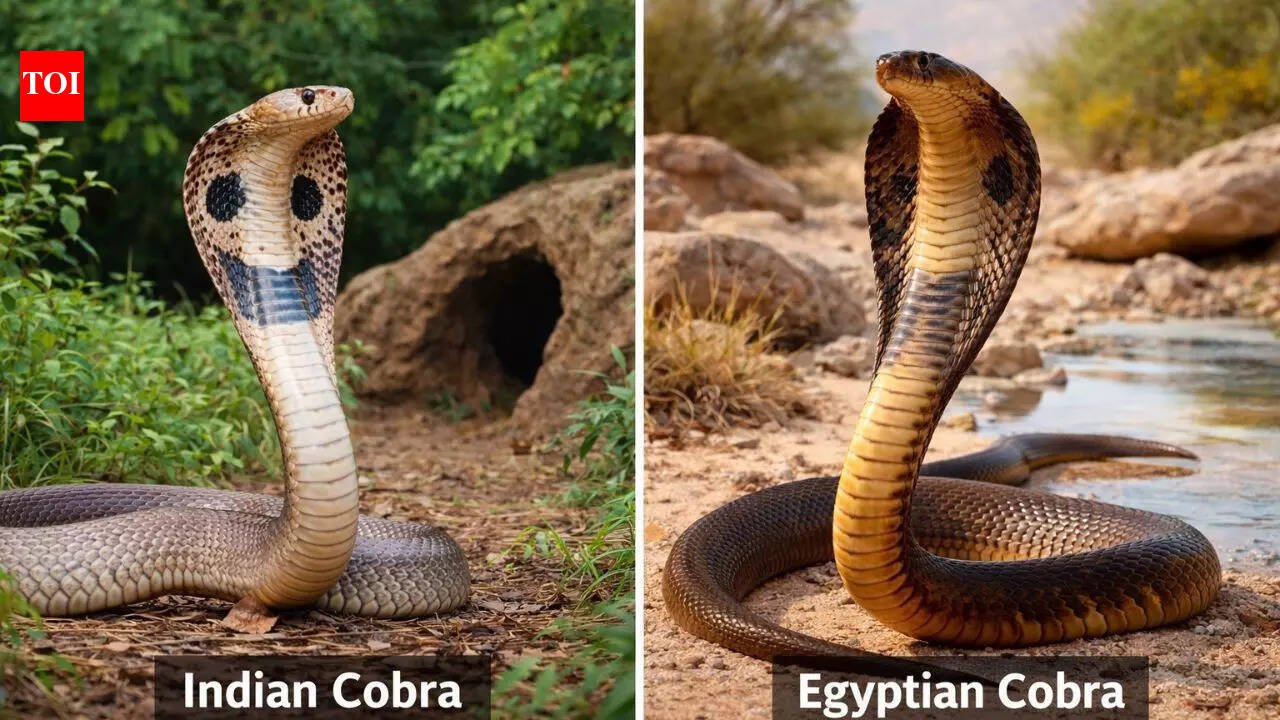
Cobras are arguably the most identifiable venomous snake in the world. Their distinctive raised posture and flared hood enable them to stand out from the crowd. As such, they have featured prominently in history and folklore across the world. Although they share several physical traits, different cobra species have evolved unique characteristics shaped by their environments, behaviour, and hunting patterns across different regions of the world.The two most common species in the family of cobras include the Indian Cobra, whose scientific name is Naja naja, and the Egyptian Cobra, whose scientific name is Naja haje.Although the two species belong to the same family, they can be found in different locations and have many distinctive differences in terms of size, appearance, and behaviour. It is through these differences that we can understand the reason behind the two species being identified as significant predators and the reason behind the interest they have attracted over the years.
Poll
Which cobra species do you find more fascinating?
Where Indian cobras and Egyptian cobras live
The Indian cobra is found in a wide range, covering the Indian subcontinent. Its presence is noted in India, Pakistan, Sri Lanka, Bangladesh, and Nepal. Unlike many other species of snakes, this cobra does not find it difficult to adjust to any new environment. Its habitats include forests, grasslands, and wetlands, and it is also found in areas around villages and farms.In this regard, this species can be found in places such as termite hills, rocks, thick vegetation, and abandoned burrows, where it finds protection and easy access to food. Thus, human encounters with this species are also noted in rural areas.In contrast, the Egyptian cobra is found in a very different geographical setting. Its range includes North Africa, where it is found in Egypt, Sudan, and surrounding countries. Its presence is also noted in the Arabian Peninsula.This species is found in dry or semi-arid zones, such as savannas, rocks, and desert fringes, but in these areas, this species is found close to water sources, which are home to the species it feeds on.
Indian cobra vs Egyptian cobra: Differences in size and appearance
Though these two species show the common characteristics of the cobra’s hood, there is a difference in the physical characteristics. The Indian Cobra has an average length of about 1 to 1.5 meters, though some can attain a length of about two meters.The most distinctive feature is the spectacle-shaped marking found on the back of the hood. When the snake flattens its hood as a defence mechanism, it resembles the shape of the glasses that people wear, and hence it is named the spectacled cobra.
Indian cobra vs Egyptian cobra: Differences in size and appearance ( Image source: AI-Generated)
The Egyptian Cobra is larger and heavier compared to the Indian Cobra. It has an average length and weight, with some specimens attaining lengths and weights of about 1.5 to 2 meters, and some even attaining lengths of about 2.4 meters.It lacks the spectacle marking found on the Indian Cobra. Depending on the region and the habitat, the colour can vary from yellowish-brown, copper, dark brown, or even black.
Venom and snakebite risk
Both species have potent venom that affects the nervous system.The venom of the Indian Cobra contains powerful neurotoxins and cardiotoxins. These toxins disrupt the nervous and muscular systems. Breathing difficulties and paralysis can result if the snake bites and the victim is not treated promptly, especially if the snake has delivered a significant quantity of venom.
Venom and snakebite risk ( Image source: AI-Generated)
The Indian Cobra is included in the “big four” list of medically significant species in India.The Egyptian Cobra also has potent venom that affects the nervous system. The effects of the snake’s venom can cause muscle paralysis and breathing difficulties, which can be life-threatening if medical treatment is delayed.Despite the reputation that these two species have, they tend to avoid human interaction as much as possible. However, they can deliver snake bites when they are accidentally provoked and feel threatened.
Hunting behaviour and diet
Both species are predatory carnivores that prey on small animals.The Indian Cobra usually preys on rodents, frogs, lizards, and small birds. The rodents form an important prey in agricultural habitats because they act as pest controllers.The Egyptian Cobra has an almost similar diet and preys on small mammals, amphibians, and reptiles. Because it is larger, it can occasionally prey on slightly larger prey than the Indian Cobra.Cobras depend on venom to kill their prey. The snake strikes its prey and injects the venom into the prey. The snake then drops the prey and waits for the venom to kill the prey before it swallows it whole.
Defensive posture and behaviour
One of the most famous characteristics of cobras is that they display a defence mechanism when they sense any threat. In this mechanism, the snake raises its anterior part and expands its hood by stretching its ribs behind its head.
Defensive posture and behaviour ( Image source: AI-Generated)
Both Indian and Egyptian cobras display this mechanism as a warning sign when they sense any threat. This mechanism makes the snake appear larger and can be accompanied by hissing and swaying motions.If the threat persists, the snake can even strike, but in most cases, the snake tries to flee the scene rather than striking the intruder.
Cultural and historical associations
The Indian cobra has a strong association with South Asian culture and mythology. Cobras are said to be connected with several gods in Hindu mythology, especially Lord Shiva.The Egyptian cobra is said to be connected with the history of Egypt, specifically with the Egyptian kingdom. The emblem, or uraeus, featuring a cobra, was found on the crowns worn by Egyptian pharaohs, symbolising their powers and protection.These species are said to be two of the most recognisable venomous reptiles in the world, with their venom being a subject of study.
