


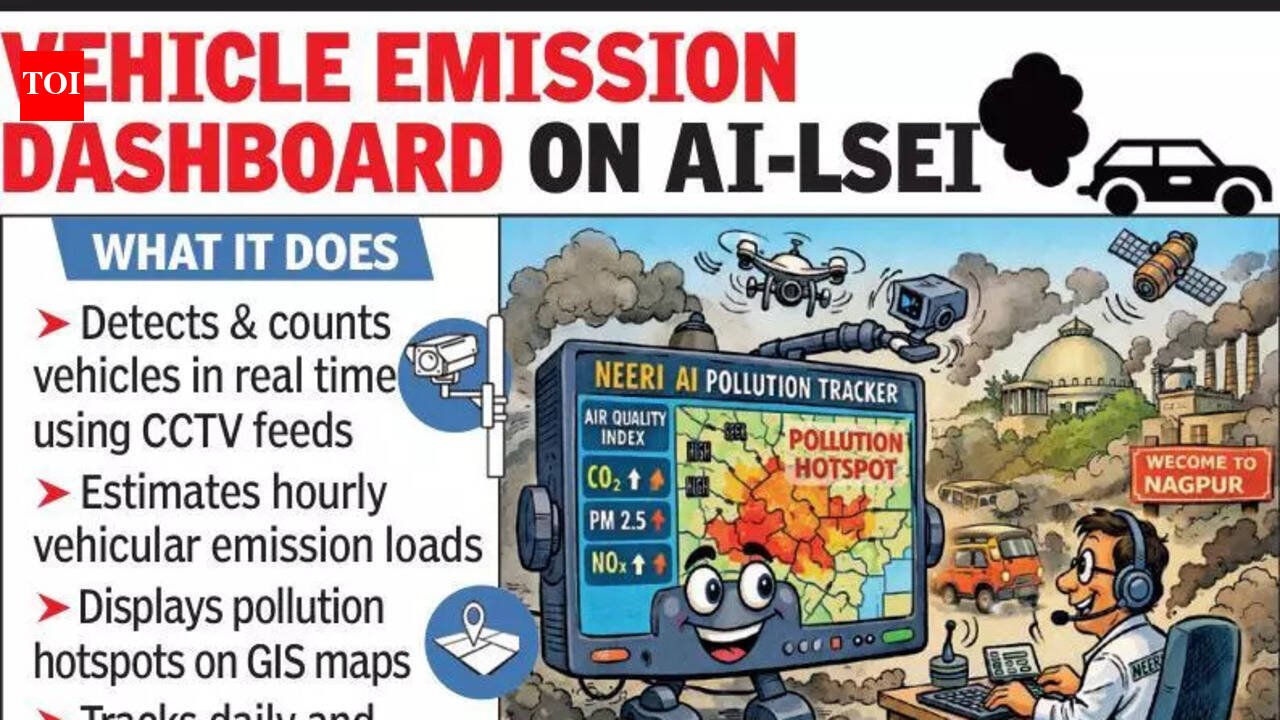
Nagpur: Scientists at CSIR-National Environmental Engineering Research Institute (CSIR-NEERI) in Nagpur developed an artificial intelligence-based dashboard that can identify vehicular pollution hotspots in cities in real time by analysing live traffic camera feeds.The tool, called the AI-Integrated Line Source Emission Inventory (AI-LSEI) dashboard, detects and counts vehicles passing through roads using CCTV cameras and instantly estimates the pollution generated by them. The system can classify vehicles such as two-wheelers, three-wheelers, cars, light commercial vehicles, buses, and heavy commercial vehicles, and calculate their emission load every hour.The dashboard was developed by a team of scientists from the air quality management division at CSIR-NEERI, comprising senior scientist Rahul Vyawahare, chief scientist KV George, Jay Singh Rajput, Atharva Malode, Raj Sonarghare, and Pranav V Nair. The team acknowledged the support and guidance of Neeri Director S Venkata Mohan.The dashboard uses scientifically established emission factors to estimate pollutants such as particulate matter (PM), nitrogen oxide (NOx), carbon monoxide (CO), and hydrocarbon (HC). The results are displayed on a GIS-based map that highlights areas with high vehicular emission loads.George said the dashboard helps overcome a major limitation of conventional emission studies. “Traditional emission inventories depend on manual traffic counts and surveys, which can take up to one year to generate results. By the time the analysis is complete, the number of vehicles on roads may already change. This system provides real-time estimates based on actual traffic activity.”The system was tested using CCTV footage recordings received from multiple cities as part of earlier studies on air pollution. The footage was analysed to determine traffic movement and estimate the emission load generated by vehicles across different locations. Subsequently, the NEERI team deployed a pilot at its entrance gate on Wardha Road using its CCTV.Vyawahare said the dashboard can provide location-specific information. “If authorities want to know the emission load generated at a busy junction such as Ajni Square at any given time, the dashboard can provide that emission load instantly. It also provides hourly vehicle counts and corresponding emission loads, along with gridded emissions,” he said.The system records how traffic volume changes throughout the day and correlates it with emissions. For example, vehicle movement starts rising sharply from early morning, with two-wheelers and cars forming largest share in most urban corridors.The dashboard uses the data available on fuel and engine technology from the Parivahan portal to estimate vehicular emission load. Emission factors derived from ARAI are used. Scientists say the tool is also helpful for traffic management. For instance, during major events or matches at the city stadium, vehicle counts and emissions can be visualised with help of the dashboard.
