


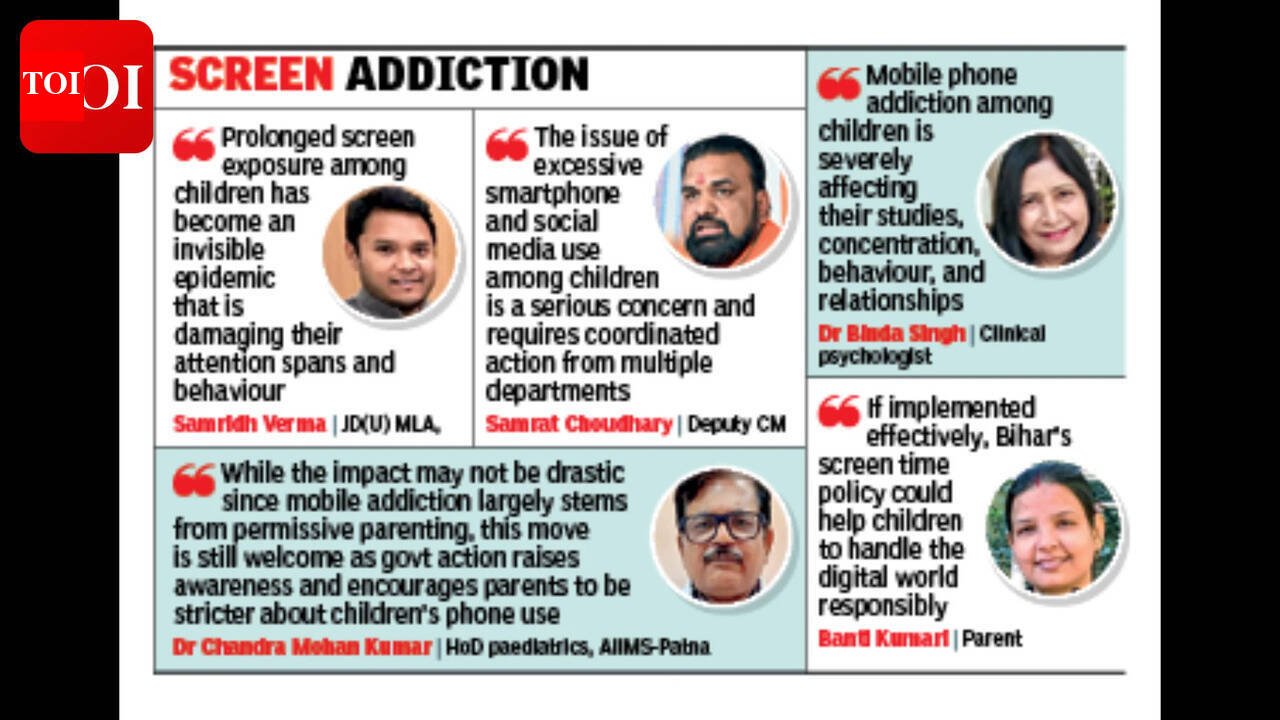
Patna: As children in the state spend increasing hours on smartphones and social media, raising alarms among parents, teachers, and doctors, the state govt is planning a policy to regulate screen time and online activity for minors.During the assembly’s budget session, deputy CM Samrat Choudhary described the issue as a serious concern that requires coordinated action from multiple departments, including education, health, information technology, and women and child development.The first major step involves seeking expert guidance from Nimhans in Bengaluru. Once its submits its detailed report, officials will hold consultations to shape the final guidelines, he said.Minister of sports and information technology Shreyasi Singh assured that her department will carefully examine the recommendations before rolling out the policy.Possible measures under discussion include introducing age-based limits on device usage, adding mandatory “digital hygiene” sessions in govt schools to teach responsible technology habits, running awareness campaigns through rural women’s self-help groups, and setting up counselling services in district hospitals for children showing signs of digital addiction.The Economic Survey 2025-26 recently pointed out that many rural teenagers in Bihar spend four-five hours a day on screens, contributing to rising anxiety, sleep problems, lower academic performance, and reduced physical activity.JD(U) MLA Samridh Verma, who raised the matter in the assembly, called prolonged screen exposure an “invisible epidemic” that damages attention spans and behaviour. Child psychologists support this view, noting that constant notifications, online comparisons, and addictive platform designs often trigger stress, low self-esteem, feelings of loneliness despite being “connected”, and even aggressive tendencies in some cases.Dr Binda Singh, a city-based clinical psychologist, said, “Mobile phone addiction among children is severely affecting their studies, concentration, behaviour, and relationships. They become aggressive, avoid family and real-world interactions, and lose the habit of reading, writing, and deep learning. Parents face blame and tantrums when trying to restrict phones at home, ruining family bonds.”She further added: “Govt-imposed bans and regulation on screen time shift responsibility away from parents. Children will not blame families, and this external restriction will greatly benefit the future generation by keeping young minds fresh, focused, and connected to reality during crucial years.”Dr Chandra Mohan Kumar, professor and head of paediatrics at AIIMS-Patna, said Australia led the way by banning it first, and then Karnataka became the pioneering state in the country—currently the only one implementing such restrictions.“While the impact may not be drastic since mobile addiction largely stems from permissive parenting, where parents hand over phones for entertainment, this move is still welcome. Legally, children cannot create social media accounts, though they may use parents’ accounts to watch reels and online content. This gives parents better oversight of history and usage. It will curb excessive gaming, photography, and similar activities that are harder from shared accounts. Most importantly, govt action signals serious concern, raising awareness and encouraging parental strictness for meaningful change,” Dr Kumar told this newspaper.A concerned parent, Banti Kumari, said: “If implemented effectively, Bihar’s screen time policy could serve as a model for other states. By combining school education, community outreach, expert-backed rules, and support for affected families, the initiative can help the younger generation grow up healthier, more focused, and better equipped to handle the digital world responsibly.”
