


Panaji: The Goa government’s planned rollout of the Deposit Refund Scheme (DRS) has hit roadblocks after the Goa waste management association said the scheme will not help clear trash dumped alongside public thoroughfares and called for a delay until it can be suitably modified.

The scheme, which plans to incentivise trash collection via the addition of a ‘fee’—ranging from ₹2 to ₹10—over and above the MRP of consumer goods sold in non-biodegradable packaging, which will be returned after the buyer returns the empty packaging at predesignated collection points, was set to roll out from April 1 but is now likely to be delayed as opposition mounts.
Besides the waste management association, industry stakeholders, including alcohol and beverage retailers and the Fast-Moving Consumer Goods (FMCG) retailers association, have already raised apprehensions about the scheme.
Also Read: MRP+ refundable deposit from April 1: Goa’s big clean-up gamble
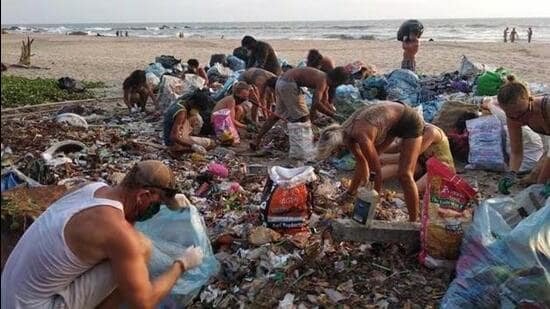
Addressing the press on Saturday, waste management association’s chairman Clinton Vaz said that the association, whose members manage waste collection in around 60 villages across Goa, believes that in its present form, the DRS will do very little to reduce garbage strewn around public places in the state. This is because most of the garbage consists of material that is not covered under the scheme.
The association said it conducted an independent study by gathering and assessing garbage from Goa’s ten most littered sites. The results showed that about half the waste comprises non-recyclable rejects, including cloth and rubber, which are not covered under the Deposit Refund Scheme. A further 20% comprises organic waste, while items such as glass bottles, aluminium cans, multilayer plastics (chips packets), and tetra packs collectively make up only 9% of the total waste strewn around public places in Goa.
“The DRS scheme is sought to be brought into Goa on the promise that it will help bring about behavioural change and incentivise the general public to dispose of waste responsibly at designated spots and not leave it strewn around,” Vaz said.
“However, our audit of waste currently strewn around the state revealed that the categories covered under the DRS—viz. glass liquor bottles, PET bottles, Multi-Layered Plastic (MLP) , aluminium cans, and tetra packs—are already by and large being disposed of correctly. The biggest sources of garbage dumped along roadsides are single-use plastics like carry bags, food waste, diapers, cloth, rubber, bulk waste from events, etc.,” he said, adding that unless the government expands the scheme to include these categories, it will have limited impact on Goa’s existing garbage problem.
“We have raised this issue during consultations with the government, but they are yet to respond favourably. We demand that this scheme be postponed by three to six months until our concerns are addressed,” the association’s vice president, Baylon Gomes, said.
According to the government’s initial plan, the scheme was to roll out in two phases. The first phase, beginning April 1, would cover alcohol sold in glass bottles, followed by beverages sold in aluminium cans and PET bottles. The second phase would include MLP packaging and tetra packs.
However, government officials have conceded that the rollout will likely be delayed until the associations are on board.
“We are in touch with stakeholders and will likely revise timelines by a few months at most, beyond which it will not be possible since the infrastructure for the scheme rollout is already being put in place,” a government official with the Department of Environment, which is overseeing the rollout, said.
The biggest advantage, proponents say, is that it will eliminate the menace of liquor glass bottles, many of which are shattered and strewn along Goa’s beaches, posing a threat to beachgoers. Waste pickers who earlier earned little to nothing for glass bottles and approximately ₹18–20 for 1 kg of PET bottles (≈50 bottles) could now earn up to ₹250 for the same 50 bottles under the DRS.
Liquor retailers have also raised concerns. “In theory the scheme sounds good, but at the ground level there is no awareness. The government has said they want to roll out the scheme from April 1, but we haven’t received any official notification from the government over whether we are allowed to charge a price above the MRP and how we bill this extra charge on our systems. Instead of focusing on waste that is already by and large disposed of responsibly, the government should focus on what’s actually causing waste along the roadsides,” Hansel Vaz of the Alcobev Retailers Association said.
The state currently generates close to 800 tonnes of municipal solid waste per day, of which nearly 45% is non-biodegradable, dominated by plastic packaging, glass bottles, and metal cans. Per-capita plastic waste generation in Goa stands at approximately 22 kilograms annually, substantially higher than the national average of 15 kilograms. During peak tourist seasons, these figures increase further, placing sustained pressure on public spaces, collection systems, and downstream processing infrastructure.
