


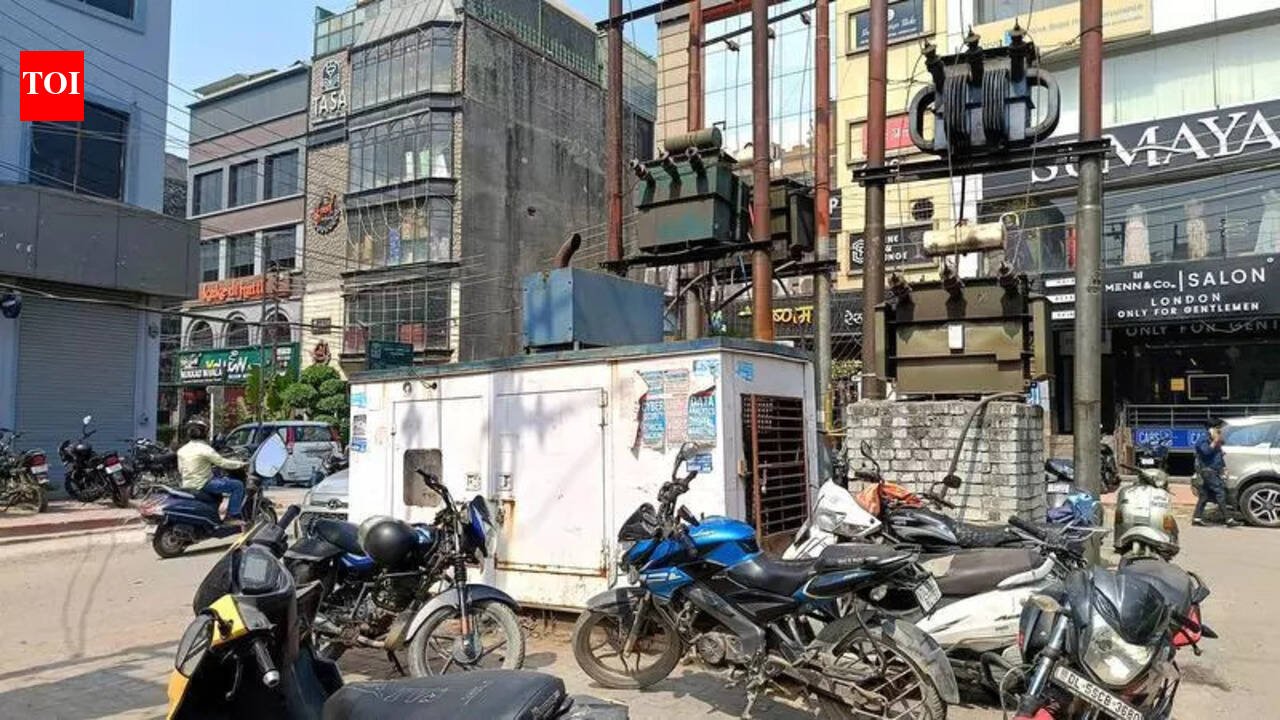
Diesel generator sets installed along roadsides, parks and pavements have become a common sight across Noida and Ghaziabad, but at the cost of public safety, convenience and in blatant violation of norms.With power cuts and voltage fluctuations frequent, shops and commercial establishments across markets, residential sectors and green belts depend on gensets to run their daily operations. But many of these are placed on footpaths, road medians, covered drains, even parks, blocking pedestrian access and raising concerns about fire hazards and electrocution.In Noida’s Sector 104 market, a roughly two-kilometre stretch is dotted with nearly two dozen generators installed along pavements and roads. Shops, eateries, gyms and showrooms rely on them during outages.For Satpal Singh, 72, who runs a tea stall by the roadside, the machines have long blended into the background. Three generators — painted green, yellow and white — stand near his stall. “I have been running my stall here for 11 years, and as far as I remember, these gensets were always here,” he said. Unfazed by a ‘no smoking’ warning etched on one of the machines, Singh lit a cigarette while standing beside it. When told about the risk, he shrugged. “Kuch nahin hota. I have done it for years,” he said.For pedestrians, however, the machines often become obstacles.Anubhava Mishra, who lives nearby, stood waiting to cross the arterial road that runs past the market. After navigating traffic and reaching the other side, she attempted to walk along the footpath, only to find three generators blocking the way.“There is no place to walk,” she said. “Between gensets, illegal parking and an auto stand right by the road, pedestrians are forced onto the main road. Vehicles are speeding past, and it is dangerous. But what choice do we have?”Shopkeepers acknowledge the inconvenience but say they have few alternatives.A manager at a hotel chain outlet in the area said space constraints inside buildings leave businesses with little option but to place generators outside. “This is a rented three-storey building and every inch is occupied,” he said. “There is no place inside to install a genset. But businesses cannot depend solely on the electricity supply. If power goes out, operations stop.”Public spaces such as parks and green belts have also not escaped the spread of generators.In Sector 37, a generator has been placed next to a tree that appears to have been heavily pruned to make space for it. Nearby, inside the boundary of a park, another generator hums beside a signboard from the Noida Authority warning that encroachments will attract penalties.Officials from the electrical safety department said the rules overseeing generator installations are clear: gensets cannot be installed in public places. “They must be located within the premises of a property, preferably on a terrace,” said Ramesh Kumar Kanojia, assistant director in Noida’s electrical safety department.Safety concerns go beyond public encroachment. Saurabh Kumar Singh, assistant director in Ghaziabad’s electrical safety department, said generators installed at ground level can also pose risks, particularly during flooding. “Waterlogging has become common,” he said. “If a generator is installed on the ground floor and water accumulates, it can lead to electrocution.”According to safety norms, generators should ideally be placed on terraces or, if installed on the ground floor, raised above plinth level to prevent water contact. Proper earthing and a trained operator are also required. “In reality, many of these norms are ignored,” Singh said. He admitted that enforcement was largely complaint-driven.“We act when we receive specific complaints and also conduct inspections,” Singh said. “If there is an imminent threat to life or property, we inform the district magistrate, who has the authority to order removal of the generator and even lodge an FIR.”Urban planning regulations also restrict installations in setback areas — the open space between buildings and property boundaries. A Ghaziabad Development Authority official said these zones exist to ensure ventilation, natural light and access for emergency services.“Installing generators in setback areas defeats the purpose and creates safety risks,” the official said.In practice, however, such installations are widespread in both residential and commercial areas of Ghaziabad.Municipal officials say generators placed on roads, pavements or medians fall under encroachment rules. “Such installations can attract fines and even confiscation,” said an official from the Ghaziabad Municipal Corporation. Yet when asked about recent enforcement, the official could not recall any significant action taken.Residents and legal experts said the issue is not new. Rajiv Ranjan Raj, a lawyer and resident of Kavi Nagar in Ghaziabad, pointed to a public interest litigation filed in the Allahabad high court in 2014 over similar concerns in Meerut markets. “The court had taken a strict view and directed authorities to clear public spaces of illegally installed generators,” he said. “Those orders should still serve as a reminder to civic bodies.“
