


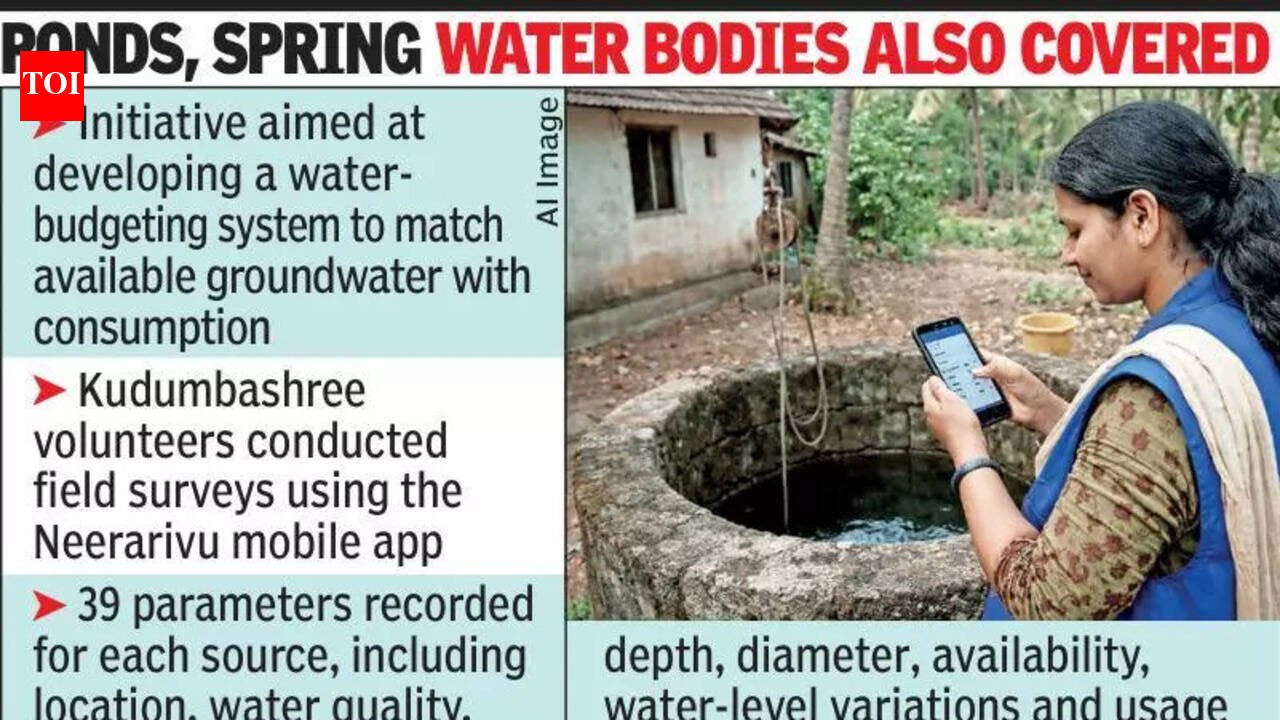
Thiruvananthapuram: In a pioneering initiative in the country, the groundwater department has counted and mapped 22 lakh wells, including tube wells and borewells, across 563 panchayats under Phase I of a statewide well census.The move is part of the govt’s effort to develop a water-budgeting system, a data-driven framework that assesses available water resources and balances them against consumption.Of the total panchayats covered in the first phase, the census has been fully completed in 331 panchayats, while around 70% of the work has been completed in 232 panchayats. Steps are under way to finish data collection in the remaining 59 blocks by including the exercise under the state plan fund. The next phase of the programme is expected to begin in the next financial year.The survey was carried out with the support of specially trained Kudumbashree volunteers, who collected and uploaded field data using a mobile app called Neerarivu.Officials recorded 39 parameters for each water source. These included the location of the well, water quality, depth, diameter, availability of water, water-level variations, and usage patterns. Other details such as the distance from septic tanks and cattle sheds and the soil composition around the well, were also documented. In addition to wells, ponds and spring water bodies were included in the mapping process.Lal Thompson, superintending hydrogeologist and nodal officer of the national hydrology project said gathering accurate information on groundwater abstraction structures, such as traditional open wells, tube wells, borewells and ponds, is essential for ensuring water security in the state.Such data, he said, will support drought forecasting, drought-mitigation planning and the preparation of detailed groundwater budgeting plans.Once completed, the project will provide a clearer understanding of the state’s groundwater resources, help identify drought-prone regions and guide the design of scientific groundwater recharge schemes. It will also assist authorities in planning drought-preparedness measures, ensuring the availability of safe drinking water and reducing the risk of water-borne diseases. The data generated through the census will strengthen groundwater management and enable better regulation of its use, at a time when groundwater extraction often goes unmonitored.The initiative will also create a digital database of water sources, helping authorities monitor and maintain traditional open wells, which play a crucial role in groundwater recharge. However, many such wells and water bodies are now abandoned and increasingly used as dumping sites.The state depends heavily on groundwater for domestic, agricultural and industrial needs. The growing presence of pit latrines in many urban and rural areas poses serious risks to water quality. At the same time, the increasing reliance on borewells, often driven by the declining quality of water in open wells, is putting additional pressure on groundwater resources.
