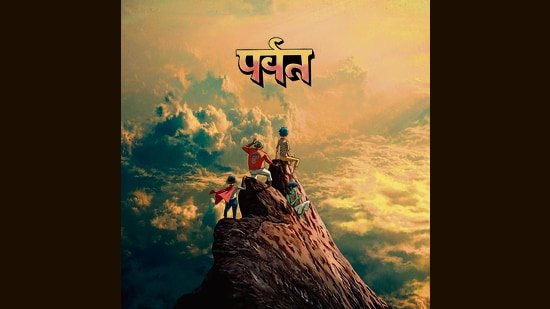
When the British virtual band Gorillaz, created by musician Damon Albarn and artist Jamie Hewlett, released the cover art for their album, The Mountain, last year, excitement rippled across the Indian internet.
The cover art for the British band’s new album, The Mountain / Parvat, featuring collaborations with Asha Bhosle, Asha Puthli, Amaan Ali Bangash and Ayaan Ali Bangash, among others.
The band’s four cartoon members were shown perched on the craggy peak of a mountain, looking down at a cloud-covered world. Above their heads was the Hindi word for Mountain, in Devanagari: Parvat.
When The Mountain was eventually released, on February 27, it became obvious why. Gorillaz’ collaborators on the album include beloved Indian names from across genres: playback legend Asha Bhosle, disco queen Asha Puthli, sarod players Amaan Ali Bangash and Ayaan Ali Bangash; there’s also British-American sitar player Anoushka Shankar.
The album’s artwork, consisting of digital collages by Hewlett that incorporate photographs, cartoons and illustrations, is glorious too. Yet, the idea that Gorillaz’ The Shadowy Light might be someone’s introduction to Bhosle’s singing left me with a one-word reaction: Eep!
My father, a walking encyclopaedia on vintage Bollywood, says that as of 2006, Bhosle had sung an estimated 10,344 songs across at least 14 languages, over more than 60 years.
In a music industry that is largely cautious, she has fearlessly tackled disco anthems and pop songs as well as compositions rooted in Hindustani classical music. She can channel the energy of a coquette just as convincingly as she can imbue a song with religious devotion.
The Shadowy Light shows that, at 92, she can still hold her own. But then this is an artist who has sung duets with Mohammed Rafi, Boy George and Brett Lee (yes, the fast bowler). She released a pop album in 1997 and was sampled by the Black Eyed Peas in the 2005 Grammy-winning Don’t Phunk With My Heart.
She has done it all amid a candyfloss swirl of gossip. Remember when SD Burman had a spat with her sister Lata Mangeshkar in the 1950s, and decided to work with Bhosle instead? Remember the affair with the married composer OP Nayyar, of the jaunty hat and jauntier tunes? And the turbulent marriage with RD Burman in the ’80s?
The inordinate focus on her personal life is ironic because Bhosle’s music is richly complex. One could spend hours listening to her discography and still only scratch the surface of her musical and emotional range. She was the queen of the nightclub number (who can forget Mud Mud Ke Na Dekh from Raj Kapoor’s Awara (1951)?) and delivered pearl after pearl in the ghazal-inspired soundtrack of Umrao Jaan (1981). No one did irreverent mischief quite like she did in her golden years; think of Jhumka Gira Re (from Mera Saaya; 1966) and Bechara Dil Kya Kare (Khushboo; 1975).
At the same time, her voice could lilt with sweet innocence, as in Kali Ghata Chhaye (from Bimal Roy’s Sujata; 1959).
Singing Jaiye Aap Kahan Jayenge in Mere Sanam, 1965, she added defiance to a woman’s heartbreak; and melancholia has rarely sounded quite so delicate as in Aage Bhi Jane Na Tu (from Waqt; 1965).
No Asha Bhosle playlist is complete without Chain Se Humko Kabhi. Rumoured to have been deleted from the 1974 film Pran Jaye Par Vachan Na Jaye on her request, the song was released on the soundtrack and lives on as an evergreen hit.Composed by Nayyar, it marked the end of his and Bhosle’s relationship and, in three and a half minutes, perfectly distils the complexity of a bad breakup into song.
The Shadowy Light is barely the tip of the iceberg when it comes to Bhosle’s music. But it is a reminder that we have a living legend in our midst. Let’s hope it makes more people look Bhosle up and lose themselves in the rabbit hole of her songs.
(To reach out with feedback, write to @dpanjana on Instagram. The views expressed are personal)