


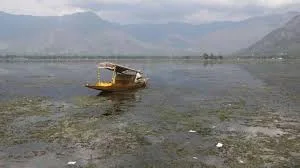
March 06: The Environmental Policy Group (EPG) has expressed deep concern over the rapidly deteriorating water condition of Dal Lake following the widespread cyanobacterial bloom that has engulfed a significant portion of the lake’s expanse.
EPG in a statement says that based on field observations, scientific understanding, and independent inputs, EPG strongly contests attempts to attribute the bloom to seasonal temperature variation or reduced water inflow.
“The bloom began approximately two weeks ago when ambient temperatures were relatively cool, not high. This fact alone rules out temperature as the triggering factor in the present case.
While there has been some scarcity of surface water inflow due to a dry spell, nearly 30 percent of the lake’s inflow is sustained by subsurface lake-bed springs. Such hydrological conditions, in isolation, are not scientifically sufficient to trigger a bloom of this magnitude. In fact, the reduced inflow currently being cited appears to be constraining control and dilution measures rather than explaining the bloom’s origin,” the EPG said.
“EPG has been informed that shortly before the bloom appeared, mechanical deweeding operations were undertaken under an annual contract awarded by the Lake Conservation and Management Authority (LCMA),” the EPG statement reads.
“The contractor was reportedly directed to carry out large-scale deweeding without prior scientific evaluation of the timing of intervention, the percentage of vegetation to be removed, or the ecological consequences of disturbing rooted lake-bed weeds. In earlier years, deweeding was undertaken with established scientific protocols, including assessment of ecological thresholds. The absence of such an evaluation in the present instance represents a serious procedural lapse.”
The EPG says that scientific literature clearly establishes that Microcystis blooms produce toxins, including microcystins, which are hepatotoxic and may also have neurotoxic effects. “Human exposure can result in skin rashes, throat irritation, respiratory complications, pneumonia, and severe gastrointestinal distress. Ecologically, such blooms degrade water quality, reduce biodiversity, block sunlight penetration, and deplete dissolved oxygen levels, thereby disrupting aquatic ecosystems and accelerating eutrophication.”
