


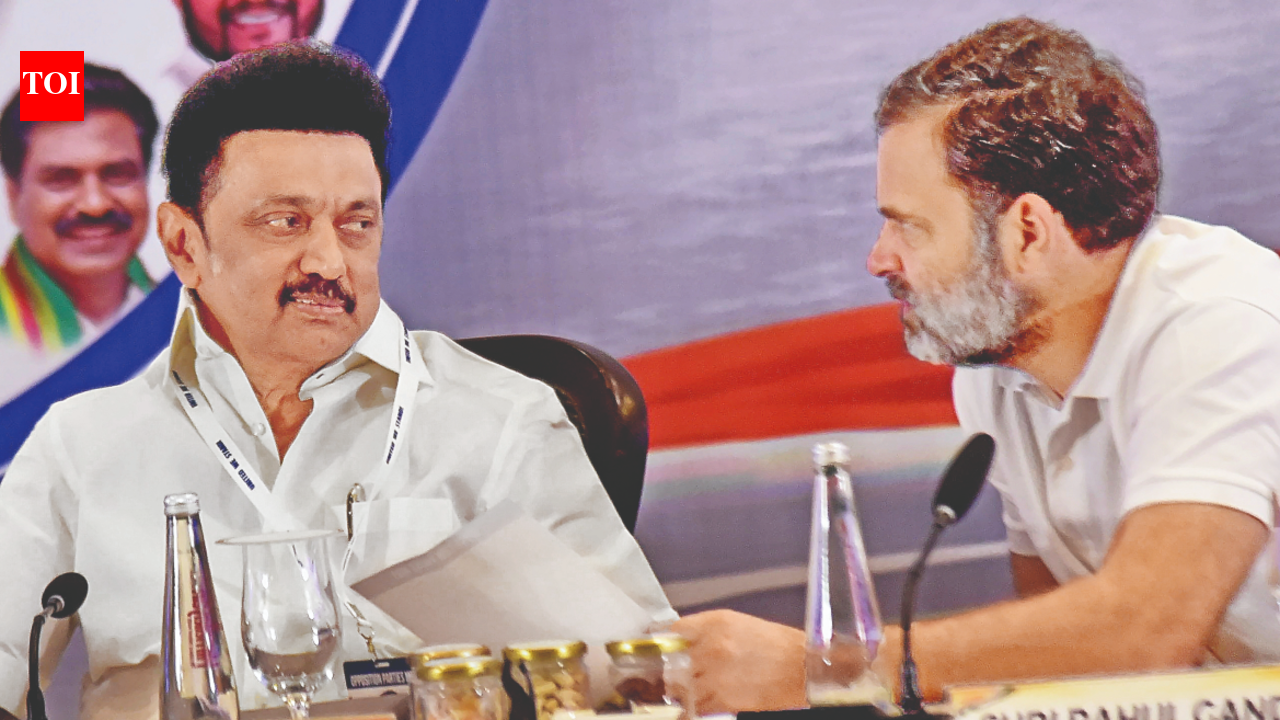
At 6.30pm on Wednesday, applause erupted at Anna Arivalayam, the DMK headquarters in Chennai. DMK and Congress had just signed the seat-sharing deal. DMK offered Congress 28 seats and one Rajya Sabha seat.On Tuesday, DMK’s offer on the table was 27 + 1. By Wednesday afternoon, it had become 28 + 1, after Congress president Mallikarjun Kharge spoke to chief minister M K Stalin. Coming out of Arivalayam at 8.15pm, Stalin gestured with his right hand and said: “Over”.Seat-sharing is an art that politicians master over the years, which demands shrewdness and a sound knowledge of ground realities along with negotiation skills and smart handling of pressure. DMK patriarch M Karunanidhi was a master of this art. And Stalin seems to be getting there. In a way, Karunanidhi faced fewer (though not smaller) challenges than Stalin does. There are more demanding allies to deal with now, politics has become more volatile, especially when a new entrant threatens to poach one’s partners.While DMK’s initial offer to Congress was 25, the same as in 2021, it raised the number by three, to 28. Congress, which started its internal discussion around 41 seats, made an initial demand to DMK for 38 seats, and eventually settled for 10 less. Congress had to give up its power-sharing demand – at least for now – and hurriedly quell threats from sections within the party that they would team up with actor Vijay’s TVK. “It is a victory for Stalin – and the alliance,” says a senior DMK functionary privy to the negotiations. So, how did Stalin pull it off? “CM backed his talks with data and focused on deliverables and ground realities. That is how he convinced Congress about the number.”When it comes to shrewd bargaining with allies, there is little difference between father and son, says former TNCC president K S Alagiri. “Having been with his father through many negotiations, Stalin functions in a similar manner,” he says.“Whenever the bargaining got intense, Kalaignar would get jovial to lighten the mood. Stalin is sincere and wants to help alliance partners. He has given more seats to allies this time. It is a good thing,” says Alagiri, who was TNCC chief during the 2019 Lok Sabha polls and 2021 assembly election. “Stalin manages all allies with cordiality. Both Karunandhi and Stalin were neither hard nor harsh like J Jayalalithaa.”There were a few sparks and challenges that Karunanidhi had to face too, during seat-bargaining with Congress in 2011. When Karunanidhi offered 60 seats to Congress, the party insisted on having three more. DMK opened the talks with an offer of 51 seats for Congress, and later raised it to 53, 55 and 58. Finally, Congress got the 63 it demanded. DMK contested just 119 seats that year. The alliance lost to the Jayalalithaa-led AIADMK. DMK spokesman T K S Elangovan, who worked closely with Karunanidhi, says the late leader meticulously studied the political scenario. “Having studied his father’s strategy for so many years. Now Stalin does the same,” says Elangovan. The divisions within Congress over power sharing and opting for an alliance with TVK came out into the open, and the party did nothing to control the situation, say senior DMK functionaries. Rahul chose not to interfere, and finally Sonia Gandhi had to step in, they said. “It was a much bigger problem this time. Stalin said a firm ‘no’ to power sharing. They had never asked for it before. There was never such a situation in the past under Kalaignar. It was always only about numbers,” says Elangovan. “Kalaignar was tough sometimes during negotiations. Stalin has matured as a politician; he is keen to have more allies,” says former Congress MP S Thirunavukkarasar. He recalls how ahead of the 1991 assembly election, Karunanidhi wanted him in the DMK alliance. Thirunavukkarasar quit AIADMK and launched MGR ADMK. “I asked for 10 seats, but Kalaignar was firm he would give us only nine – and insisted Panruti S Ramachandran (former minister in MGR’s cabinet), who was in my party then, should not contest. Karunanidhi said Ramachandran worked against DMK during the Emergency. I accepted,” recalled Thirunavukkarasar. Stalin used his father’s criteria to gauge the strength of an ally, including the number of stronghold constituencies, performances in previous Lok Sabha and assembly elections, strength of cadre, transfer of votes and the potential of campaigns. When this reasoning became intense, and when alternative options looked bleaker, Congress had to give in to Stalin’s persuasion.
