


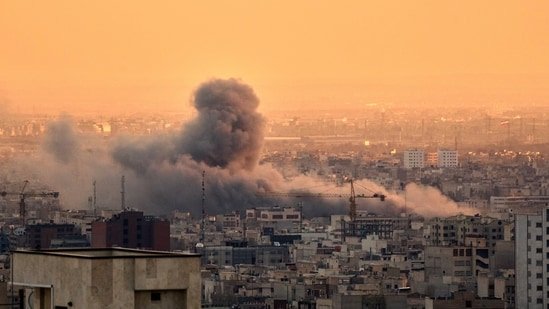
ON MARCH 4TH a pilot in the Israeli Air Force became the first member of his service to score an air-to-air kill in more than 40 years. It was hardly a fair fight. His F-35, one of the world’s most advanced warplanes, shot down an Iranian Yak-130, originally designed as a training jet. “We are punching them while they’re down,” declared Pete Hegseth, America’s secretary of war, “which is exactly how it should be”.

The lopsided encounter embodies the American and Israeli campaign as a whole. At the political level, American officials have offered dubious and sometimes contradictory rationales for war, as well as war aims that shift daily. By contrast, the military campaign evinces careful planning, massive firepower and overwhelming success.
In a video put out on March 3rd, Admiral Brad Cooper, the commander of the Pentagon’s Central Command (CENTCOM), which oversees military operations in the Middle East, claimed that in four days America had attacked almost 2,000 targets, including 17 ships, among them a submarine. Also on March 3rd an American submarine appears to have attacked and sunk an Iranian frigate near Sri Lankan waters, some 3,000km from Iran (see video below)—America’s first use of a torpedo since 1945. The first day of the war was “nearly double the scale” of America’s “shock and awe” attack on Iraq in 2003, said Admiral Cooper. Israel’s bombing is even more intense. The country is striking around 1,000 targets a day, according to the Israel Defence Forces (IDF), a rate of bombing enabled by American tankers refuelling Israeli jets.
The willingness of America and Israel to start the war in broad daylight on February 28th was shaped by the opportunity to kill Ayatollah Ali Khamenei, Iran’s supreme leader. The brazenness reflected the dire state of Iran’s air defences, which were mostly dismantled in last year’s 12-day war. After the first wave of strikes—which, to preserve an element of surprise, were conducted by long-range missiles fired by stealthy planes and distant warships—America and Israel have been able to get their planes over their targets. That allows them to use cheaper and more numerous guided bombs rather than relying on scarce, expensive “stand-off” munitions. “We have a nearly unlimited stockpile” of these, Mr Hegseth boasted.
Israeli officers joke that, unlike their previous strikes on Iran, this is a “war in English”, planned in lockstep with America. Discussions began last summer, after the 12-day war, but joint-strike plans were developed after Eyal Zamir, the IDF’s chief of staff, visited the Pentagon in January. The two countries have divided Iran into large zones which they call ballistic-missiles operation areas, or BMOAs. Israel deals with western and central Iran, including Tehran, the capital; America handles southern Iran and its adjacent waters. Israel is largely flying over Syria; America largely from Jordanian bases and from the USS Abraham Lincoln in the Arabian Sea and USS Gerald Ford in the Mediterranean.
Though both countries are attacking missile launchers (“hundreds”, according to Admiral Cooper), the division of labour is one reason why Israel has focused on regime targets. They include a gathering of the Assembly of Experts, a body to choose the next supreme leader, on March 3rd and Basij paramilitary forces on March 4th. Meanwhile, America has concentrated on Iran’s navy. The division also reflects the relative risk appetite of each country, says Martin Sampson of the IISS, a think-tank, who served as an air marshal in the Royal Air Force, with Israel willing to fly single-engined jets deep into Iran, where search-and-rescue teams would struggle to recover downed pilots.
The war plans involve several phases. Two have been implemented. The first was the opening strike on February 28th. The second was the subsequent 100 hours, in which Israel attacked its highest priority targets out of fear that President Donald Trump might call an early end to the war. A third phase, of lower priority targets, is now under way. Planners say there are sufficient American and Israeli targets for four or five weeks of war, a timeline that Mr Trump has also mused about. “We will now begin to expand inland,” said General Dan Caine, America’s chairman of the joint chiefs of staff, speaking alongside Mr Hegseth on March 4th, “striking progressively deeper into Iranian territory.”
Most nuclear targets are earmarked for later in the conflict. That is in part because—despite misleading claims by American officials—Iran has done little to those sites since last year’s war, apart from piling soil on top of the bomb craters. Nonetheless, on March 3rd Israel said it had attacked the Min Zadai complex on the north-east edge of Tehran, which it claims was a covert facility related to nuclear-weapons development. The target bank includes not only more missile and nuclear sites, but also every Islamic Revolutionary Guard (IRGC) headquarters across Iran—a clear sign that the aim is both to degrade its military capabilities and cause the regime to collapse.
“This is incredibly well integrated and thought through as a deliberate campaign,” says Mr Sampson, who previously led British air operations against Islamic State in Syria and Iraq. The war could soon shift, he says, from largely pre-planned and mostly static targets to what air planners call “dynamic” ones, including new targets not identified before the war.
Britain’s decision to grant America permission to use Diego Garcia, a vital airbase in the Indian Ocean, will help. By flying from there, rather than from the American continent, America can increase the rate of flights, re-use crews more often and draw on a deep magazine of weapons on the island. American bombers can then handle “deliberate” targeting, says Mr Sampson, while fighter jets can “move around much more freely and have a bit more tactical freedom” to strike targets spotted by drones and surveillance planes. These are likely to begin operating further east, closer to Iran.
Already, the war has become a showcase for new, exotic and unusual weaponry. At the bottom end, America has debuted its Low-cost Uncrewed Combat Attack System (LUCAS), a cheap-ish, long-range strike drone. That it should be flying into Iran is ironic, given that LUCAS is an American knock-off of the Iranian-designed Shahed-136 projectiles used by Russia in Ukraine. Advocates of “precise mass”, the idea that the Pentagon should rely more on low-cost, high-quantity munitions, are pleased.
At the top end, America has also used its PrSM ballistic missiles for the first time. These missiles, with a range of 500km and fired from HIMARS launchers in Bahrain, would have been illegal to build and deploy had Mr Trump not abrogated the Intermediate-range Nuclear Forces (INF) Treaty with Russia in his first term. And in its opening salvo against Khamenei and his cabinet, Israel is thought to have used large numbers of air-launched ballistic missiles, an unusual category of weapon that only China and Russia also possess. On top of that, America is thought to have employed Claude, an artificial-intelligence model, to process intelligence, select targets and carry out military simulations—all amid a blazing political row with Anthropic, the model’s creator.
America and Israel have so far enjoyed considerable operational success. Iran’s political leadership is in turmoil, with the next supreme leader—Khamenei’s son, Mojtaba, is one of the rumoured candidates—also marked for assassination, according to Israel Katz, Israel’s defence minister. General Caine said that Iranian ballistic-missile launches were down 86% from the first day of the war, with a 23% fall between March 3rd and 4th alone. Drone attacks, he added, were down 73%. Most importantly, perhaps, Israeli intelligence sources suggest that there are signs of Iranian soldiers, police officers and IRGC members failing to show up for duty. For all that, military attrition, however overwhelming and effective, by no means guarantees the regime’s demise—Israel’s key war aim, and one of Mr Trump’s ever-shifting goals.
