


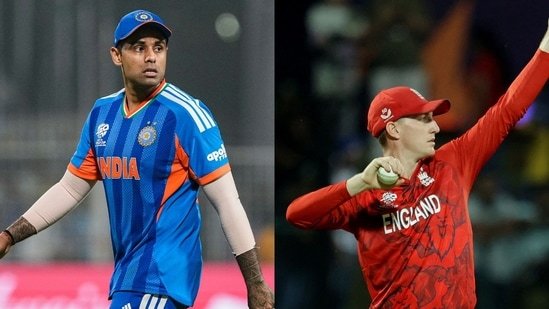
India vs England in a World Cup semi-final rarely feels like a routine knockout. These games usually arrive with history, pressure, and a brutal clarity: whichever side has built the most repeatable cricket across the tournament tends to survive.
This semi-final at Wankhede fits that pattern. On reputation, the contest looks tight. On current tournament numbers, venue behaviour and role clarity, India enter as slight but meaningful favourites. England still have enough firepower to flip the game in a single phase, but India’s profile has been stronger across more batting slots and more stable in match control.
India’s batting profile gives them the first edge
The biggest statistical advantage for India is not having a single player carry the line-up, but the spread of contributions and the range of scoring gears across the top six.
Sanju Samson has scored 143 runs in three innings at an average of 71.50 and a strike rate of 195.89. Suryakumar Yadav has 231 runs at 38.50. Ishan Kishan has 224 runs at a strike rate of 185.12. Shivam Dube, Hardik Pandya and Tilak Varma have all added strong returns with healthy scoring rates, giving India multiple acceleration points beyond the powerplay.
That matters in a semi-final because knockout batting is often less about one dominant innings and more about whether a team can absorb one bad phase without the innings breaking.
England still have elite match-winners. Harry Brook has 228 runs at a strike rate of 161.70, while Will Jacks has 191 runs at an average of 63.66 and a strike rate of 176.85. But the returns from some expected pillars have been patchier. Phil Salt has 125 runs in seven matches, and Jos Buttler has 62 in seven. England’s middle order has enough quality to repair innings, but it has also been forced into repair mode too often.
That difference in batting stability is the first major reason India move ahead in a pre-match model.
Wankhede data changes the tactical picture
The venue numbers from this tournament are central to any prediction.
At Wankhede so far, the average first-innings total is 174, the average second-innings total is 151, and the average winning total is 175. Wickets have been split almost evenly between pacers and spinners, with pacers taking 43 and spinners 42.
That tells us two important things. First, this has not behaved like a simple flat deck where chasing automatically becomes easier. Second, the surface has offered enough balance for both seam and spin, which increases the value of attacks that can control the game through multiple phases rather than rely on one style.
The gap between first- and second-innings scoring also suggests scoreboard pressure has mattered. That makes the ability to post a par-plus total and then squeeze in the middle overs especially valuable.
On current evidence, India look slightly better built for that script.
Bowling depth vs bowling control
England probably have a greater bowling spread in terms of wicket-taking options. Adil Rashid has 11 wickets, Liam Dawson 10, Jofra Archer 10 and Jamie Overton 9, with Sam Curran and Will Jacks adding flexibility. In a defence, that kind of layered attack can be a major advantage.
India’s edge lies in control concentration. Varun Chakaravarthy has 12 wickets, Bumrah 9, Arshdeep 8 and Axar 7. More importantly, India have a cleaner control template for a knockout on a balanced surface. Bumrah remains the premium pressure bowler in the match, especially at phase breaks. Varun gives India a wicket-taking threat in the middle overs rather than only containment. Axar can hold tempo and prevent drift.
England may be more flexible. India look more repeatable.
Model projection and toss-dependent outcome
Using a simplified Bayesian-style prediction model, starting from a 50-50 prior and updating for batting form, bowling effectiveness, venue fit and par-score suitability, India finish ahead before the toss.
Pre-toss projection places India at 58 to 62 percent, with England at 38 to 42 percent. A practical pinned estimate is India 60 percent, England 40 percent.
But the innings order matters at Wankhede.
If India bat first, their probability rises because their current batting profile is better suited to building a 175-plus score, and their bowling structure is well equipped to defend with control. In that scenario, India project at 64 to 68 percent, with a pinned call of 66-34. If India reach 185 to 195, they become strong favourites.
If England bat first, the game tightens. England’s bowling depth becomes more valuable in a defence, and their batting ceiling remains high enough for one explosive phase to define the match. In that scenario, India project at 52 to 56 percent, with a pinned call of 54-46. If England post 175 to 184, the game moves very close to even. Beyond 185, England’s edge rises sharply.
Verdict
India should start as favourites, but not by a margin that makes this predictable. The statistical case rests on stronger batting continuity, better alignment with Wankhede’s scoring pattern, and a bowling core that can control phases rather than merely survive them.
England still have a clear winning route: early wickets, a Brook or Jacks surge, and a defendable total that lets their multi-option attack keep India from cruising through the middle overs.
Before the toss, the analytical call is India by a small but real margin.
