


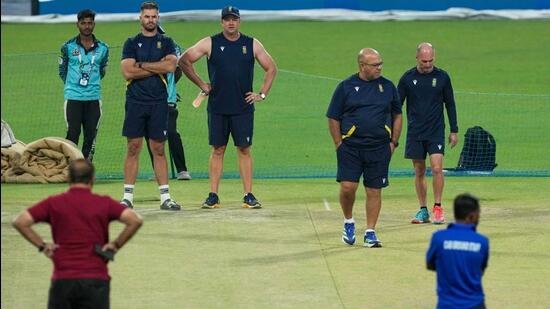
Kolkata: They have been here, but not done that. Two sides long defined by composure, adaptability and, at times, heartbreak, now stand one game away from another shot at the ultimate prize. Look up South Africa and New Zealand’s history to understand the fickleness and cruelty of sport. They don’t complain though. They keep trying.
This semi-final is about learning from the past and exorcising the ghosts and pains of not being able to go all the way. Expect athleticism, sublime catching and smart cricket.
If tournaments are about peaking at the right time, both teams have arrived here by different but equally compelling routes. Unbeaten, tactically supreme, South Africa have impressed by resisting the urge to play one-dimensional, high-risk T20 cricket. Instead, they’ve blended strategy with bursts of power, a template that has served them well in pressure games.
Aiden Markram’s leadership has been central. His batting previously focused on anchoring the middle overs against spin but now he has reinvented his cricket by attacking the bowlers in the Powerplay itself.
After him, South Africa have deployed the trio of hitters—Dewald Brevis, David Miller and Tristan Stubbs—with defined roles—to counter spin, pace and to finish—and a high success rate. But their real edge may lie with the ball.
South Africa’s pace unit has been tactically outstanding, relying on a hefty variation of wide yorkers, good lengths and smart field placements. They have staggered their strike bowlers rather than front-loading them. The ability to hold back overs for match-ups has also repeatedly stalled opposition surges.
The question for South Africa is familiar: can they sustain clarity under knockout pressure? History has not always been kind, but this side appears less emotional, more methodical. Also that unbeaten run helps, though Markram sounded a bit guarded.
“If you want to look at it through that (unbeaten run), then I don’t think you’d be a very clever man,” he said. “If you’re sitting in our changing room, I think you want to look at it from a side where you’re bringing a lot of confidence into a must-win game and a lot of trust in the plans and the things that we’ve been doing well. So it’s as simple as that for us.”
Few teams understand tournament pacing like New Zealand. They rarely dominate headlines in the group stages, but they quietly accumulate wins, refine combinations and sharpen roles. They almost didn’t make the semi-final, yet they are here, having overcome a ‘pretty nervy’ watch of the Pakistan-Sri Lanka game that sealed their fate.
“I think at every stage, the result is you just want to get through to the next stage,” said New Zealand captain Mitchell Santner. “Whether it’s the first stage, obviously Super 8 and now it’s the semi-finals. It’s one game and you can potentially move on. So again, we’re here now, which is ideal. But again, we know we’ve got a challenge tomorrow against a very good team.”
With the ball, New Zealand lean heavily on control and disciplined seam movement. But they have also unusually relied on Santner too much in the middle overs. If fast bowler Matt Henry isn’t cleared to play—he is landing Tuesday night after a brief visit home for the birth of his second child—New Zealand may bring back Jacob Duffy.
On the batting front, New Zealand’s Powerplay numbers might not always be explosive, but they are efficient. There could be a temptation to bring Glen Phillips up the order, considering the small boundaries at Eden Gardens. Where New Zealand might run into trouble though is the death overs, where Corbin Bosch averages 6.25 runs per over.
“It’s not the easiest role nowadays, owning the death overs,” said Markram. “But he, at least from a mindset point of view, really wants it and has been wanting it for a while. And I think now the numbers are showing and it’s been a massive play for us.”
South Africa have often carried the narrative of near-misses in ICC events. But this group appears insulated from that noise. New Zealand, meanwhile, have turned knockout resilience into identity. They are comfortable being underdogs. In many ways, this semi-final represents modern T20 at its most evolved: data-informed, role-driven, emotionally measured.
South Africa bring sharpened aggression and belief. New Zealand bring composure and tournament nous. One team will leave with another story of resilience. The other will carry fresh questions into the next cycle. But for now, standing between them and the final is 40 overs of controlled, tactical intensity, and the ability to remain calm when the noise rises.
