


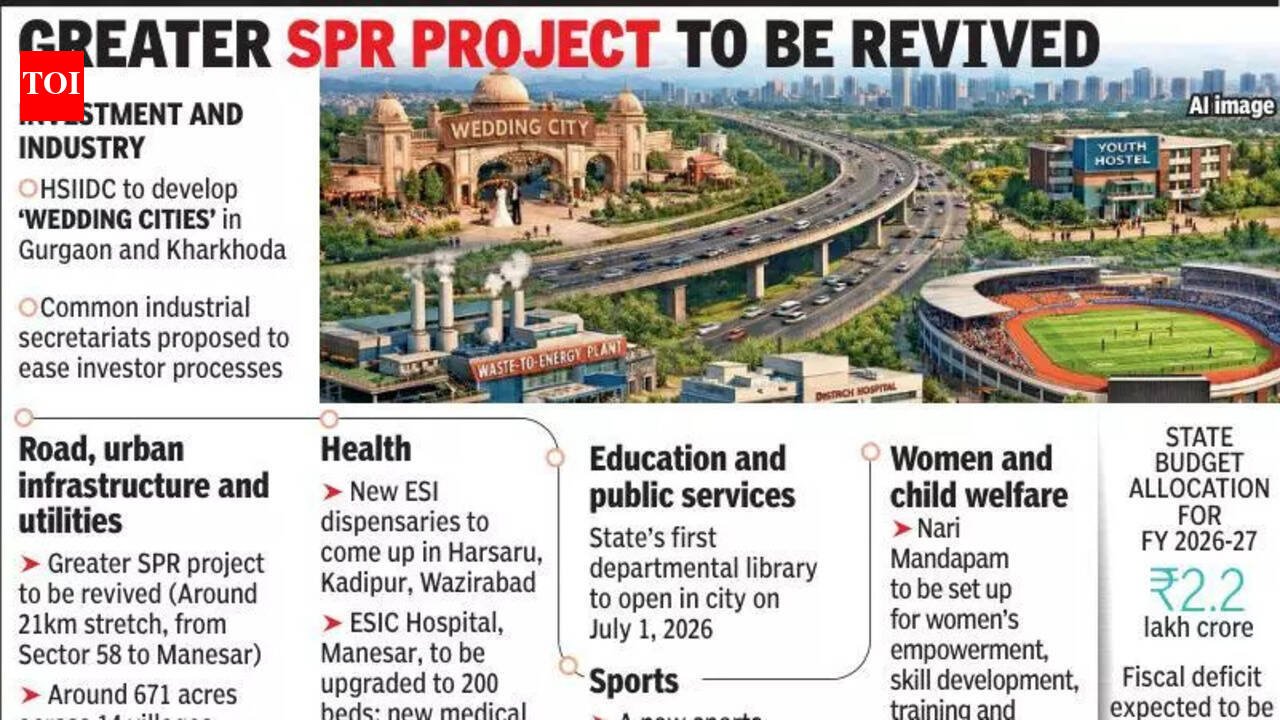
Gurgaon: Haryana’s biggest revenue generator, Gurgaon emerged as the clear focal point of the state budget presented on Monday by chief minister Nayab Singh Saini, who also holds the finance portfolio. The package for the district included big-ticket mobility projects, a fresh healthcare facility, investor-friendly industrial reforms, waste-to-energy capacity, and new social and sports infrastructure.Saini said the budget was shaped following consultations with different sections of the society, with around 5,000 suggestions received and incorporated into the proposals.On the investment front, the budget proposed common industrial secretariats in four cities, including Gurgaon and Manesar, to streamline approvals and reduce friction for businesses through a more coordinated, single-window-style interface.Industries minister Rao Narbir Singh said the move aligned with the region’s industrial needs. “Common industrial secretariats are a welcome initiative for the convenience of investors in key centres of Haryana’s industrial development, such as Gurgaon, Faridabad, Manesar and Rewari. This will give new momentum to industry,” he added.In a separate urban-economy push, HSIIDC will develop “wedding cities” in Gurgaon and Kharkhoda, envisaged as organised, purpose-built venues with allied services. Officials said the idea was to formalise a large informal event economy while creating local jobs and business opportunities.The budget also placed Gurgaon at the starting line of a statewide knowledge initiative, announcing the state’s first departmental library in the city from July 1.Healthcare and worker welfare also formed one of the densest clusters of announcements. New ESI dispensaries will come up in Harsaru, Kadipur and Wazirabad to expand access for insured workers and their families in growing residential and industrial belts. The ESIC hospital in Manesar will be upgraded to 200 beds, and a new medical college will be established there.For the city’s wider public health system, construction of a 400-bed district hospital in Gurgaon is slated to begin in the current financial year. At the primary-care level, Wazirabad and Daulatabad PHCs will be upgraded to CHCs, modern health centres will be developed in Rithoj, Sidhrawali and Ransika, and a wellness centre will open in Pataudi.On the environment front, the budget announced five waste-to-energy plants of 25MW capacity each across Faridabad, Gurgaon, Manesar and two regional clusters.Congestion relief featured through a new multilevel parking facility for Gurgaon, aimed at easing pressure in commercial zones and high-density markets. The most consequential mobility announcement, however, was the revival of the Greater Southern Peripheral Road project, pending for nearly a decade. The state govt has notified 671 acres across 14 villages for it, and said the award of the project is expected shortly.The 21km corridor from Sector 58 to Manesar is planned as an outer ring road for new Gurgaon, intended to redistribute traffic, open up planned development and improve connectivity between emerging sectors and the industrial belt.Sports and youth infrastructure also found space in the budget. Gurgaon is among the districts slated to get a new sports stadium, and is also among five cities where a new hostel will be opened to support athletes, students and working youth seeking affordable accommodation. The Rajiv Gandhi Sports Complex at Daulatabad will be upgraded to an international-level para sports stadium, a move aimed at strengthening inclusive sports infrastructure and enabling higher-level para training and events in the district.The budget proposed a ‘Nari Mandapam’ in Gurgaon as a dedicated platform for women’s empowerment, skill development, training, capacity building and recognition of achievements. Gurgaon is also among the districts where a Vatsalya Bhawan will be built as an integrated single-window platform for services related to women and children, intended to bring together support systems that are often spread across departments.
