


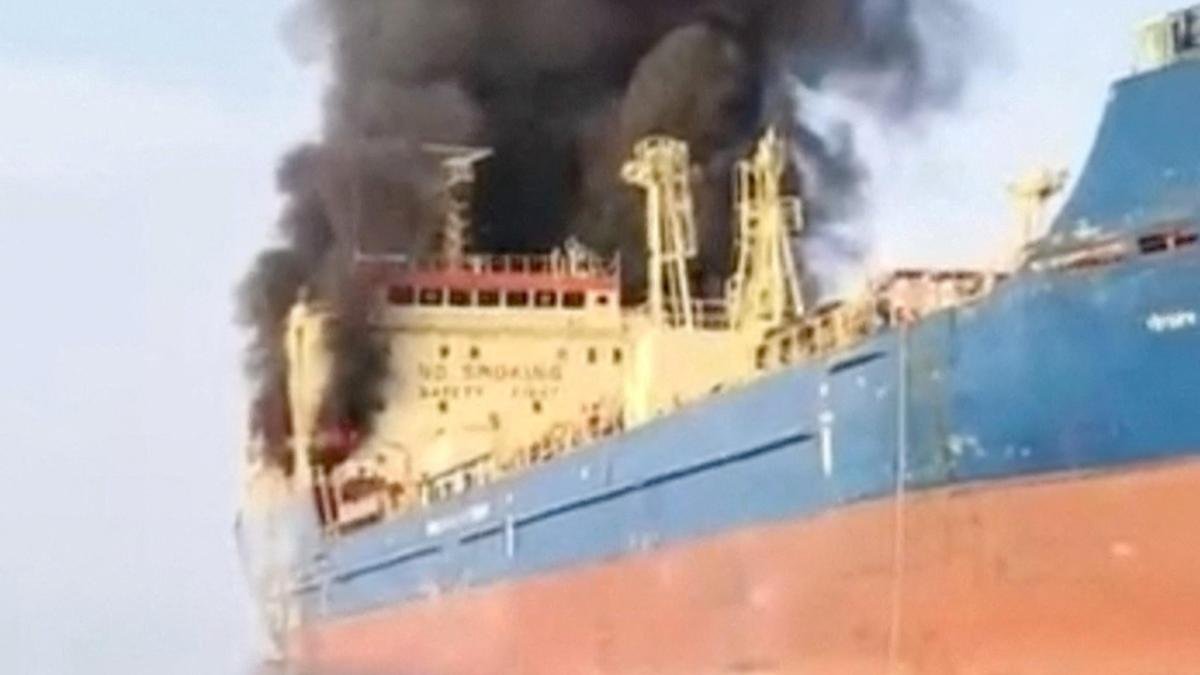
Smoke billows from an oil tanker under U.S. sanctions, that was hit off Oman’s Musandam peninsula, in this screen grab from a video obtained by Reuters on March 1, 2026.
| Photo Credit: Reuters
The attack on Skylight, a tanker with 15 Indian and 5 Iranian seafarers on board, has brought to the fore the risks to Indian seafarers serving on ships in the Persian Gulf route as well as those flagged as shadow fleet by the U.S.
Three ships have been reportedly attacked so far since the latest round of hostilities began. Ship traffic through the Strait of Hormuz has ground to a halt on March 1, 2026, while some 60 to 70 ships had transited in the previous day.
Oman’s Maritime Security Centre said Skylight was subjected to an attack around 5 nautical miles north of the port of Khasab in the Musandam governorate, according to Oman news agency.
The entire crew of 20 individuals, comprising 15 Indian nationals and five Iranians, have been safely evacuated, it said. It said four crew members sustained injuries of varying degrees and have been given medical care.
Skylight was included on the U.S. government sanctions list in December of 2025. Sanctions typically lead to companies being unable to do financial transactions or even do business, leading to wages of seafarers not being paid. It leads to much distress among seafarers, even abandonment of ships. Repatriation of seafarers to their home nations becomes a problem too.
International Federation of Transport Workers (ITF) data shows that 6,223 seafarers were abandoned across 410 ships in 2025. In terms of nationality, India had the most abandoned seafarers with 1,125, followed by the Philippines (539), Syria (309), Indonesia (274) and Ukraine (248).
An analysis of Lloyd’s List Intelligence data alongside the ITF shows that the majority of abandonments on tankers and LPG carriers in 2025 occurred on shadow fleet vessels, says Joshua Minchin, senior reporter with Lloyd’s List Intelligence.
An ITF spokesperson said: “Indian seafarers represent a significant proportion of the world’s seafarers working in the merchant fleet, and all efforts must always be undertaken to ensure that they are never be placed in harm’s way – the ITF and its affiliate unions are working around the clock to verify the safety and security of all the seafarers we collectively represent.”
Meanwhile, the Directorate General of Shipping (DGS) of India has issued strict advisories restricting Indian seafarers from joining or being put on work in ships in Iran. Manning companies are prohibited from recruiting and sending Indian seafarers to Iran while extreme caution is advised for joining any vessel scheduled to transit through Strait of Hormuz.
Anil Devli, CEO of the Indian National Shipowners’ Association has said there are 27 Indian flag ships in the region with a majority of them in the Persian Gulf and some in the Gulf of Aden region. Many of the Indian tankers caught in the region are laden with Crude Oil or LPG and the rest are waiting to load the energy imports of India which are so crucial for us as a country. Mr. Devli asks that the government uses its good offices to Iran and Israel to ensure safe movement of Indian flag ships.
Published – March 02, 2026 06:57 pm IST
