


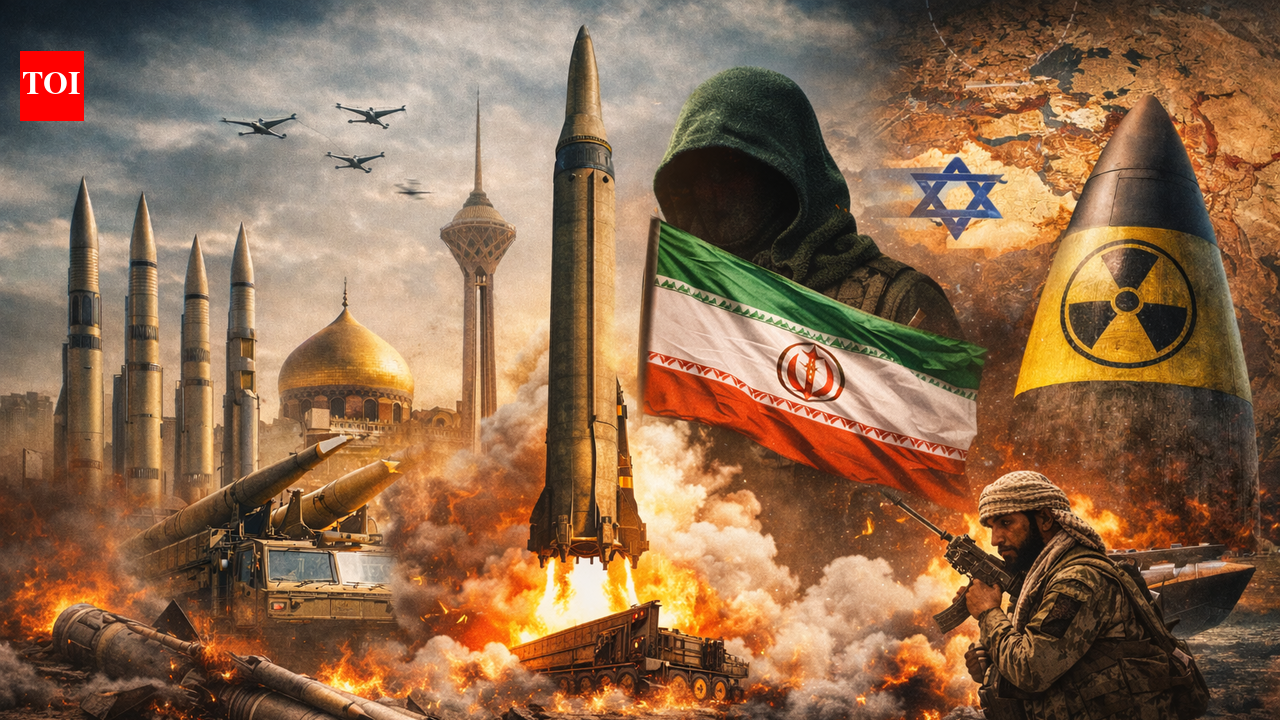
Israel’s military said on Sunday it had destroyed roughly half of Iran’s missile stockpiles during last year’s war, even as Tehran continues to rebuild one of the Middle East’s largest and most diverse arsenals.“During the operation in June 2025, we destroyed approximately half of the Iranian regime’s missile stockpiles and prevented the production of at least 1,500 additional missiles,” military spokesman Brigadier General Effie Defrin said in a televised statement from Jerusalem.
“The regime had recently been producing dozens of surface-to-surface missiles per month and intended to increase production to hundreds per month,” he added.Israeli officials had earlier estimated that Iran was left with about 1,500 missiles and 200 launchers at the end of the conflict. However, by late 2025, they observed signs that Tehran was working to replenish its stocks after expending hundreds of missiles in exchanges with Israel in April and October 2024 and during the June 2025 war.
A vast and layered missile force
Despite battlefield losses, Iran’s missile arsenal remains extensive. In 2022, US Central Command chief General Kenneth McKenzie said Tehran possessed “over 3,000” ballistic missiles, not including its growing land attack cruise missile force.Iran’s inventory is dominated by short range ballistic missiles and medium range ballistic missiles. These include solid fuel systems such as the Fateh family, Zolfaghar, Dezful, Kheibar Shekan and Sejjil, alongside older liquid fuel designs such as the Shahab and Ghadr series.Ranges vary from 300 kilometres to 2,000 kilometres, with some systems assessed as potentially capable of reaching even further if fitted with lighter warheads. Iran formally adopted a self imposed range limit of 2,000 kilometres in 2015, but analysts note the country could abandon that cap. Space launch vehicles such as Safir, Simorgh, Qased and Zuljanah use similar technologies to long range ballistic missiles, raising additional proliferation concerns.
Shift towards precision and solid fuel
Over the past two decades, Iran has prioritised combat readiness, precision and survivability rather than simply extending range.Missile precision is commonly measured by circular error probable, the radius within which half of fired missiles are expected to land. Some of Iran’s newer solid fuel systems, including Fateh 313 and Zolfaghar variants, are assessed to have a circular error probable of between 10 and 30 metres, a marked improvement over older Shahab series missiles measured in hundreds or even thousands of metres.Solid fuel propulsion has become central to this strategy. Solid fuel missiles are easier to store, faster to launch and less vulnerable to detection than liquid fuel systems, which often require fuelling at the launch site. Iranian engineers are now assessed to have greater indigenous capability in producing solid rocket motors than advanced liquid fuel engines.Following mixed performance against US and Israeli air defences in 2024 and 2025, Iran has also invested in manoeuvrable re entry vehicles and terminal guidance systems. Systems such as Fattah 1 and upgraded variants of Khorramshahr are designed to complicate interception by altering their trajectory during the final phase of flight.
Nuclear capability concerns
Although Iran publicly frames its missile programme as a conventional deterrent, many of its medium range ballistic missiles are inherently capable of carrying a nuclear warhead, a long standing international concern.United Nations Security Council Resolution 1929, which returned to effect in September 2025, states that “Iran shall not undertake any activity related to ballistic missiles capable of delivering nuclear weapons, including launches using ballistic missile technology.” The resolution is accompanied by restrictions on procurement of missile related technology and targeted sanctions.Tehran has nonetheless continued developing ballistic missiles and space launch vehicles that share technologies with long range missile systems.
Regional reach and proxy transfers
Iran’s missile capability extends beyond its own territory. It has transferred missile systems and technology to regional proxies.Yemen’s Houthi movement has used Iranian derived missiles to strike targets in Saudi Arabia and the United Arab Emirates and to target commercial shipping in the Red Sea. Tehran has also supplied hundreds of close range ballistic missiles and air defence missiles to Russia for use in Ukraine.This networked approach adds a layer of strategic depth, allowing Iran to exert pressure across multiple theatres even if its domestic stockpiles are degraded.
Arsenal rebuilding under way
Israel’s claim that half of Iran’s missile stockpile was destroyed underscores the scale of the June 2025 conflict. However, Brigadier General Defrin’s statement that Iran had been producing dozens of missiles per month and planned to scale up to hundreds suggests a rapid regeneration effort is under way.Iran’s sustained investment in solid fuel production, precision guidance and manoeuvrable warheads indicates that, even after heavy losses, its missile forces remain a central pillar of its military doctrine and regional deterrence posture.While the exact size of its current inventory remains difficult to verify independently, the breadth of systems across short range, medium range and cruise missile categories means that Iran retains the ability to strike military bases, infrastructure and strategic targets across much of the Middle East.
