


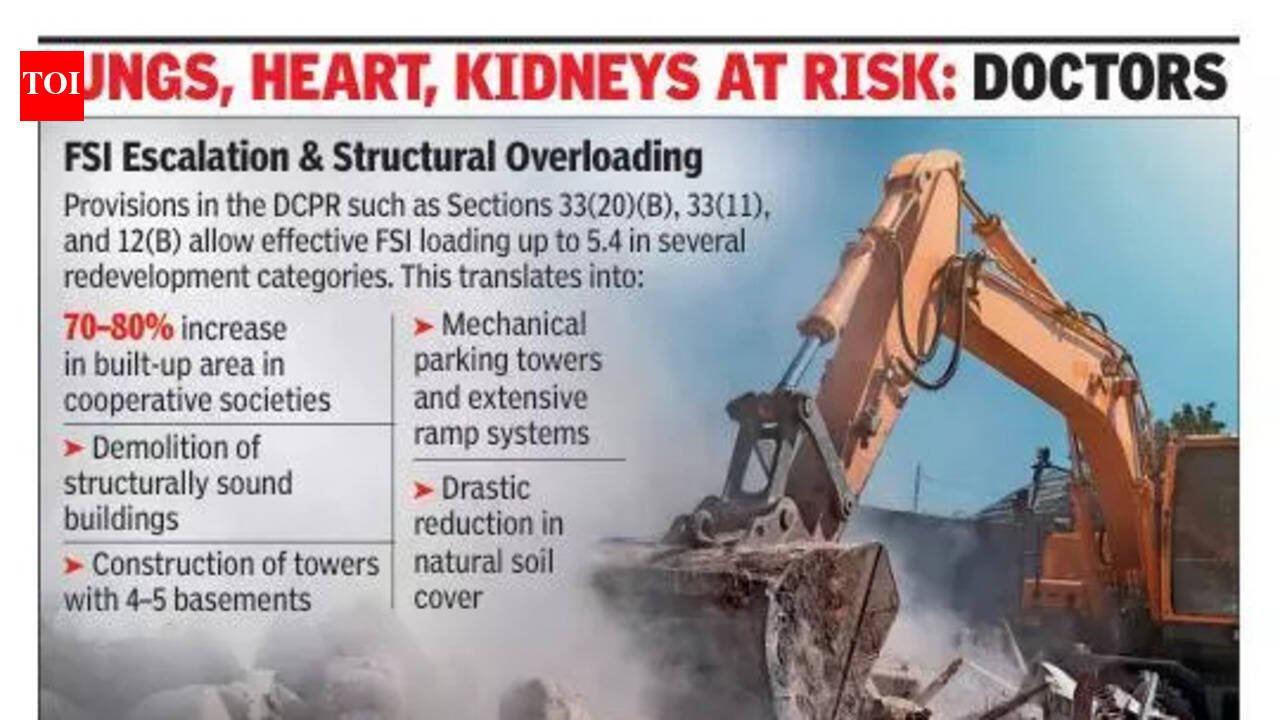
Mumbai: Is Mumbai’s new Development Control and Promotion Regulation (DCPR- 2034), which governs land use and building construction, triggering a public health crisis? With new laws permitting unusually tall towers due to excessive floor space index (FSI) in saturated wards, and unabated redevelopment and concessions in open spaces allowing five-foot distance between two buildings, medical experts warn of a potential health catastrophe.With large-scale road concretisation and loss of green cover, doctors said Mumbai is facing a slow but undeniable environmental and public health collapse. “We are witnessing a sustained increase in respiratory illnesses, cardiovascular disease, heat stress, anxiety disorders, and pollution-related complications,” they said.Senior architect Shirish Sukhatme, who has been talking to leading doctors about the correlation between the new DCPR and public health, said urban density in Mumbai already exceeds 20,000 persons per sq km in several wards, making it among the densest cities in the world.“Infrastructure capacity — drainage, road width, public transport, water supply — has not proportionately expanded. The result is environmental stress beyond carrying capacity,” he said.Senior cardiologist Dr Dev Pahlajani from Breach Candy Hospital said indiscriminate redevelopment worsens pollution because of the building materials used. “Smog and other pollutants cause accumulation of toxic particles in the atmosphere. Anything over the WHO guidelines for PM 2.5 (fine particulate matter) causes heart attacks. These particles get inhaled through the lungs, travel to the arteries, injuring or damaging them,” he said.Dr Arshad G Mohammad, ex-president of Indian Medical Association (Mumbai West), said unchecked redevelopment (where even solid buildings are demolished) and greed for more space is shrinking the city’s greenery. “The worst effect is on the respiratory tract, causing allergy problems, asthma, bronchitis and lung diseases. Debris and dust contain carcinogens, which trigger cancer,” he said. Post-Covid, he said, “we saw a rise in interstitial lung disease. Now, rampant redevelopment is causing further havoc.”Pulmonologist Dr Sujeet K Rajan calls Mumbai’s thick smog the price citizens pay for “so-called development”. The city wants coastal roads, metros, wider roads, and constant rebuilding, but the air has become the unpaid bill. Construction dust, diesel exhaust and traffic congestion are no longer background irritants; they are shaping what doctors prescribe, what patients fear, and what the city’s future health profile will look like.In clinics, the damage is already visible. Dr Rajan points to inhaler demand as a blunt indicator of worsening air. Patients now walk in asking for Budecort to “feel better,” unaware it’s a steroid-based inhaler meant for controlling inflammation after viral bronchitis. The market reflects this shift: Pharma sales data from Nov 2025 show Cipla’s Foracort, Budecort, and Duolin among India’s top ten bestselling medicines, together generating Rs 194 crore. Breathing appears to have become a retail category.Public health expert Dr Ravi Duggal argues pollution is rising not only because of activity, but because enforcement of existing rules is patchy. Construction sites are mandated to display electronic boards with pollutant levels and AQI. But AQI—the one number the public recognises and associates with danger— is often missing. He warns relentless construction is eroding the “sea effect” that once helped disperse and neutralise pollution. If construction outpaces what coastal winds can dilute, Mumbai risks becoming “another Delhi.”The harm is not limited to lungs. Senior nephrologist Dr Bharat Shah said while direct causal pathways are still being mapped, clean air is highlighted as essential for kidney health in the forthcoming World Kidney Day on March 12. A major 2024 review concluded PM2.5 can disrupt renal homeostasis and trigger oxidative stress and inflammation, potentially leading to DNA damage and kidney failure.Doctors may ask for undeniable proof but waiting decades for perfect studies is a luxury polluted cities do not have. The Global Burden of Disease study found ambient PM2.5 pollution India’s leading health burden, linked to 980,000 premature deaths in 2019. IIT Bombay researchers in 2017 estimated Mumbai’s excess mortality and morbidity rose sharply over two decades, driven largely by particulate matter. Gates Cambridge scholar Vijay Kanuru says administrators have allowed pollution to accumulate until it can be seen and smelled, demanding a war-footing response, not cosmetic fixes like watering of roads.Dr Pahlajani said Mumbai has got an “ocean”, so pollution was never this serious. “Now, it has a lot to do with the construction activity. These last two years have been very bad. And it has to do with the new DCPR, which has allowed more FSI everywhere. Every society is out to increase their area. They are also digging basements going four to five levels down, causing carbon emissions,” he said. Sukhatme recommends a review of the new DCPR. “This is no longer a planning issue. It is a medical emergency,” he warned.
