In 1947, Punjabi poet and writer Amrita Pritam (1919-2005) left Lahore, sought refuge in Dehra Dun and then went to Delhi to look for a job. She was 28 years old. While on the train at night, she found she couldn’t sleep. It was dark and windy outside, and the small mounds in the flat landscape looked like graves to her. She had witnessed too much horror, seen too many dead bodies and too many people who looked like living corpses. You could get exhausted narrating tales of grief but the tales would last longer than your lifetime. As she sat wide awake in the train, she thought of 18th century poet Waris Shah, known for his great Punjabi epic, Heer Ranjha.
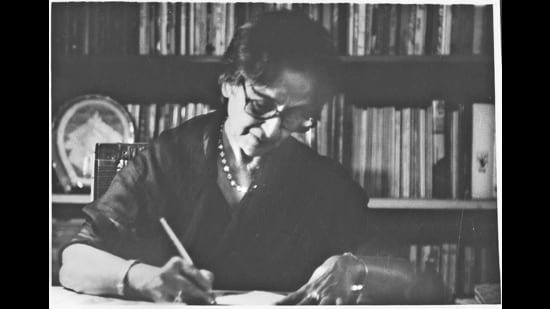
Pritam was only 28 when she wrote her most famous poem, Aaj aakhan Waris Shah nu. (HT Archives)
Hands trembling, Amrita Pritam picked up the pen and wrote the poem, ‘Aaj aakhan Waris Shah nu’ (Today I invoke Waris Shah…) on the train that night, where she asked the poet to mourn the suffering of not one Heer, but of lakhs of daughters of Punjab. Who will sing of their sorrows, she asked. It became Pritam’s most famous poem – people would carry it in their pockets, take it out and weep. All this she recounts in her autobiography, Rasidi Ticket. But she adds that the poem triggered a wave of slander and calumny against her in the Punjabi media. Sikhs said she should have addressed Guru Nanak, the Communists said she should have addressed Lenin or Stalin.
Throughout her life, Pritam would be attacked for her writing and for her personal life. But she remained uncowed. Ahead of Women’s Day, I want to invoke the steely spirit of this delicately beautiful woman, who always lived life on her own terms. Her first rebellion was when she was a young girl and saw that her nani had kept separate glasses in the kitchen for her father’s Muslim friends. Outraged, Pritam insisted she would also drink from those glasses. The matter went up to her father, who had no idea of what his mother had been up to. The discriminatory practice was promptly discontinued. Writes Pritam, “At that moment, neither my nani, nor I, knew that when I grew up I would fall in love with a man from that very religion…”
Pritam first met Urdu poet and lyricist Sahir Ludhianvi in 1944 in Preet Nagar, a village between Lahore and Amritsar. She had come there to attend a mushiara and heard Sahir for the first time. That was the start of a long, yearning love that lasted many years. When he visited her in Lahore, he would sit silently and keep smoking. Pritam would store the butts carefully and then smoke them one by one. In this way, she felt she was touching his hands. That’s how she began smoking.
She writes that in all her years of knowing him, she never understood Sahir’s silences — and perhaps he didn’t either. Pritam had married in 1936, but was unhappy in her marriage and finally separated from her husband in 1960. But when she was pregnant in 1946, she kept thinking of Sahir in the hope that her child would look like the poet. When she told Sahir about this later, he laughed and remarked, “Very poor taste!” (Sahir had a lifelong complex about his looks.)
In fact, when Pritam’s son Navraj was about 13, he asked his mother, “Tell me truthfully, am I Sahir Uncle’s son?” (The answer was no.) In 1960, when she read in the tabloid Blitz that Sahir had a new love, she was devastated. “That was the year I wrote my saddest poems.”
But the real love of Pritam’s life was not Sahir, it was the artist Imroz (1926-2023), who addressed her fondly as Maaja (the name of the heroine in an Italian novel they had both read) and Barkate (which means good fortune, abundance), wrote beautiful love letters to her, painted her, illustrated the covers of her books, looked after her in her last years when she wasn’t well, and was her steadfast companion for over four decades.
There are many heart-warming stories of their abiding love (Uma Trilok, in her book Amrita-Imroz: A Love Story, says that he always escorted her to events and waited patiently for her in the car park or lawn if he wasn’t invited). They never married and the live-in relationship made Amrita Pritam the target of consistent attacks in the Punjabi media.
In one of Pritam’s novels, Dilli Ki Galiyan, published in 1970, the heroine Kamini is subjected to similar attacks, which she faces with stoic courage. A journalist with a newspaper, Kamini writes an influential column called Dilli ki Galiyan. When she rejects a poet, Jagir Singh’s advances, he launches a vilification campaign against her, spreading rumours that she uses sex to get ahead in her profession.
There is also a strand of Kamini’s love story woven into the book’s narrative. Kamini was in love with a college friend, Sunil, for many years, but he left the city and she heard nothing from him for a long time. Even after he suddenly drops into her office one day and meets her in his hotel, he is silent. Pritam writes of his silence: “Sunil doesn’t say anything – he never did.” Kamini’s real love is the painter, Nasir, who stands by her through all her travails. When Kamini first goes to Nasir’s studio and looks at his work, she writes in her column that he has painted Woman With a Bangle, Woman With a Comb etc, but she’s waiting for the day he’ll paint Woman With a Mind. Interestingly, this is exactly what AmritaPritam told Imroz! (The autobiographical elements in Dilli ki Galiyan are hard to miss.)
Perhaps it’s fitting to end with a touching poem Pritam wrote for Imroz in the last days of her life: “Main tainu phir milaangi / Kithe, kis tarah, pata nahin…” (I will meet you again / Where, how, I don’t know…).
(To reach Poonam Saxena with feedback, email poonamsaxena3555@gmail.com. The views expressed are personal)