


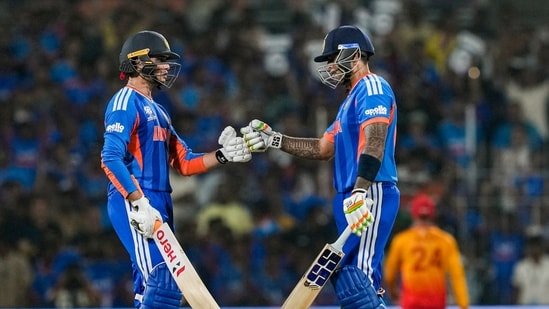
After the embarrassing low came the exhilarating high. Within 96 hours of being bowled out for their second-lowest total in all T20 World Cups, India produced the second-highest total in the history of the tournament in a statement-making display that wouldn’t have gone unnoticed.
The big one India were capable of, but proved doggedly elusive, eventuated at the MA Chidambaram Stadium in Chennai on a warm Thursday night, with a hapless Zimbabwe feeling the full fury of their batting might. Having conceded 254 to West Indies on Sunday, Sikandar Raza’s men were again punished for their temerity in fielding first for a second game in succession, India’s top six all scoring at more than 150 runs per 100 balls faced, with Sanju Samson’s 24 as numerically the smallest individual contribution in a commanding tally of 256 for four.
The thing about numbers is that they can be used for convenience. Samson’s might have been the lowest score among the six batters who took guard, but in a lot of ways, it was among the more significant for two reasons: a) India didn’t lose a wicket off the first over of their innings for the first time in four outings and b) After five abortive attempts, India finally had an opening partnership of reasonable substance.
Before Thursday, India’s highest opening salvo was 25 against Namibia in New Delhi, where they amassed 209 for nine. That was between Ishan Kishan and Samson, who was filling in for the unwell Abhishek Sharma, watching the action from his hospital bed after being laid low by a stomach infection. Once passed fit, the left-handed Abhishek reclaimed his rightful place at the top of the batting order, but efforts of 0, 0 and 15 and a hat-trick of first-over dismissals of left-handed openers by off-spinners meant India had to shake things up before the must-win game against Zimbabwe.
Samson’s right-handedness became his greatest virtue as India consciously rejigged their batting order, but did so without sacrificing their natural grain. In a brilliant and well-intentioned move, the think tank continued to back Abhishek by asking Kishan to bat at No. 3 and pushing Tilak Varma down the order to No. 6, behind Suryakumar Yadav and Hardik Pandya. Tilak had honed his skills at the most optional of net sessions on Wednesday – attended, apart from him, by only Varun Chakravarthy – and was immediately up for the challenge as much as Kishan was at No. 3, a position he occupied for seven innings in a row on his recall to the Indian team last month after 26 months in the wilderness.
On Sunday night in Ahmedabad, chasing 188 for victory after South Africa recovered from 20 for three after four overs, India imploded spectacularly, being rolled over for 111. In the three full days between matches, India planned studiously, but they also watched videos of their dominant batting displays from the previous year, when they struck terror into the hearts of every opposition. Tilak revealed later that almost without thought, he had lapsed into semi-defensiveness after coming in in the first over for three games on the bounce. The audio-visual display pieced together by the video analyst, he acknowledged, freed him up mentally, adding that head coach Gautam Gambhir had also driven home the importance of staying positive and upbeat if the batting had to regain its fearsome mojo.
Shackled as they had been as much by their mindset as by the game situation and pitches that weren’t absolute belters, India broke free in stunning fashion, the most heartwarming effort being Abhishek’s return to run-scoring ways in the form of a maiden World Cup half-century. Coming off bowler-friendly surfaces in Sri Lanka, where they finished top of their group, Zimbabwe had been given a harsh reality check in Mumbai by the free-spirited West Indians. That shellacking, they must have been convinced, was the worst they would endure in the competition, but they were to be proved terribly wrong by India, who smashed 17 fours and 17 sixes in 20 overs of unbridled aggression. A remarkable 15 of the 20 overs yielded at least 10 runs each, such was the ferocity of the Indian approach.
When the top order fires
Maybe wisdom dawned late on its own; maybe it was the result of their timidity and limpidness against the Proteas. Whatever the reason, this was India at their majestic attacking best. There were no half-measures, no holding back, no bedding oneself in. Samson did the early running with a six in each of the first two overs, after which he took off the bigger pads – he swapped them for the smaller, wicketkeeping ones later in the night – and soaked in the entertainment offered by Abhishek and Kishan, his captain and Tilak and the behemoth Hardik Pandya, whose ball-striking is as clean as anyone else going in world cricket.
The sole block when there was a slight dip in momentum was between overs 7 and 10, when only 29 runs came in the 24 deliveries sent down in tandem by offies Raza and Brian Bennett. In a way, it was understandable, given the wrecking ball that brand of bowling has come to resemble for India at the World Cup. After that, the onslaught was sustained and unending. Richard Ngarava, one of Zimbabwe’s bowling stars in the tournament, went for 62 in his four overs. At the same time, Tinotenda Maposa, the medium-pacer brought in for leggie Graeme Cremer in what Raza termed a ‘strategic move’, was pummelled for 40 in two.
Hitherto having barely got out of third gear, India entertained and enthralled, but also immensely enjoyed themselves. The spring is back in their collective batting stride; the smiles are broad and infectious; the joie de vivre is all too evident. India didn’t go from the best to a bad outfit after one forgettable batting night, but they have quickly transported themselves from slightly self-doubting to more enlightened and expressive. With a virtual quarterfinal against West Indies beckoning, there couldn’t be a more encouraging development so far as skipper Suryakumar and head coach Gambhir are concerned.
