


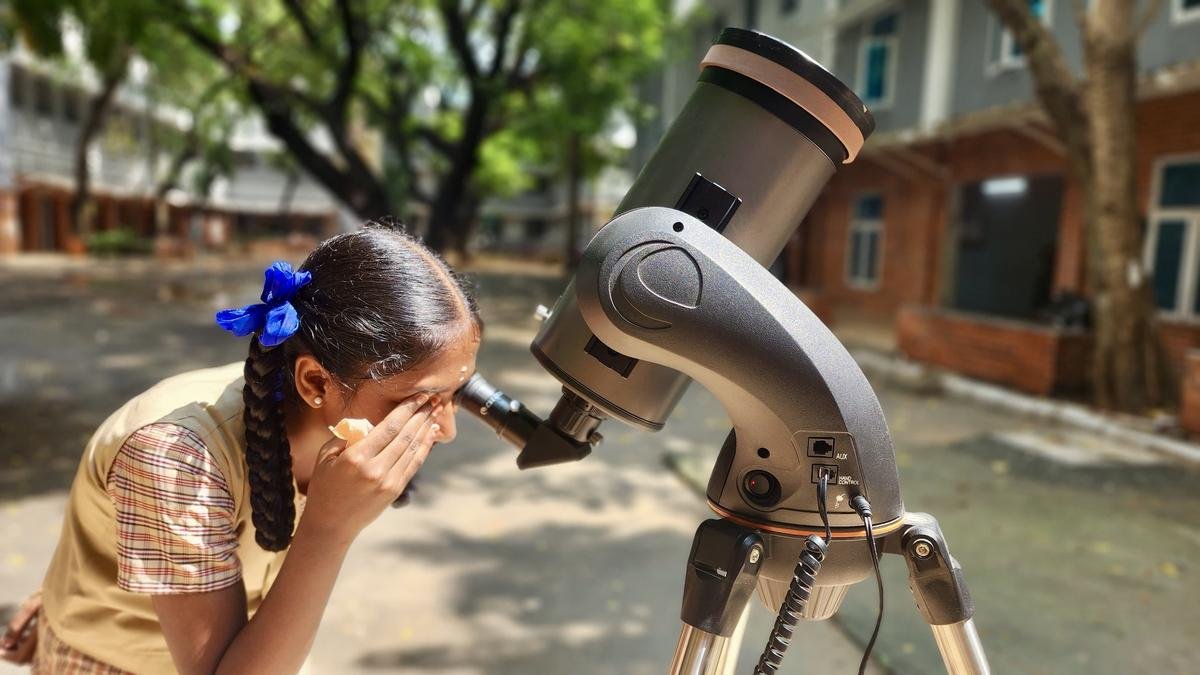
More often than not, in the larger Indian context, students learning science at school follow a formulaic manner of engaging with the subject. There is a strict syllabus, way of learning, way of grading that learning, and even an inquisition that’s tied to viewing science as merely an academic subject. Those of you sitting in schools right now who genuinely love science might have already felt this. The scenario regrettably ends up as a tired, ho-hum, half-lidded condensation of how the expression of science is actually felt.
In 2016, two science enthusiasts from Coimbatore noticed this gap and embarked on a journey under the name “Mango Education”, to build up a true scientific temper. In the words of one of the co-founders of Mango Edu., Mr. Obuli Chandran, the intention was poetic with a tinge of foreshadowing — “to make kids fall in love with science and give them a sense of a different perspective”.
Realising that a proper team was needed to tackle this concern, the blueprint was set.
Today, Mango education operates and collaborates with private and government schools in Coimbatore and Chennai and has as many as 600 to 700 children studying with them every year!
Incipience of Mango
What is Mango education? Founded in 2016 by Obuli Chandran and Arumugam Sankaran, Mango Education is a Coimbatore-based organisation, or rather a team of 12 (right now) well-trained educators, promoting astronomy. They work with schools for running astronomy courses and conduct many science-related events in Chennai and Coimbatore. They are popularly known for their various science-based expeditions focused on astronomy and wildlife throughout India for students.
Who is teaching? A versatile group of people qualified from different science backgrounds such as physics, computer science, electronics, engineering, etc. who were trained as a team of educators to teach astronomy under Mango Education.
The stage is all set for the night sky.
Today their flagship programme is astronomy but that wasn’t always the case! Srilakshmi N, astronomy educator and head of Chennai operations at Mango Edu., explained, “10 years back, the primary aim was to impart subjects that are not taught in the conventional school syllabus. So, it (Mango Education) initially started off with subjects like baking, carpentry, etc.” Mr. Obuli calls this the experimentation phase. A course at the time from Mango called ‘Science of Angry Birds’ taught projectile motion by letting kids play the angry birds game. “We were experimenting with a wide variety of things”, he said.
This of course wasn’t highly viable for a startup. “When you have too many courses, getting enough kids for every course is a challenge”, Mr. Obuli remarked. This shifted Mango’s approach and converged Mango’s visions towards the one domain it flaunts — ASTRONOMY.
The Mango approach
“When we started Mango itself, we realised that the way science has been taught is something that we were not okay with, in the sense that science has always been about just a bunch of facts — as simple as the sun rises in the East or be it about evolution. Science is adaptive to change, evolves, and keeps going. But we hardly talk about how those facts were arrived at. What were the thought processes involved? ”, mentions Mr. Obuli. “There is a history to science. It involves a lot of storytelling and therefore it involves putting our children through the minds of those scientists.” Mango Education’s teaching approach to science heavily relies on conversations with kids, prompting them to think on their own. Mr. Obuli ushers in an example. “If you were somebody looking at the apple falling down or the moon going around, what would you have come up with?”
A collage of the recent total lunar eclipse captured by the Mango team from the skies of Chennai.
This was enlightening and no sooner, Mango’s classes in their early years became a parent-favourite. Yet ironically, some parents were asking a question maybe we are all too familiar with — Would Mango also coach the kids to get better marks in the exam? Mango was and still is very clear on that matter. By making children ‘fall in love’, Mango’s responsibility is to push them to be self-learners. Marks will procure itself.
There is a history to science. It involves a lot of storytelling.
“We encourage kids to be curious and flexible thinkers. It will help the child grow and learn to question the world around them. It develops their sense of imagination, creativity and rational thinking. We feel that regardless of whether a child takes up science as a career or not, these are all basic tools, cross–domain skills, that should go in anybody’s life”, added Srilakshmi. In fact, this is also the core idea at play when the Mango team conducts their routine expeditions and events.
To the stars and back
Mango education wants to make astronomy relatable to you, your friends, your parents, even your neighbours. This means that celestial events, like a planet’s opposition or eclipse, become key, setting Mango Education’s wheels on the ground. Their range extends from doing public outreach events (in Chennai and Coimbatore), stargazing nights for schools, to full-blown expeditions, even in Ladakh.
“This year alone, we have taken 400 children to expeditions, 400 kids across different schools to Mudumalai, Kodaikanal, and Ladakh. We go to Ladakh every year”Obuli Chandran
The predecessors of the current astronomy expedition programmes that Mango undertakes are the science and wildlife-based trips and research institute visits that were conducted as far back as 2018. Mango has taken kids to IISC (Indian Institute of Science), Kodaikanal Solar Observatory, Mudumalai forest, Sriharikota facility in ISRO, Vainu Bappu Observatory, Western Ghats, etc.
At Hanle, Ladakh.
The astronomy expedition to Ladakh at the Hanle Dark Sky Reserve has become a flagship for Mango. This year, they are going again in June!
Note: Gadgets are banned in these expeditions. Instead, board games, music and campfire take the main role.
“There’s a sense of fulfilment”, rejoiced Srilakshmi, when hundreds of curious people, from 8-year-old kids to 80-year olds, turn up in Chennai when they do public outreach events.
Bridging the gap using astronomy
“Our pedagogy is to teach astronomy through its fundamental pillars — Physics and Mathematics”, Srilakshmi said. This is where Mango Education encounters a challenge. A lot of students dread maths. Srilakshmi notes, “You have trigonometry, geometry, you know and they don’t relate to where it is applied”.
For Mango Education then, the solution lies with the way they teach Astronomy which naturally utilises and applies many mathematical concepts. “Even to find the distance to a star, it’s sometimes basic geometry that is being used”. The more students interact with physics and maths this way, further closes the gap between textbook learning and applied learning. Astronomy’s linchpin which is a sublime shift in perspective (recalling Mr. Obuli’s words about Mango’s original intention) thus becomes fruitful.
At an expedition.
Mango in Schools
Until 2022, Mango Education was running privately. During COVID, much like others, the company which was heavily reliant on physical interactions with people took a hit. It was in 2022, when things were starting to get normal, that Mango education started to work with schools.
Mango teaches astronomy courses in private schools. They also collaborate with government schools to do various science programmes. During Chandrayaan landing in 2023, Mango worked with the Corporation of Chennai to teach the government school children all about Chandrayaan.
Mango now hopes to connect more directly to people and also to more schools across Tamil Nadu, beyond Coimbatore and Chennai, making astronomy possible even from our skies.
