


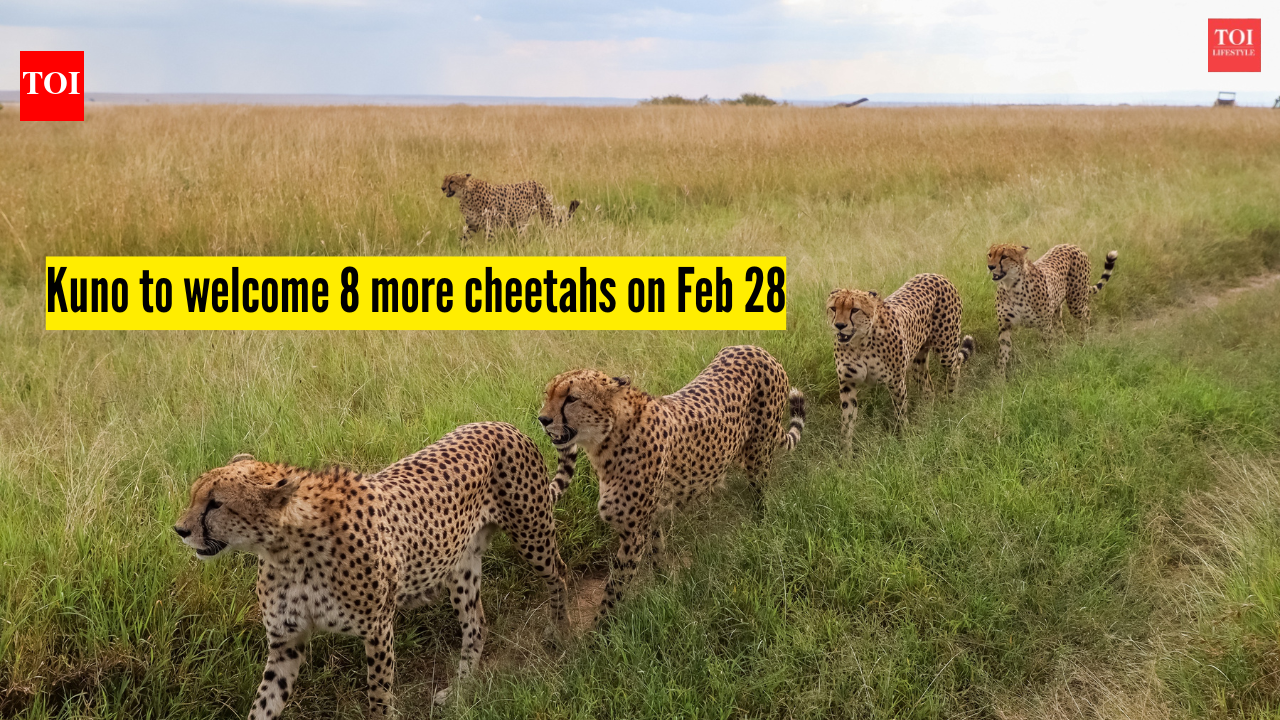
India’s ambitious cheetah reintroduction programme is set to enter another phase, with eight more African cheetahs scheduled to arrive at Kuno National Park (KNP) in Madhya Pradesh on February 28, as per PTI. With this third translocation, the total number of cheetahs in India will rise to 46, officials confirmed. The incoming batch from Botswana will include six females and two males. According to Madhya Pradesh Principal Chief Conservator of Forest (Wildlife) Subharanjan Sen, the animals will be flown to Gwalior aboard an Indian Air Force (IAF) aircraft before being transported by helicopter to Kuno National Park at around 9:30 AM on February 28.
Canva
This marks the third international transfer under Project Cheetah, India’s first intercontinental translocation of a large carnivore. The programme began on September 17, 2022, when Prime Minister Narendra Modi released eight cheetahs from Namibia into Kuno to mark the 75th anniversary of India’s Independence.To bolster the first population, a second group of 12 cheetahs arrived from South Africa in February 2023.
An expanding population
In addition to adapting to Indian conditions, the cheetahs have started reproducing since their arrival, which is a significant step towards the long-term viability of the initiative. The first cheetah births on Indian soil in over 70 years have been documented at Kuno with several cubs born in India. Just days earlier, on February 7, 2026, Aasha, a Namibian cheetah and now a second-time mother, gave birth to five cubs.
Canva
On February 18, 2026, Madhya Pradesh Chief Minister Mohan Yadav announced that a South African cheetah, Gamini, delivered three cubs at Kuno National Park. This litter took India’s overall cheetah population to 38. The Asiatic cheetah went extinct in India in 1952, primarily due to hunting and habitat loss. In addition to improving biodiversity management in the forest landscapes of central India, the reintroduction effort seeks to return the species to appropriate grassland ecosystems. However, this has not been achieved with ease. Apparently, several adult cheetahs have lost their lives since the initiation of this project, due to a variety of reasons including diseases and infections as well as territorial fights. Wildlife authorities have stated that mortality is not unexpected in reintroduction programmes and that adaptive management strategies have been implemented to address emerging concerns, including changes in monitoring protocols and enclosure management.Read more: Snakes swimming in the flooded streets of Bali? Scary vidoes shock travellers
Quarantine and monitoring
Cheetah Project Field Director Uttam Sharma said that special enclosures have been prepared at Kuno to receive the Botswana batch. Upon arrival, the animals will remain in quarantine for approximately one month. During this period, veterinary teams will monitor their health, diet and adaptation before gradually releasing them into larger acclimatisation enclosures and eventually into the wild. The quarantine process is a standard part of international wildlife translocations and is designed to ensure disease screening, stress management and behavioural adjustment in a new habitat.Read more: “Not eligible this time”: What led to this Indian couple’s US visa rejection despite having FIFA pass
Expanding landscape
Kuno National Park, situated in the Sheopur district of Madhya Pradesh, has been chosen as the main location for the reintroduction because of its prey species, grassland habitat, and relatively low human pressure in the core areas. The national park has also seen habitat restoration work carried out over the years to favor the big cats. However, the Gandhi Sagar Wildlife Sanctuary has also come up as a second landscape for cheetah expansion. Currently, the sanctuary holds a South African male coalition and a female, which indicates the project’s aim to establish multiple viable populations in the long run. With the arrival of the Botswana batch, conservationists are also hoping that the enhanced genetic diversity and the higher number of females will help improve the chances of breeding and population establishment. As India’s cheetah count rises to 46, Project Cheetah continues to draw global attention as one of the world’s most closely watched conservation experiments.
