


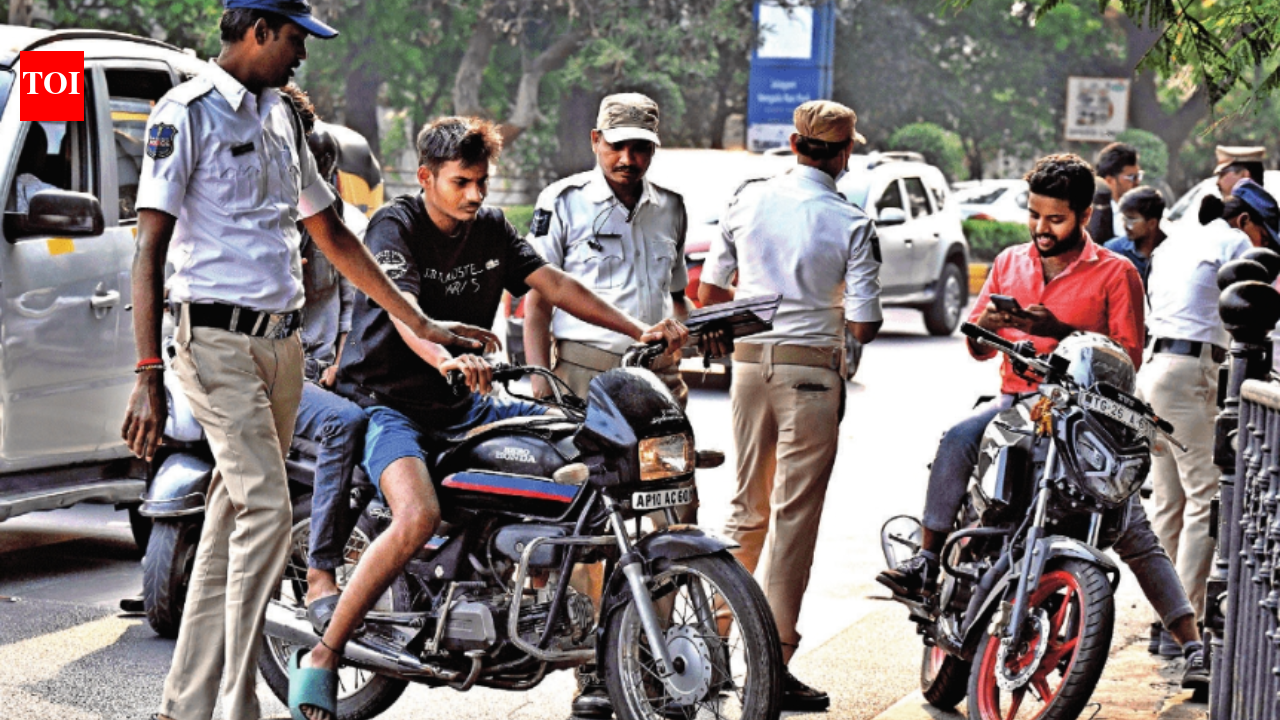
With 90 lakh vehicles on city roads and over 1.3 crore traffic challans worth Rs 500 crore issued in 2025 alone, Hyderabad’s enforcement numbers have now surpassed its vehicle population, triggering questions about whether the city’s challan system has improved road discipline or merely multiplied penalties.As challan volumes continue rising, the debate is shifting from enforcement quantity to enforcement quality, and whether the system is delivering deterrence or simply inflating penalty counts.Despite the high numbers, experts have raised concerns about monitoring and transparency of the e-challan framework, pointing to the absence of an independent audit mechanism to periodically review how violations are recorded, processed, and enforced.“The practice of traffic personnel capturing images of violations using mobile phones and uploading them into the e-challan system needs clearly defined SOPs. There is also no publicly accessible dashboard showing how many challans are issued, paid, pending, or what enforcement steps are taken against chronic defaulters,” said Vinod Kanumala of the Indian Federation of Road Safety.
Experts cautioned that without notifications and secure data protocols, such practices may raise questions about procedural validity and privacy safeguards. Without audits and transparent reporting, the system risks being perceived as a revenue-generation mechanism rather than a deterrence tool.On multiple occasions, the Telangana high court has pulled up traffic police, seeking clarity on devices used to capture motorists’ images for e-challans. The court also made clear that police cannot stop vehicles or compel on-the-spot payments, snatch keys, confiscate vehicles, or restrain motorists to force payment.Flawed enforcementDheerendra Samineni, road safety expert and founder of Safe Drive India, alleged that the current enforcement model is flawed. “Generating challans appears to have become a business. How can police generate challans by hiding around trees on stretches like the Outer Ring Road? That raises privacy concerns. On many roads, speed limits are not clearly displayed. It is the duty of the police to install proper cameras and signage boards,” he said.He pointed out that schemes offering 70% discounts on challans weaken enforcement. Many motorists assume they can settle fines later at discounted rates, diluting the deterrence effect of penalties, he added.Recovery rate hardly 40%On the other hand, police officials admitted that the recovery rate of challans is below 50%, indicating many penalties remain unpaid. “Generating challans is not our intention. Our objective is ensuring motorists follow regulations and improve discipline.There is a need to strengthen technological enforcement by installing more automatic number plate recognition cameras and advanced CCTV systems to minimise human intervention, improving accuracy and compliance,” said Ranjan Rathan Kumar, DCP (traffic), Cyberabad.Adding to the concern are over 50,000 wrong challans reportedly issued last year, raising questions about accuracy of automated enforcement. A common issue involves misreading number plates. Police attributed such errors to ANPR limitations and occasional glitches in retrieving vehicle data. Unclear or damaged plates, similar combinations, and poor lighting can result in incorrect tagging.However, officials maintained the error rate is minimal, with nearly 99.5% of challans accurate, and grievance mechanisms available online or at traffic offices.MV Act 2019 a deterrent?Amid rising violations, police said stricter enforcement is key to improving road discipline. Central to the debate is the Motor Vehicles (Amendment) Act, 2019, which enhanced fines for multiple offences. While several states, including Karnataka, Kerala, Odisha and Gujarat adopted higher penalties, Telangana chose not to enforce the steep structure, prompting recurring questions: would sharper fines deter violations? “Increasing the cost of violations can act as a strong deterrent. However, technology has to be backed strongly in rolling out contactless enforcement. Though there are ANPR cameras at crucial junctions, we have proposed more equipment,” said VC Sajjanar, city police commissioner.Experts cautioned penalties alone may not suffice; enforcement must drive behavioural change, drawing from countries with stronger safety records. “Point-based licence suspensions linked to insurance premiums would deter repeat offenders better than one-time fines,” said TS Reddy, a transport planning expert.How global cities are implementing challan systemsDubaiThis Middle East city uses a automated traffic enforcement ecosystem combining radar, speed cameras, red-light cameras and smart sensors to detect violations such as speeding and signal jumping. Violations are digitally recorded and linked to the vehicle plate, driver’s licence, Emirates ID. Many offences also carry black points on the licence; accumulating excessive points within a specified period can result in licence suspension or vehicle impoundment.SingaporeThe city follows a hybrid enforcement model that combines automated detection with on-ground officer enforcement. The system includes speed and red-light cameras, electronic road pricing (ERP) gantries, bus-lane cameras and illegal-parking surveillance. The country operates the Driver Improvement Points System (DIPS), where repeat or serious offences attract demerit points in addition to fines. Accumulating 24 points within 24 months can lead to licence suspension or revocation. Traffic fines must typically be paid within 28 days of notice, ensuring high recovery and compliance.OsloThis city in Norway has an extensive automated enforcement network, including fixed speed cameras and average-speed control systems that monitor vehicle speed over road stretches rather than single points. Violations are electronically recorded, while police may also issue fines. Norway follows a strict penalty-point system. Accumulating 8 points within three years can result in licence suspension. Fines are high; offences like signal jumping, unsafe overtaking can attract penalties ranging from Rs55,000 to Rs 95,000 along with points.StockholmIn this Swedish city, automated cameras capture violations such as speeding and red-light running, after which police authorities review the photographic evidence to confirm the driver’s identity before issuing fines. Notices are mailed to the registered vehicle owner with a specified payment deadline (often up to 90 days for minor offences). Failure to pay leads to reminders and eventual escalation to the Swedish Enforcement Authority, with additional charges, ensuring strong legal backing and recovery efficiency.TokyoThe Japanese city relies on advanced automated enforcement for multiple violations. When a camera detects an offence, a notice is sent to the registered vehicle owner, and in some cases the driver must report to a police station. If fines are paid within the stipulated period (seven days), the case does not proceed to court. Japan operates a cumulative driver demerit point system over a three-year period — 6 to 14 points can trigger licence suspension, while 15 or more may lead to revocation.
