


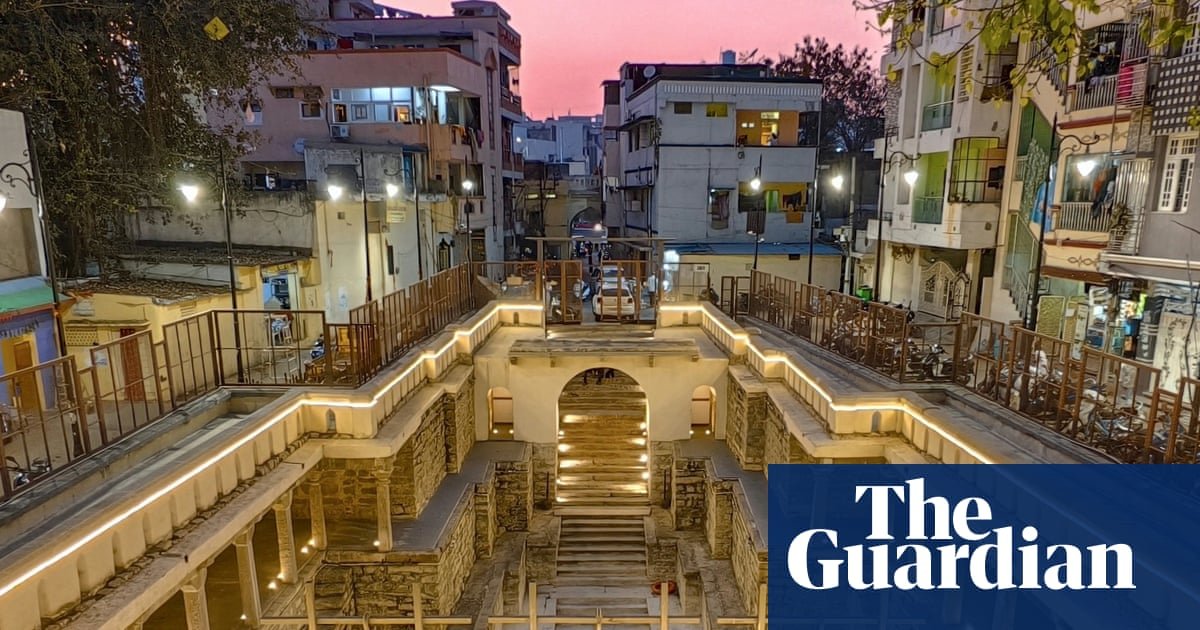
A loud cheer and sounds of clapping reverberated around Bansilalpet, a neighbourhood in Hyderabad, when the first trickle of clean water dribbled out of the ground. After an 18-month effort to clear out 3,000 tonnes of rubbish and restore the stone walls and adjacent area, the 17th-century Bansilalpet stepwell had become a source of clean drinking water for the first time in four decades.
“It was such a joyous moment to see water collecting into the stepwell after clearing 40 years of garbage,” says Hajira Adeeb, a 45-year-old resident of Bansilalpet, who grew up seeing the well become transformed from the community’s water source to a dumping ground. “I visit almost every day. The area is clean and lit up in the evenings. I enjoy sitting there.”
India is famed for its stepwells – multi-storey structures built to provide access to groundwater, with steps and platforms descending to the water level. Thousands were built across the country near natural aquifers – underground porous rock saturated with water – mostly between the 11th and 18th centuries.
The wells were abandoned under the rule of the British, who considered them unhygienic and largely prohibited their use, and deteriorated further in the late 20th century when people started to use them as a place to discard rubbish.
While many wells have disappeared or crumbled, the Stepwell Atlas, a collaborative effort between researchers and organisations including the Indian National Trust for Art and Cultural Heritage (Intach), lists more than 3,000. About 100 are in the southern Indian state of Telangana, with nearly half of these in the state’s capital, Hyderabad.
Stepwells range widely in size and architectural detail, and some of the biggest and most striking have been restored. Among the best-known examples are the 9th-century Chand Baori in Abhaneri, Rajasthan, which has 3,500 steps cascading down the sides of an enormous central tank in an intricate crisscross pattern; the Unesco-listed Rani-ki Vav in Gujarat, with ornately covered tiers and thousands of sculptures of Hindu gods and goddesses; and Agrasen-ki Baoli, a 60-metre-long well in the middle of a Delhi street.
But these are heritage sites, popular with domestic and international tourists – and in the case of Chand Baori, Bollywood film directors – and they do not provide usable water. Of the thousands of stepwells that have fallen into disrepair, only a small number have been restored for their original purpose: providing water for domestic and local use such as washing, cleaning and gardening; fewer still provide drinking water.
The well at Bansilalpet was the first of its kind in Telangana to do so and has become a template for the revival of other stepwells in the state. Since its restoration was completed in December 2022, the well has consistently maintained a water depth of nine metres (28ft) in the summer months.
The transformation is thanks to the architect Kalpana Ramesh, who has now revived 25 stepwells in the state as sustainable sources of water, with the support of Telangana’s Municipal Administration and Urban Development Department, and the Rainwater Project, a social enterprise she co-founded.
Ramesh has been harvesting rainwater in her own home for domestic use for 15 years, so she does not have to rely on the tankers that sell water to her neighbours.
“I was sure that the system of harvesting rain to recharge groundwater would work on a larger scale, even today when the built-up area in cities has left very little natural ground for rainwater to seep in,” she says.
To date, Bansilalpet is the only stepwell in Telangana to provide drinking water, but Ramesh hopes to raise enough funds to equip all 25 wells with additional filtration systems to make the water safe to drink. “If the water from all the stepwells became potable, it would then encourage people to preserve these systems,” she says.
India is facing the worst water crisis in its history. It is home to more than 1.4 billion people – nearly 18% of the world’s population – but has only 4% of the planet’s fresh-water resources.
More than 600 million Indians already face high-to-extreme water stress, and the country’s water demand is projected to double by 2030. Erratic monsoon patterns, inadequate infrastructure and the expansion of water-intensive crops mean India is heavily reliant on groundwater, consuming a quarter of the global total.
According to India’s Central Ground Water Board, over-exploitation of groundwater means the states of Punjab, Haryana, Delhi and Uttar Pradesh in northern India, Rajasthan and Gujarat in the western states, and Tamil Nadu, Karnataka, Andhra Pradesh and Telangana in the south are heading towards zero water availability, known as “day zero”.
The Telangana government is taking a multipronged approach to the state’s water scarcity crisis, including about 500,000 rainwater-harvesting projects, plans to supply grey water to datacentres, rejuvenating the Musi River, desilting the Sriram Sagar reservoir to restore its capacity to 3,172 million cubic metres and imposing hefty fines for wasting drinking water.
Stepwells were built in open areas where the natural gradient of the ground allowed rainwater to seep in and replenish the underground aquifers. Today, however, with concrete construction and asphalt roads preventing rain from soaking into the ground, surface water needs to be captured and directed into underground channels and trenches.
The collected rainwater passes through filters made of layers of sand, gravel, pebbles and boulders to drain into recharging pits. The filtered rainwater replenishes the natural aquifers, giving the community free, accessible and clean water, even during dry summers.
While the stepwells help with the availability of shallow groundwater, a whole transformation of the water ecosystem – including clean ponds, lakes, rivers, rainwater-harvesting systems and community engagement – is needed to bring about significant change.
Pandith Mandure, who was the director of Telangana’s ground water department when the Bansilalpet restoration started four years ago, says: “In two years, from 2021 to 2023, there was a noticeable rise of six metres to seven metres in the level of groundwater in the Hyderabad region due to measures like clearing lakes, drains, recharge shafts [larger boreholes that penetrate deep enough to reach aquifers] and restoring stepwells.”
Ramesh, through the Rainwater Project, is encouraging local people to keep clean any bodies of water – such as ponds, streams and rivers – that are close to stepwell projects. “Rainwater should not be allowed to go in drains,” she says. “There is enough potential to make rainwater work for cities.”
