


Sitanshu Kotak was calmness personified at the batting crease when he used to carry the Saurashtra batting on his broad, overburdened shoulders. He wasn’t the prettiest left-hander, not by a long way, but he had the chops. The stomach for battle. The burning desire to maximise his abilities. The temperament to stand up to the fiercest, fieriest and the craftiest, look them in the eye and almost bore them into submission.
Time, and retirement, have hardly altered his outlook to life. The Indian team’s batting coach is still as unflappable, positive and pragmatic as he was at his prime as a stodgy, unyielding batter. That’s exactly what the team requires right now, after having played itself into a corner following its first horrendous night in a 20-over international in seemingly forever.
The inopportune timing of their loss to South Africa on Sunday must hurt, because it has left Suryakumar Yadav’s men with four must-win matches if they are to emulate the feat of Rohit Sharma’s Class of ’24. The first of those looms at Chennai’s MA Chidambaram Stadium on Thursday, with overachievers Zimbabwe as their opponents.
Undone by one African nation, India have no choice but to put it past another if they are to remain in the race for the semifinals. It’s a prospect that was unimaginable two and a half weeks back, when they carried justified overwhelming favouritism into the tournament. A 76-run hammering in the league stage would have been embarrassing, but not decisive. In the Super Eights, any defeat, and especially one by such a massive margin, will inevitably take one’s fate away from their own hands.
Pressure mounts, but panic is not the plan
Unaccustomed to being in such a situation – India had strung together a 17-match winning streak in ICC tournaments between the start of the 2024 T20 World Cup and last Sunday – it’s more than likely that the nerves will be jangling. Suryakumar will be feeling the heat, but not as much as head coach Gautam Gambhir, whose report card already has more red than green. India did win the 50-over Champions Trophy and the T20 Asia Cup with Gambhir in charge in the last 11 and a half months, apart from managing a creditable 2-2 draw in a five-Test series in England last summer. But they have also been soundly beaten twice at home in 12 months in Test cricket – 3-0 by New Zealand in November 2024 and 2-0 by South Africa exactly a year later, those results sandwiching a 3-1 rout in Australia.
Jangling nerves isn’t such a bad thing because it shows that you care. As Kotak sagaciously pointed out, even when he played a district match, he felt anxiety and butterflies in the stomach. It’s how one manages the tension – pressure, if you like – that is most important.
Pressure is a constant in the kitbag of an Indian cricketer, much like one’s leg guards, batting gloves, the helmet and the box. Some thrive in it, revelling in being presented with the opportunity of responding to a crisis. Others develop feet of clay, become addled in their thinking, lose sight of the larger picture, are overcome by stage fright. India’s cricketers are used to the weight of expectations, be it in the country’s blue or while donning the colours of their respective franchises, and they know what it takes to bounce back.
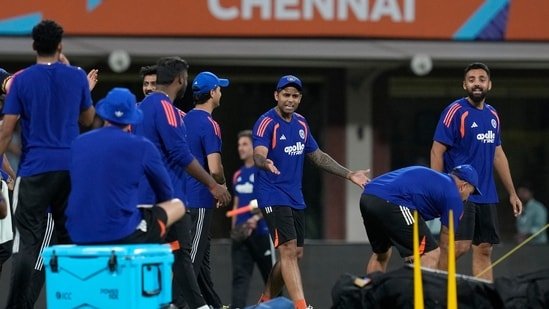
There was an air of calmness and purpose about their extended training session at Chepauk on Tuesday night. What was pencilled in as a three-hour stint spilled over to four; Rinku Singh was absent as he had flown home to visit his ailing father, but all the other 14 were in attendance, going about their business as if it was just another practice session, not the final full-strength stint ahead of a crucial clash.
Kotak said not too much should be read into the fact that Sanju Samson was first into nets with Ishan Kishan. Samson has suddenly emerged as the potential ‘saviour’, given Abhishek Sharma’s horror run. Abhishek, who followed up three straight ducks with a woefully scratchy 15 against South Africa, was turning his arm over at the adjacent ‘net’ to Suryakumar and Tilak Varma, whose strike-rate too has been under focus. Tilak was one of only two players, alongside local lad Varun Chakravarthy, to hit the optional nets on Wednesday evening. At No. 3, he has had to walk in in the first over four times in this tournament, which has necessitated him to play with greater circumspection than he would have liked. Like the rest of his colleagues, Tilak was in his bubble on Tuesday. There was a bit of general horsing around, perhaps a little less than normal, but there was no indication that India were feeling the heat or that they have pressed the panic button already.
There is expected to be at least one change, if not more, for Thursday, but that shouldn’t be put down to a knee-jerk reaction. Strategically, after three successive outs in the first over with a left-handed opener falling each time to an off-spinner, India are contemplating changing things up and opening with a right-hander (Samson). There is also the possibility of vice-captain Axar Patel returning to the XI after being left out for the Ahmedabad outing on a tactical switch which backfired with Washington Sundar being reduced to a bit role.
India are experienced enough not to retreat into their shells, and Kotak, again in complete control, ruled out in typically disarming fashion the possibility of any wholesale changes in the style of play which has characterised their T20 dominance over the last 20 months. If the poise of the batting coach is reflective of the mood in the camp, there shouldn’t be a great deal of concern with regard to mindset and headspace. As for execution, that’s another matter altogether.
