


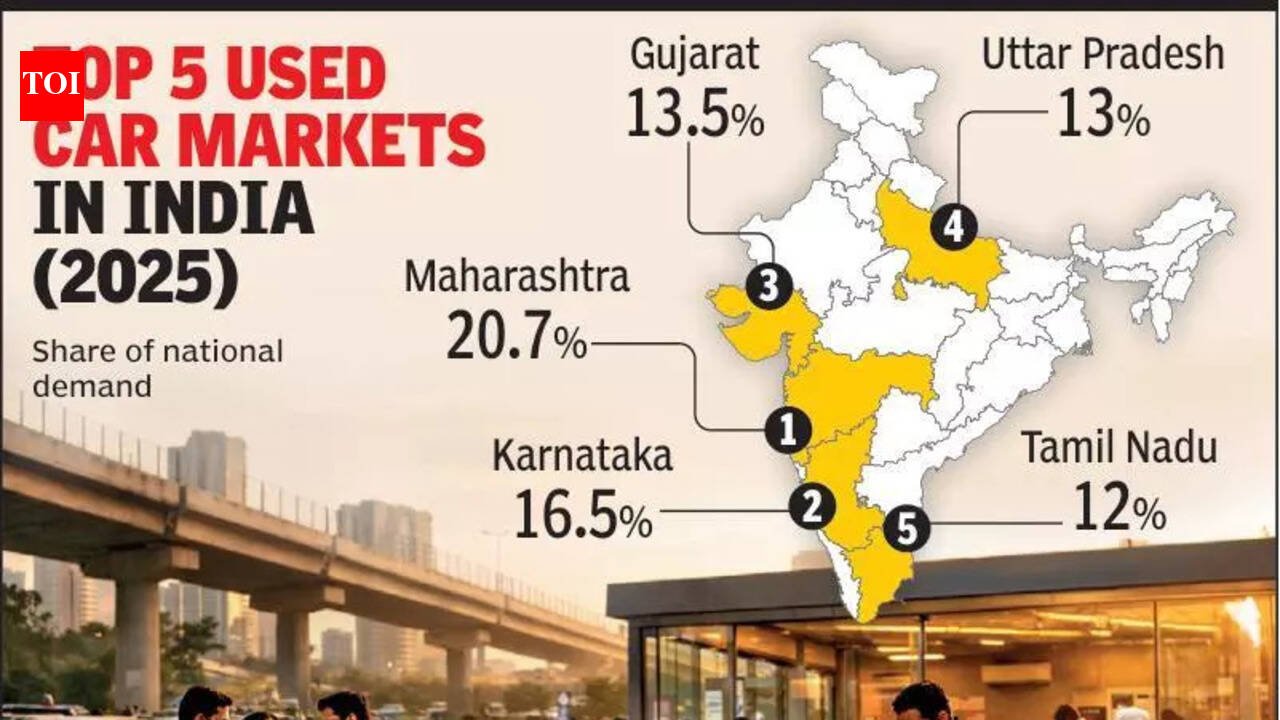
Ahmedabad: Gujarat has surged to become India’s third-largest used car market in 2025, accounting for 13.5% of total national demand, according to a market analysis by Cars24. The state now trails only Maharashtra at 20.7% and Karnataka at 16.5%, while moving ahead of Uttar Pradesh at 13% and Tamil Nadu at 12%.The rise has been swift, reveals findings based on a 2025 market analysis by Cars24. Gujarat’s share jumped from 8.7% in 2024 to 13.5% in 2025 — a sharp increase of 4.8 percentage points in a single year, one of the steepest gains among major states. Industry observers say this marks a structural shift, with the state transitioning from a supplementary market to a core demand driver.Dealers say the growth reflects clear on-ground trends. Pranav Shah, chairperson of the Federation of Automobile Dealers Associations (Fada) Gujarat, said nearly 40% of new car purchases now involve exchanges. “These are largely second-time buyers upgrading their vehicles,” he said. Rising new car prices over the past five years have nudged many consumers toward pre-owned vehicles as “a more affordable alternative”.A senior regional transport official said Gujarat’s robust new vehicle registrations naturally feed the resale ecosystem. “Around 40% of buyers upgrade to higher variants, ensuring a steady flow of vehicles into the second-hand market. Online platforms now command a significant share alongside traditional local dealers,” the official said.Districts such as Anand and Mehsana see additional churn from NRIs who buy vehicles during visits and resell them before returning abroad. “In many cases, first-time buyers begin with a used car and upgrade to a new one within a year or two. Interestingly, the second-hand car market is stronger in rural areas than in urban centres,” the official added.The market itself has evolved. Once dominated by local brokers and unorganised traders, Gujarat’s used car segment now includes organised platforms and manufacturer-backed certified programmes offering warranties and quality checks. Improved loan availability for used cars has narrowed the financing gap with new vehicles, boosting buyer confidence.Replacement cycles are also shortening. “While ownership earlier stretched longer, many buyers now replace cars within seven years, and in some urban pockets within two to three years,” Shah added. Business owners and members of the trading community — a key demographic in Gujarat — are among the frequent upgraders, often balancing image with practicality.
