


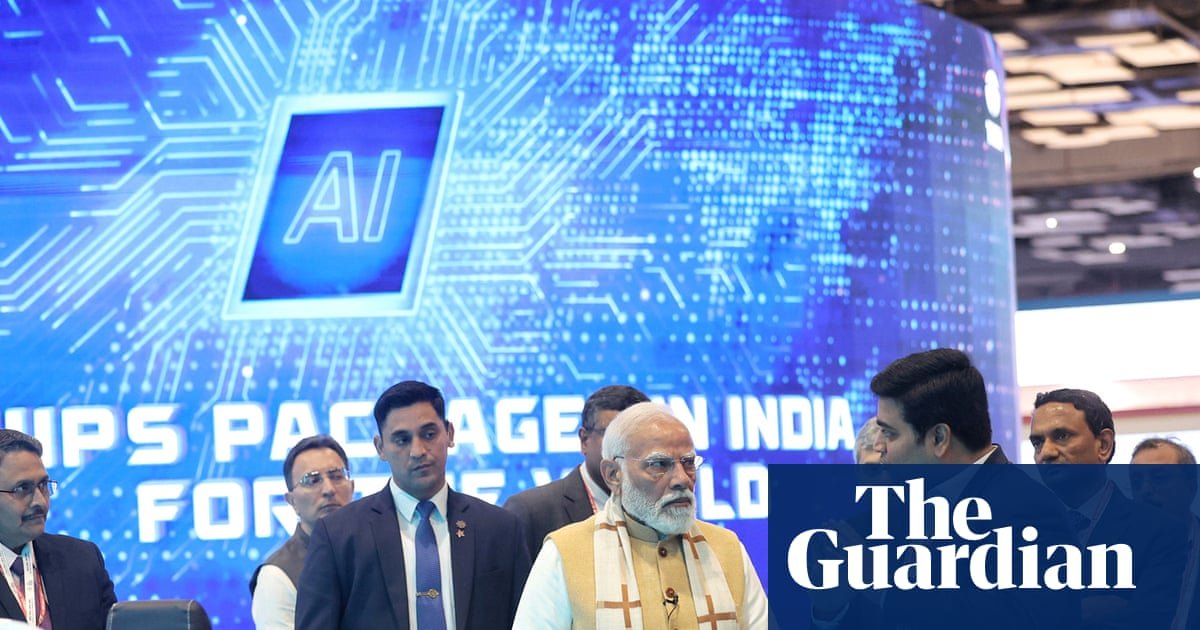
Hello, and welcome to TechScape. This week, we’re examining the tech industry’s push for influence in two places separated by a time difference of 13 hours and 30 minutes. The first is where tech sees its next big market, the second its home turf. My colleague Robert Booth reports from last week’s India AI Impact summit, where tech companies pledged to spend tens of billions in the coming year to build customer bases and datacenters in the subcontinent. Dara Kerr and Lauren Gambino reported from Silicon Valley, where billionaires are marshalling their wealth to influence California’s politics at greater levels than they ever have before.
AI in Modi’s India
India is seeking to position itself as the world’s third AI power behind the US and China, a desire that was on full display last week at the India AI Impact summit. The prime minister, Narendra Modi, expressed enormous enthusiasm for the technology at the conference in Delhi, likening it to “when the first sparks were struck from stone”.
At the summit, Modi laid out his vision for AI in India, arguing the world shouldn’t let the US and China dominate the AI race and that India shouldn’t accept American or Chinese hegemony in the space.
“We must prevent an AI monopoly. Many nations consider AI to be a strategic asset, and therefore it is developed confidentially and its availability is carefully managed.
“However, our nation India holds a different perspective. We believe that technology like AI will only truly benefit the world when it is shared and when open source code becomes available,” he said.
Presentations at the summit focused less on automation of white-collar work, as is hoped for and feared in the US and Europe, and more on applications that the tech companies argued could raise the prospects of India’s 1.45 billion people: predicting monsoons; automating medical diagnoses; increasing agricultural yields. Bill Gates visited a banana plantation where farmers use AI to spot disease and call in drones to spray pesticide. In an effort to tap into India’s national sporting obsession, Google even unveiled an AI cricket coach. (Gates’s appearance at the summit was brief. Amid ongoing attention to his links to Jeffrey Epstein, the Microsoft founder suddenly cancelled his speech.)
OpenAI’s co-founder paid lip service to Modi’s goal of sharing, even though his company famously shares little about its AI’s inner workings: “Democratization of AI is the best way to ensure that humanity flourishes. On the other hand, centralization of this technology in one company or country could lead to ruin … Some people want effective totalitarianism, in exchange for a cure for cancer. I don’t think we should accept that trade-off.”
Tech giants are spending heavily in India, whether they agree with Modi’s vision or not. OpenAI, Google and Anthropic all announced deals aimed at getting their bots into more Indian users’ hands. Google announced a $15bn investment in datacenters and subsea cables linking India to the US and other countries. In December, Microsoft committed $17.5bn to similar projects in the country, and Amazon declared it would spend $35bn on its own datacenters there soon after.
India’s huge online population presents a major opportunity for growing AI companies, which gives Modi leverage. The country already has about 1.4 billion people with a government-issued digital identity. More than 700 million have a digital health account, and about half a billion use the national digital payments system. About 800 million people have joined Facebook and WhatsApp, which gives Meta a leg up in distributing its generative AI products. Rishi Sunak, the former UK prime minister who now works for Anthropic and Microsoft, enthused about this “extraordinary” digital public infrastructure, which he described as the “rails where you can develop a product that can be distributed to a billion people”.
However, the country lacks the semiconductors, power plants and vast gigawatt datacenters to go it alone. In common with most other countries, it faces a choice between US and Chinese AI models.
The Trump administration, seeing AI as central to its battle for supremacy with China, has been clearing the path for US AI companies. The US government signed the Pax Silica at the Impact summit, a technology agreement that binds India closer to US tech and away from Beijing. US delegates to the summit framed the deal with India as an alliance of two nations that “broke centuries of colonial rule”, and as “two great democracies saying we will build together”.
On Wednesday, though, the White House’s senior AI adviser, Sriram Krishnan, renewed the Trump administration’s criticism of AI regulation, disagreeing with Modi but mostly taking aim at the EU’s AI Act. Krishnan told delegates he would continue to “rant” against legislation that was not “conducive to an entrepreneur who wants to build innovative technology”. France’s Emmanuel Macron used his time at the summit to vow to regulate AI and prevent “digital abuse” of children.
India appears unlikely to turn to China for now. Beijing has the AI models, but there are tensions on the Himalayan border, and Chinese companies and leaders were scarce at the summit.
In a more comical display of disunity, an attempt by Modi to stage a show of unity among leading tech billionaires went awry when Sam Altman and his rival, the Anthropic CEO, Dario Amodei, awkwardly declined to hold hands on stage. Modi stood at the centre of a line of 13 tech executives, including leaders from Google, Meta and Microsoft, who all raised clasped hands – apart from Altman and Amodei. Robert Booth
Reworked: A series about what’s at stake as AI disrupts our jobs
Billionaire buy-in in California
Silicon Valley’s billionaires are leveraging tens of millions of dollars to influence California politics in a marked uptick from their previous participation in affairs at the state capitol. Behemoths such as Google and Meta are getting involved in campaigns for November’s midterm elections, as are venture capitalists, cryptocurrency entrepreneurs and Palantir’s co-founders. The industry’s goals run the gamut – from fighting a billionaire tax that has already prompted some rich residents to flee the state to supporting a techie gubernatorial candidate to firing up new, influential super political action committees. Unlike other industries, such as oil and pharma, tech has been relatively tame when it comes to lobbying in the state.
“If you’re an uber-zillionaire, you give money early and often. They have more wealth and resources than they’ve ever had before, so that allows them to play on both sides of the aisle and up and down the ballot and across issues like never before,” said David McCuan, a political science professor at Sonoma State University who studies state lobbying.
Gavin Newsom, California’s tech-friendly governor who has been quick to veto legislation that cramps the sector’s unfettered growth, is reaching his term limit. That means Silicon Valley needs to find a new ally. The industry may have found its candidate in an upstart mayor from nearby San Jose, Matt Mahan.
Mahan’s infusion of cash will help him compete in a state where campaigns are enormously costly, but tech’s monetary support may not sway voters at a moment of skepticism of the industry and its billionaires. Voters are increasingly wary of AI, and datacenter growth has become a flashpoint in elections across the country. Mahan’s Democratic rivals are racing to paint him as Silicon Valley’s man in the race, betting that position will be more of a liability than an asset. One opponent, billionaire Tom Steyer, has pitched himself as a progressive foil to Mahan, arguing that he was uniquely positioned to take on tech billionaires and wealthy corporate interests. Another candidate, Democrat Betty Yee, has warned that a “billionaires’ boys club was trying to take over Sacramento”.
Meanwhile, the democratic socialist senator Bernie Sanders spoke to a sold-out crowd at the educational heart of Silicon Valley, Stanford University, over the weekend. He stood on stage beside Ro Khanna, whose congressional district encompasses part of Silicon Valley but who has embraced a proposed tax on billionaires in California that Newsom opposes.
Khanna told reporters on Friday that he was working with the union and tech leaders to come up with a compromise to the wealth tax proposal. Sanders and Khanna met with tech industry figures, though they declined to specify which ones, then took the stage at Stanford. Sanders has warned that Congress and the American public have “not a clue” about the scale and speed of the coming AI revolution, pressing for urgent policy action to “slow this thing down” as tech companies race to build ever-more powerful systems. Dara Kerr and Lauren Gambino
Read more: California’s billionaires pour cash into elections as big tech seeks new allies
Read more: ‘Slow this thing down’: Sanders warns US has no clue about speed and scale of coming AI revolution
