
Last Updated:
During the interview, President Parmelin emphasised that, without India, global AI will remain unequal
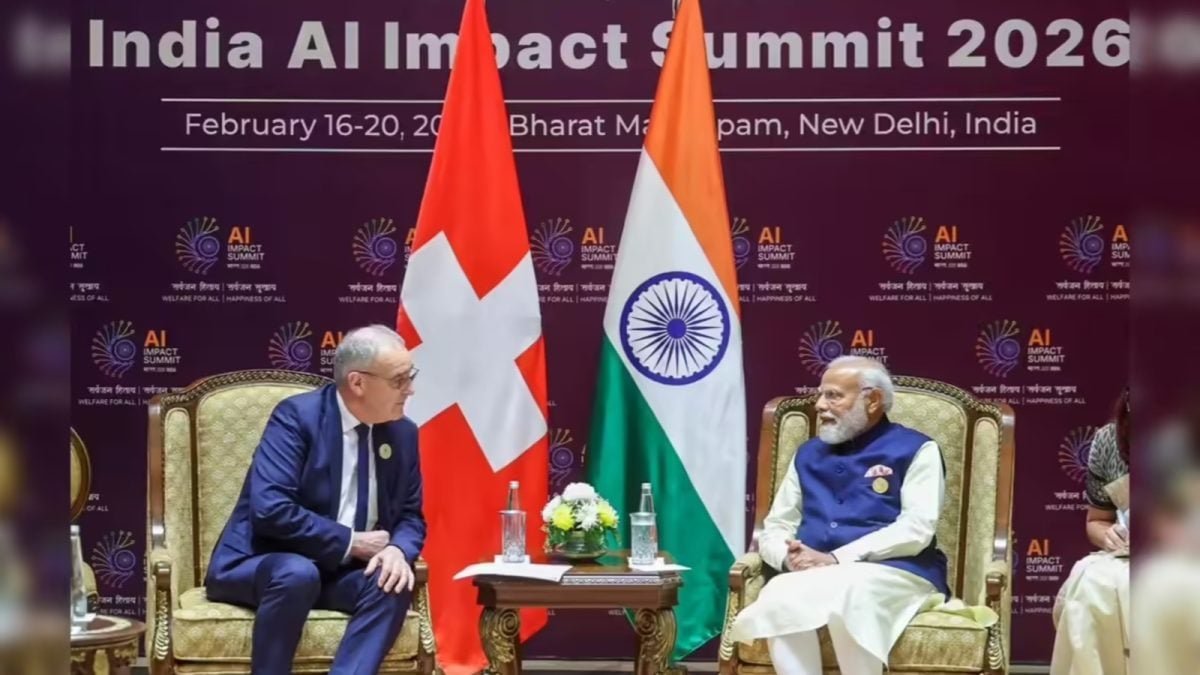
Swiss President Guy Parmelin said Switzerland is keen to build on the momentum created by previous AI summits, especially the landmark meeting in New Delhi. File pic/ANI
The AI Impact Summit in New Delhi brought together global political leaders, policymakers, and top technology executives for high-level discussions on the future of artificial intelligence, its governance, and its role in shaping economies and societies. Leaders and delegations from countries including Switzerland, Estonia, Spain, Finland, Bolivia, Greece, and several other nations attended the summit, alongside senior executives from global technology firms such as Google and OpenAI.
On the sidelines of the summit, CNN-News18 spoke with Swiss President Guy Parmelin, who outlined Switzerland’s vision for inclusive and trustworthy AI, highlighted India’s growing leadership role in shaping global AI cooperation, and spoke about the deepening economic and technology partnership between New Delhi and Bern.
Edited excerpts:
In a recent article, you frame AI as a force that must be made “more equal”. Yet critics say global AI governance discussions too often reflect Western priorities, not voices from the Global South. How will Switzerland ensure that AI policies shaped with India are genuinely global, not just Western-endorsed frameworks dressed up in consensus language?
Switzerland strongly welcomes and supports India’s push to build global cooperation on AI so that countries everywhere can develop, adopt, and deploy the technology in ways that genuinely benefit their citizens. Switzerland was closely involved in shaping the AI Impact Summit, contributing across all seven workstreams and co-chairing the group focused on empowerment and social inclusion. We firmly believe that AI must be democratised. That means making AI tools more affordable and accessible, ensuring systems can be scaled, replicated, and adapted across sectors, and investing in people by strengthening AI literacy, education, and skills. At the same time, Switzerland supports global efforts to promote secure, trustworthy, and resilient AI systems that are both efficient and reliable.
India and Switzerland have signed a free trade agreement under the EFTA framework. What tangible gains should Indian and Swiss businesses expect in the next 12 to 24 months, and what are the toughest political or regulatory bottlenecks that could still blunt the agreement’s impact?
The agreement has been in force for just over four months, so it is still too early to draw firm conclusions. That said, past experience suggests trade volumes are likely to grow. We also anticipate a rise in investments from EFTA countries into India.
The EU and India recently signed what has been called “the mother of all deals”—a sweeping trade and strategic partnership. Switzerland is not an EU member. Does Switzerland now see an opportunity to expand its own bilateral trade with India to tap into its 1.4 billion-strong market? If so, what concrete sectors are you targeting, and how quickly?
India and Switzerland have recently deepened their economic partnership, most notably through the India–EFTA Trade and Economic Partnership Agreement. Under the pact, India has offered Switzerland substantially improved market access for nearly 95 per cent of existing Swiss exports, excluding gold. Key sectors already stand to benefit. Swiss watches and most categories of machinery enjoy zero-duty access, while a significant share of chemical products also receives favourable treatment. In services, Switzerland gains a stronger entry into India’s financial sector, with New Delhi permitting higher foreign equity caps and introducing clearer, more transparent licensing norms.
Switzerland plans to host the next global AI Summit in Geneva in 2027. What concrete outcomes from the AI Impact Summit in New Delhi do you hope will shape the agenda for that event?
Switzerland is keen to build on the momentum created by previous AI summits, especially the landmark meeting in New Delhi, and remains committed to working with all partners to ensure the benefits of AI reach people everywhere, without leaving anyone behind. Going forward, Switzerland will anchor its efforts in the principles agreed at the Delhi summit. These include strengthening human capital, expanding access to AI for social empowerment, ensuring AI systems are trustworthy and energy-efficient, promoting the use of AI in science, democratising AI resources, and harnessing AI for economic growth and social good. To turn these ideas into action, Switzerland supports voluntary cooperation frameworks and will engage with all stakeholders willing to give the summit process a clearer, more sustainable, yet agile and efficient working structure.
February 20, 2026, 16:24 IST
Read More
