
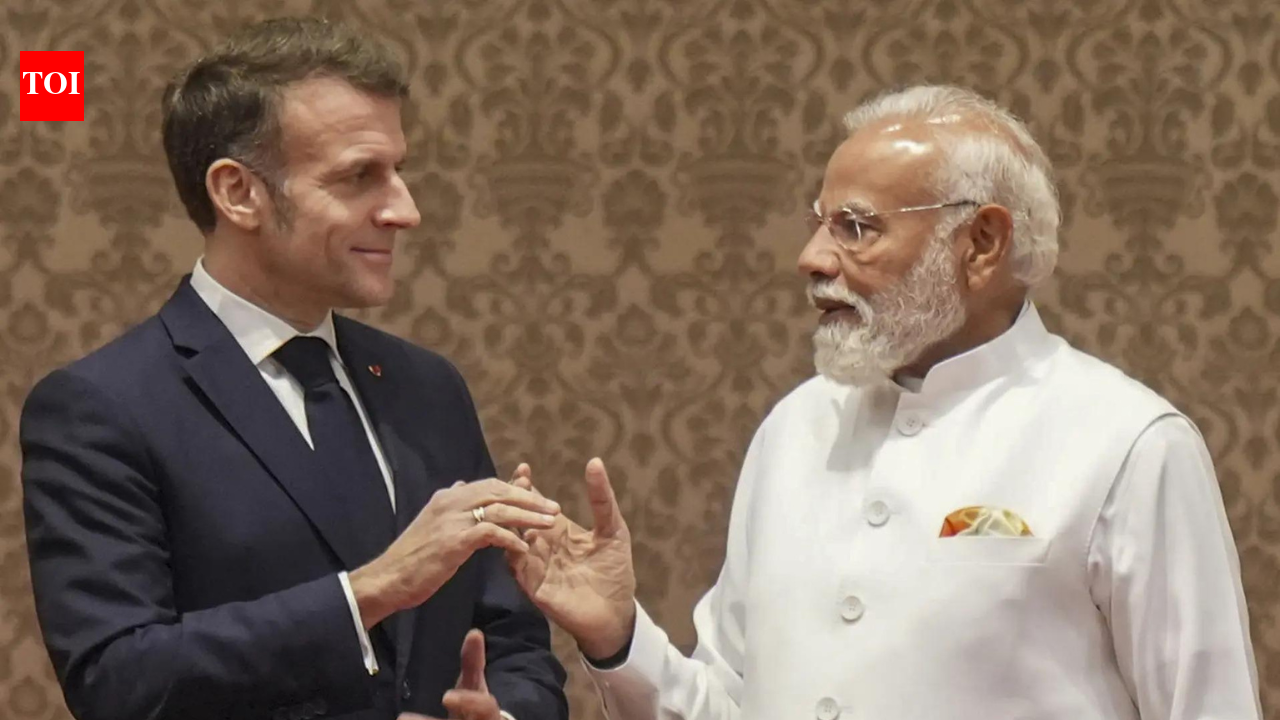
NEW DELHI: French President Emmanuel Macron on Thursday dismissed the criticisms on Rafale deal with India, saying that it only made “your country stronger”.“We are always increasing indigenous components. It’s part of the dialogue between the company and your government. I don’t see how people can criticise because it makes your country stronger, it increases the strategic coordination between us, and it creates more jobs here,” he said, speaking to the reporters.
“Very clearly, we are extremely committed to having the maximum number of Indian components and manufacturing the maximum number of critical devices in India,” he added.“The Indians, who are currently customers, want to co-produce with us; we have seen the Rafale here, but they want to co-produce combat aircraft in India. They want to handle more of the maintenance, which is legitimate,” Macron said.Defence ministry, earlier this month, cleared the path for what officials describe as the “mother of all defence deals,” with the Defence Acquisition Council (DAC) approving the procurement of 114 Rafale fighter jets from France.
Why it matters for India
The deal marks a major step in strengthening the Indian Air Force’s (IAF) combat capability at a critical juncture. Although the United States and Russia had offered their fifth-generation fighters — the F-35 and Su-57 — defence planners ultimately viewed the Dassault Rafale as a proven, combat-ready platform capable of being inducted without the long timelines associated with newer-generation aircraft.The decision comes as India works to bridge a widening capability gap. While New Delhi has placed orders for 180 Tejas Mark 1A jets under its indigenous programme, production delays linked to engine supplies have slowed deliveries. The Advanced Medium Combat Aircraft (AMCA), India’s proposed fifth-generation stealth fighter, is not expected to enter operational service before the mid-2030s. In that context, the Rafale acquisition serves as a critical stopgap, ensuring the IAF maintains squadron strength and technological superiority during the transition.The Rafale’s operational value has already been demonstrated. During Operation Sindoor, Rafale jets deployed 250-km-range SCALP cruise missiles in precision strikes on terror infrastructure in Pakistan’s Muridke and Bahawalpur districts. The missile system — guided by inertial navigation, GPS, terrain-referenced navigation and an infrared imaging seeker — enabled deep-penetration attacks with high accuracy.
