
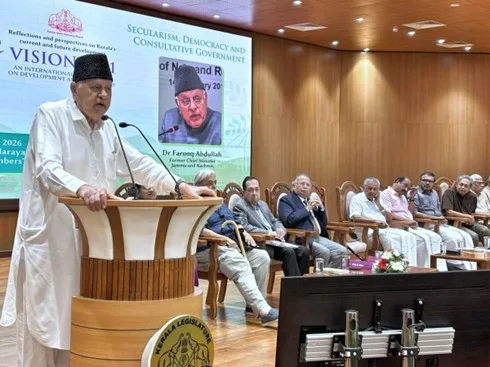
Srinagar, Feb 18: “At a time when the country’s democratic values and secular fabric are facing serious challenges, Kerala’s approach of respecting all religions and every human being equally serves as a model for the entire nation,” National Conference (NC) president Dr Farooq Abdullah said on Wednesday.
“The democracy visible in the country today is not the democracy for which the people of India had struggled,” Dr Abdullah said while addressing the Vision 2031 International Conference organised by the State Planning Board in Kerala. The event was attended by the state’s Chief Minister Pinarayi Vijayan, cabinet ministers, prominent leaders from various states and Members of Parliament.
Praising the atmosphere of religious harmony in Kerala, Dr Farooq also commended the state’s governance and developmental achievements. He said that under the leadership of Chief Minister Pinarayi Vijayan, the government is promoting the state and Kerala’s culture in a commendable manner. “This model of governance respects every religion and every individual, which is why Kerala is a matter of pride not only for its own people but for the entire country,” he said. He also described the eradication of extreme poverty in Kerala as a major and remarkable achievement.
The former J&K Chief Minister added, “India is currently passing through a significant crisis in which speaking the truth has become the greatest challenge.” He alleged that sections of the media, including mainstream outlets, are attempting to shape public opinion by promoting falsehoods while concealing the truth.
Emphasising that Kashmiris are proud Indians and will always remain so, he said that India’s real strength lies in its diversity. “If unity within diversity weakens, the nation itself will weaken,” he said. “Fascist forces, no matter how hard they try, will not succeed and will eventually become part of history.”
During his address, the NC chief expressed economic concerns regarding the Indo–US trade agreement, particularly its potential impact on the horticulture sector of Jammu and Kashmir. He warned that growers of apples, walnuts, and almonds would be severely affected.
“No clear policy has yet been presented by the central government in this regard,” he said, questioning how local producers would be able to compete if imported goods enter the domestic market in large quantities.
Criticising the excessive centralisation of powers, Dr Abdullah expressed dissatisfaction with the current system of governing Jammu and Kashmir as a Union Territory. “Many legislative decisions remain pending and greater clarity and transparency are needed in administrative matters,” he said.
He reiterated his long-standing demand for the restoration of statehood and genuine federal balance, stressing that India’s constitutional framework requires a fair distribution of powers between the Centre and the States.
Discussing the security situation, Dr Farooq said the abrogation of Article 370 was presented as a solution to terrorism, yet violence has not completely ceased. Referring to past incidents such as Pulwama, Pahalgam, and Udhampur, he questioned whether the promise of lasting peace has truly been fulfilled.
The former CM reiterated his appeal for unity and mutual understanding. He urged citizens across the country to support efforts aimed at restoring peace, dignity, and democratic trust in Jammu and Kashmir, and to demonstrate a shared sense of responsibility.
