
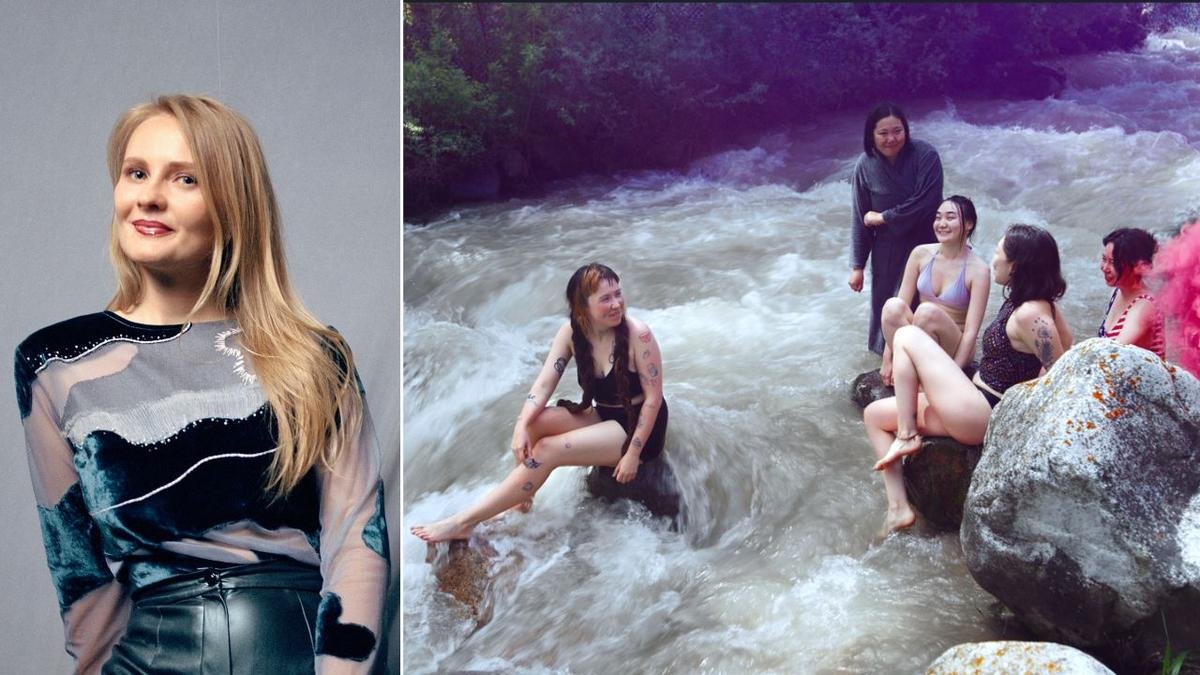
Pune-based Arya Rothe, 36, director-producer, self-taught editor, and co-founder of NoCut Film Collective, is known for her International Film Festival Rotterdam (IFFR) award-winning feature documentary A Rifle and a Bag (2020). The 2023 IDA (International Documentary Association) Logan Elevate Award winner has now edited a Kazakh documentary, River Dreams, which has its world premiere in Forum segment of the 76th Berlinale.
The Kristina Mikhailova-directed documentary is the very first Kazakh documentary to be screened at Berlinale. And Mikhailova is the second Kazakh woman director to appear in the festival’s official programmes, since Zhanna Isabayeva’s Nagima was in the Forum segment in 2014. Since then, Kazakhstan’s films at Berlinale have been limited to fiction works directed by men.
Last year, landmark buildings across Kazakhstan were lit up in orange to mark the UN’s International Day for the Elimination of Violence Against Women, part of the 16-day annual ‘Orange the World’ campaign of the UN that the country observes. The non-fiction film River Dreams begins with a river of orange, too.
Set along a river in Kazakhstan, River Dreams is a powerful exploration of women’s inner worlds. As currents move through water and memory, women lay bare love, rage, endurance, and survival. Their voices cut through silence, transforming scars into acts of resistance. Tenderness becomes defiance. The river is both witness and refuge, a space where dreams are whispered, and danger is confronted head-on. With its bold cinematic language, this deeply humanist film is a tender act of defiance and resistance.
Arya Rothe, director, producer, editor, and co-founder of NoCut Film Collective.
River girls
Mikhailova says, “It was my dream to follow a river from beginning to end, from glaciers to sands. That’s exactly what happened: first, I travelled the 130 km on foot, by bike, or on a motorbike, and then I repeated the journey with our team and a camera. It was the adventure of a lifetime. River Dreams is a long, incredible adventure spanning almost eight years. I pitched this project for the first time eight years ago, but the actual production took five years.”
She wanted to understand “at least one river, to hear her voice, taking a kind of posthumanist approach.” River Aksay, which lies next to her childhood house, became the subject of her lens. “I observed her, studied her, and one day I just fell in love with her,” she adds, “Rivers are so vast, so powerful, especially mountain rivers. It’s mesmerising! And I recognised myself in the strength of this river. I recognised a strength in myself that had always scared me. Then I spoke with many other women who resonated with the idea ‘I am a river’. It turned out that all of us, the river girls, could speak the same language.” So, River Dreams became a long, tender, desperate monologue of a river, told through the voices of the women living in Kazakhstan. “It is a political and social statement, but radically tender,” she adds.
Breaking stereotypes
The Forum selection makes the film eligible for a number of awards, including the Berlinale Documentary Award, FIPRESCI and Caligari awards, among others. Mikhailova calls her film “a frank, sincere, and desperate statement, created not only by the film team but also by all the ‘river girls’ and people we met during filming. You can feel it in every minute of the film because I have an ability to see with her heart, and our brilliant cinematographer Amir Zarubekov (it is his feature debut as well) captured this in every frame, every composition. I was thrilled to work with such talented people.”
Mikhailova hates stereotypes about Kazakhstan, having been at the receiving end constantly. “I am very happy that my film will destroy at least a few of them,” she adds.
Women’s lot, a universal theme
The film resonated with Rothe, who recalls, “I met Dana (Sabitova) and Kristina for the first time when I was pitching a project as a producer at DOK Leipzig in 2022. That was when I first caught a glimpse of River Dreams [which they had been working on for seven years] and found the project very intriguing. We passionately complained to each other about the lack of structure in our countries to support documentary filmmaking, but nothing work-related came of it then. Based on a trailer I had edited that she’d seen, in August 2024, Kristina left me a message asking if I would edit her film”
When Rothe watched the material, she found it “deeply relatable, carefully crafted and filmed with rare tenderness.” Soon after, she travelled to Almaty to work on the edit for over a month. “I was also able to experience her world firsthand. I saw the river, met her film colleagues… We spoke for hours about the history of Kazakhstan before its invasion by Russia. The new Kazakhstan, formed after the fall of communism, is the same age as Kristina: 32 years old. Kristina’s is probably the first documentary that focuses on the stories of young women born in this new Kazakhstan, and on how its history, colonial past, and patriarchy continue to shape their lives today. I witnessed firsthand how difficult it has been for Dana [Sabitova, producer] and Kristina to live in Kazakhstan while making a film this radical. They love their country, and it is precisely that love which fuels their need to critique it- but doing so is far from easy.”
The project’s first rough cut, submitted to Dok Incubator, was selected for an eight-month edit lab in Slovakia and the Czech Republic, which helps you finish your film and pitch it at IDFA (the prestigious International Documentary Film Festival Amsterdam). Completed in September 2025, Rothe edited the film with Mikhailova, who says, “Arya brought a bright, fresh perspective to the material, and we discovered many parallels between women’s issues in India and Kazakhstan, which enriched the film greatly.”
What Rothe — who was taken in by Kazakh cinema, especially Aizhan Kassymbek’s Madina (2023) — took away the most from working on this project was “the rare gift of stepping into the tender yet radical world of the women of Kazakhstan. Their courage and passion lifted me, reaffirming the magic of cross-cultural collaboration I pursue consistently in my work,” she says.
First of many to come
Mikhailova asserts, “It’s the first Kazakh documentary film in the history of Berlinale. Not more, not less. It is also important to note that River Dreams is a debut feature both for director and producer. Since Nagima (2014), films from Kazakhstan included in the Berlinale programme have been exclusively fiction films directed by men.”
The language she speaks best is cinema, Mikhailova says. “I understand cinema the most, I express myself through it best, and it is an artistic practice that has almost entirely shaped me. What I value in any artistic practice is radicalism, because it has the potential to change things. But radicalism is very inconvenient in ordinary life. And making a radical film is even more painful, long, expensive, and difficult. So, when River Dreams was invited to Berlinale, especially the Forum Special section, it felt like a breath of fresh air. It is a recognition of being accepted as you are, and being accepted by others. It felt very personal.”
She is aware that her documentary film can be seen as “complex and ambiguous”, but she also loves and welcomes “provocation”. “Within the film, there is endless love for Kazakhstan, for my home, for my river girls, but also a lot of audacity, anger, irony, and protest against what hurts me in my country,” she concludes.
