
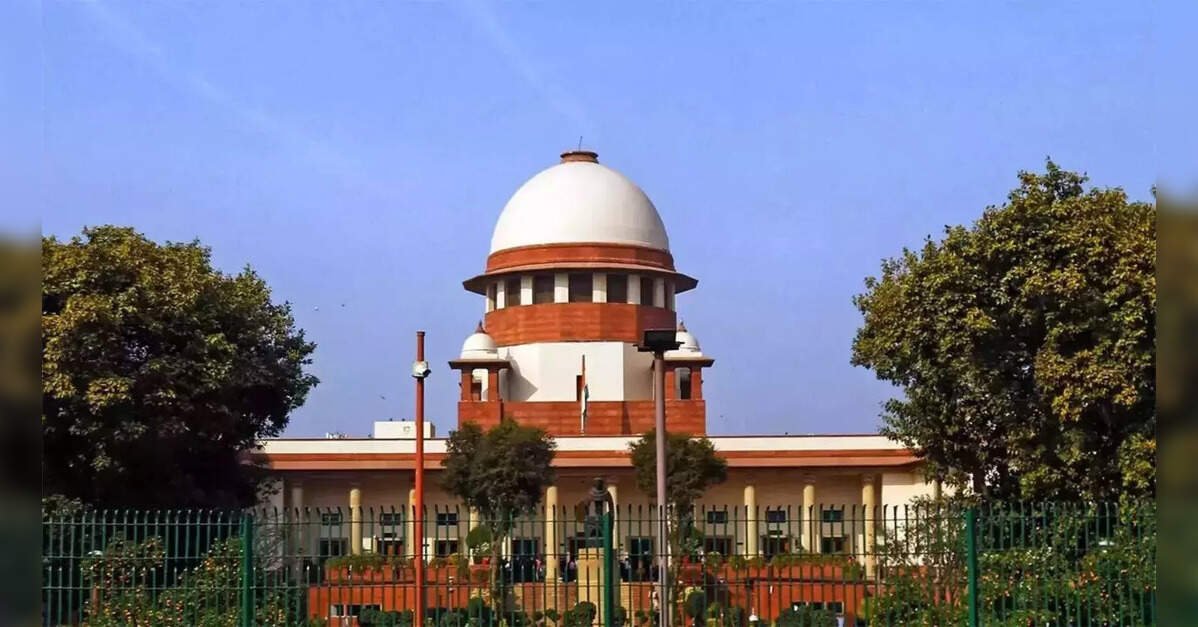
MUMBAI: The Supreme Court recently dismissed as withdrawn a Special Leave Petition (SLP) filed by Keyana Estate, an associate of the Kalpataru Group, bringing a seven-year legal battle to an end in favour of Goregaon homebuyer Paresh Parihar.
Parihar booked a flat in 2013 in the Kalpataru Radiance project at Goregaon (West), with possession promised by December 2016, but received it only in January 2024. With the matter now closed, the developer is required to pay approximately Rs 1.82 crore to the homebuyer as interest for the delayed possession.
The dispute began when Parihar and his wife, who paid over Rs 3 crore — around 95 per cent of the total flat cost — did not receive possession within the agreed time. Under the agreement signed in December 2014, the developer was required to hand over the flat by December 31, 2016, with a short grace period. When this did not happen, the couple approached the Maharashtra Real Estate Regulatory Authority (MahaRERA) in 2019.
In September 2020, MahaRERA held that the developer failed to deliver possession on time and was liable under Section 18 of the Real Estate (Regulation and Development) Act, 2016. It directed the promoter to pay interest at 9 per cent per annum from July 1, 2017, until actual possession with occupation certificate. The developer challenged this order before the Real Estate Appellate Tribunal, but the appeal was dismissed. The tribunal also ordered that Rs 52.1 lakh deposited by the developer as a pre-condition for appeal be released to the homebuyers.
The matter then reached the Bombay High Court. In its judgment dated October 8, 2025, Justice NJ Jamadar dismissed the developer’s second appeal, holding that no substantial question of law arose.
The top court noted that although an Occupation Certificate was issued on April 10, 2023, it was subject to conditions, including compliance under Section 270A of the Mumbai Municipal Corporation Act, which requires proof of adequate water supply before occupation. The court observed that merely offering possession without fulfilling such mandatory conditions could not free the developer from liability. It also pointed out that 95 per cent of the sale consideration was already paid by the buyers and rejected the developer’s defence of force majeure.
For the Parihar family, the wait for their home was not just a delay on paper — it was years of silent suffering. What was meant to be a dream home promised in December 2016 turned into an endless stretch of uncertainty, anxiety, and emotional exhaustion, with possession finally coming only in January 2024. They paid nearly everything they saved, yet lived with the constant fear of losing both money and hope.
“It was a mental, physical, and financial ordeal for us,” Parihar said, his voice heavy with emotion.
“There were times we felt broken and pressured to give up, but we kept fighting — not just for our home, but for our dignity. This journey tested our patience, our faith, and our strength, but it also proved that if you refuse to surrender, even the most powerful can be held accountable,” he added.
