
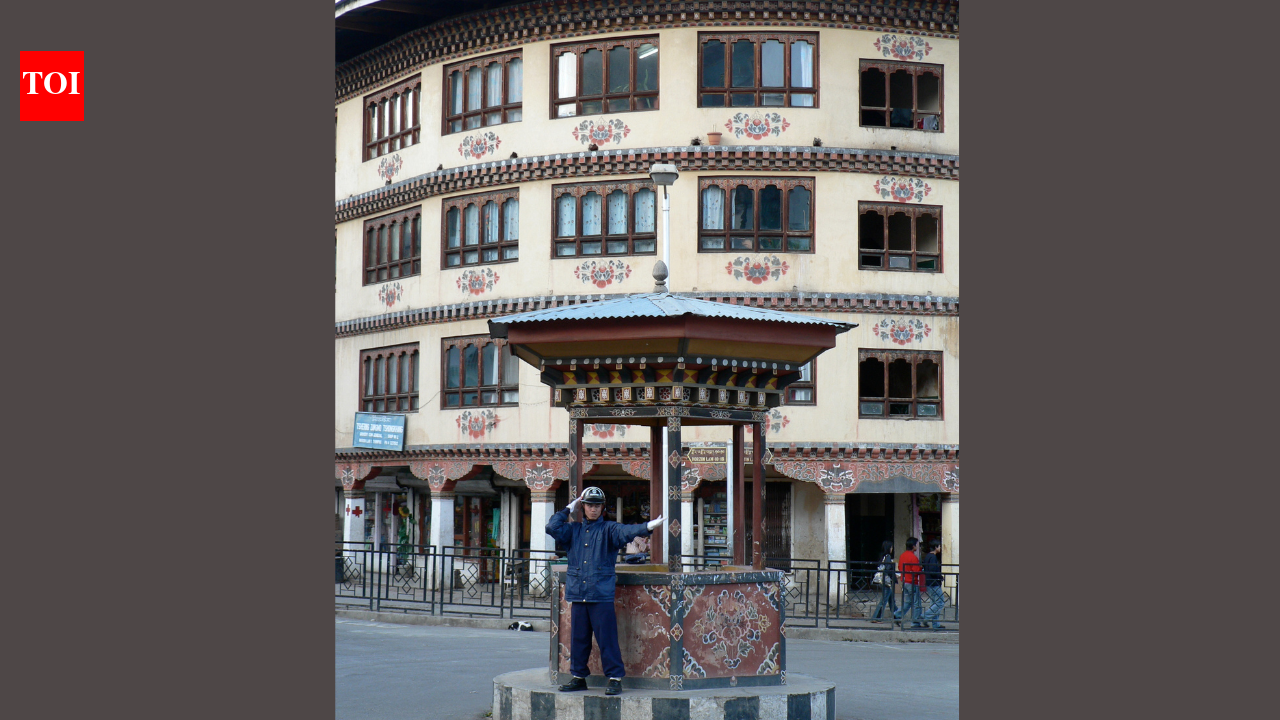
Imagining a place with no traffic lights can be a tough thing for anybody who lives in metro cities. But as they say, there are exceptions. And if you haven’t guessed it yet, it’s the capital of Bhutan, Thimphu, which is famously known for operating without a single functioning traffic light. Instead of automated signals, traffic at the city’s busiest intersections is directed manually by uniformed police officers standing inside decorative white booths, using hand gestures with almost choreographed precision.
Why no traffic lights?
A distinctive feature of Thimphu’s road network is that it is one of only two national capitals in the world without traffic lights. Although traffic signals were once installed, they were removed before becoming operational. Instead, traffic is manually managed during key intersections by uniformed police officers, the precise and choreographed movements of whom have become a hallmark of the city. In addition, public bus services are available throughout the day, with proposals to include tram services in the near future.
According to information from the Royal Bhutan Police, traffic management in Thimphu city is carried out under manual control to ensure smooth flow and vigilant driving. The system reflects Bhutan’s preference for a more human-centred approach to governance and urban management. In fact, when traffic lights were briefly installed in Thimphu in the late 1990s, public reaction was not enthusiastic. Residents reportedly found them impersonal and unnecessary. The signals were soon removed, and the city returned to its tradition of police-directed intersections, a system that continues today. Read more: H-1B visa under threat: US lawmaker introduces EXILE Act; what it means for Indian applicants
A capital that moves at its own pace
Thimphu is not a sprawling megacity. With a relatively small population compared to other capitals in Asia, the traffic flow is still reasonable. Even the lack of traffic lights has ceased to be a problem and has come to be seen as a cultural statement, which is in harmony with the country’s overall philosophy of Gross National Happiness. At major junctions such as Norzin Lam, visitors often stop to watch the traffic police in action. Dressed in crisp uniforms and white gloves, officers direct vehicles, pedestrians and turning cars through carefully timed gestures. It feels less like a rush-hour scramble and more like a synchronised performance. Read more: The island that is so full of venomous snakes that humans can barely visit
What travellers should know
For visitors, Thimphu is straightforward. Drivers are accustomed to manual traffic control, and road discipline is generally strong. Pedestrians should wait for clear signals from officers before crossing, especially at busy intersections. The lack of traffic lights does not mean a lack of regulation. Bhutan enforces traffic laws strictly, and the police presence ensures compliance. In an increasingly automated world, Thimphu stands out as one of the remarkable exceptions, as a capital city in which humans still give instructions, as opposed to computers.
