
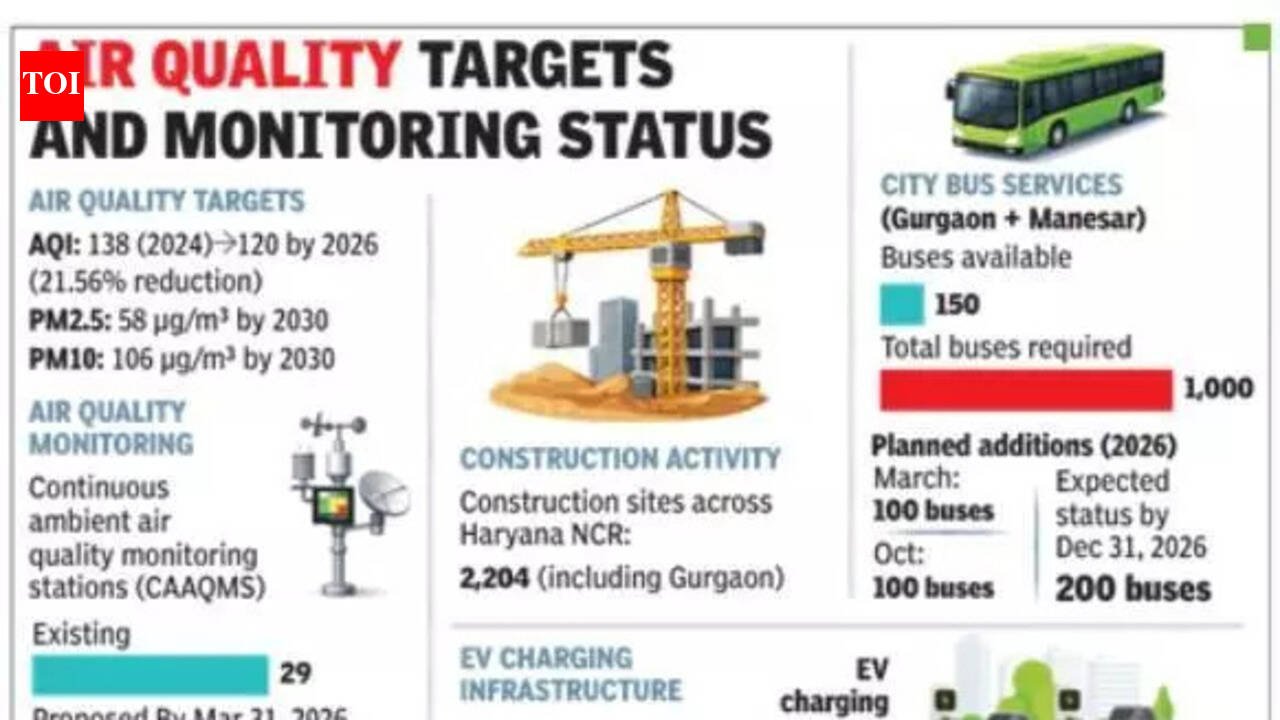
Gurgaon: Haryana has firmed up its air quality plan. Air quality index (AQI), PM2.5 and PM10 targets for the state and dust control, bus expansion and EV charging plans for the city — these form part of the measures.Under its annual action plan — with special focus on NCR — submitted on Sunday to Commission for Air Quality Management (CAQM), Haryana has set a target to reduce average AQI levels by 21.5% by the year-end. The action plan also includes a city bus augmentation component for Gurgaon and Manesar combined. As per the data, the total requirement is 1,000 city buses, while 150 buses are currently available — a gap of 850 buses. According to the plan, “Haryana’s annual average AQI, which stood at 138 in 2024, is projected to be brought down to 120 by end of 2026. For particulate matter, the state has set longer-term targets, with annual average PM2.5 to be reduced to 58 µg/m³ and PM10 to 106 µg/m³, both with a target year of 2030.”For Gurgaon, the action plan lists city-specific implementation measures focused on road dust control. The city identified 294 roads to be covered in 2026, with month-wise targets ranging between 22 and 27 roads. The plan also specifies that 50km of road length per month is to be covered for dust control throughout the year.As for monitoring infrastructure, Haryana, which currently operates 29 continuous ambient air quality monitoring stations (CAAQMS), has proposed increasing the number to 41 by March 31, indicating a gap of 12 stations. Manual air quality monitoring stations already met the target at 46. The plan records that Gurgaon has 18 mechanical road sweeping machines at present, against an assessed requirement of 42 machines. It notes that, under MCG, eight works are currently ongoing on minor and narrow roads, with manual sweeping carried out by 4,910 workers against an assessed requirement of 5,426. The plan states that 100% coverage of the identified roads can be achieved after three months.The plan says that the expansion of city bus services is proposed based on requirements assessed under ministry of housing and urban affairs guidelines. To address the shortfall, the plan sets a monthly target of adding 100 buses in March 2026 and 100 buses in Oct 2026, with an expected status of 200 additional buses by Dec 31, 2026.As for electric mobility infrastructure, the plan records that two electric substations for govt buses are currently available in Gurgaon as of Dec 31, 2025. The total requirement for EV charging points in the city is pegged at 20, with the plan indicating a gap of 20 charging points. Quarterly targets for 2026 include 10 charging points in Q2 (April–June) and 10 in Q3 (July–Sept), with an expected status of 20 charging points by Dec 31, 2026.The plan also notes that Haryana has 2,204 construction sites across the NCR region, including Gurgaon, which are to be covered under dust mitigation measures as part of the action plan. Gurgaon ranked 4th nationally, a monthly analysis by Centre for Research on Energy and Clean Air (CREA) pointed out, as its PM2.5 stayed ‘very poor’ to ‘severe’ on 25 of 31 days, with a monthly mean concentration of 163 µg/m³ — nearly three times India’s daily National Ambient Air Quality Standard of 60 µg/m³ and about 10 times the WHO guideline of 15 µg/m³.
