
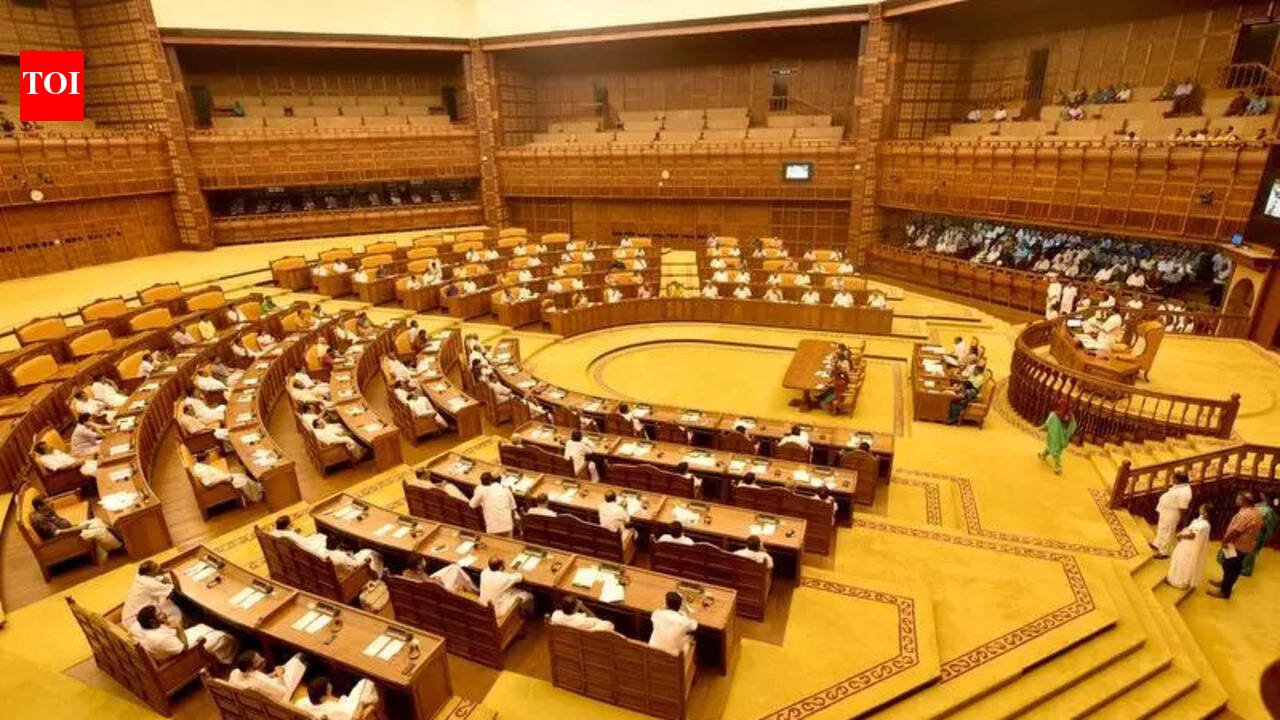
T’puram: The assembly on Wednesday adopted a resolution moved by chief minister Pinarayi Vijayan under Rule 118, expressing concern and protest over what the state govt described as continued neglect and discriminatory treatment by Centre on a range of issues. The resolution was passed in the absence of the opposition, which boycotted the proceedings for the day.Moving the resolution, the chief minister said India’s capacity to stand with dignity before the global community depends on all its states being secure, developed and prosperous. Weakening states, he said, would weaken the country as a whole. He pointed out that the Constitution upholds the federal principle through a three-tier system of governance.The resolution stated that many legitimate demands raised by Kerala over the past several years did not receive due consideration from the Union govt, causing widespread disappointment among the people of the state. It said such an approach goes against democratic federal values and raises concerns about balanced national development.Emphasising that overall national growth is possible only when all regions develop in a balanced manner, the resolution said the recent Union Budgets increasingly undermined this constitutional principle. It listed several long-pending demands of Kerala that were not addressed.One of the key issues highlighted was Kerala’s long-standing demand for an AIIMS. The resolution noted that the state govt identified land and completed most of the land acquisition procedures, but Centre did not take any follow-up action.The resolution also raised serious concerns regarding the Mahatma Gandhi National Rural Employment Guarantee Scheme. While Kerala was among the leading states in implementing the scheme, the conversion of the programme into VB-G RAM-G reduced central assistance from 100% to 60%, resulting in an estimated loss of Rs 3,800 crore to the state. It further pointed out that the allocation for the scheme in the 2026-27 Union Budget was reduced from Rs 88,000 crore to Rs 30,000 crore, a national cut of Rs 58,000 crore, which would have a significant adverse impact on Kerala.On railway infrastructure, the resolution said Kerala’s rail network continues to remain slow despite heavy passenger usage. It noted that covering the 573km stretch between Thiruvananthapuram and Kasaragod takes nearly 13 hours. It also flagged the denial of approval for a proposed coach factory, the lack of action on surveys for three or four additional railway lines between Thiruvananthapuram and Mangaluru, and the absence of any allocation in the Union Budget.The Vizhinjam international seaport project was cited as another area of concern. The resolution said that despite repeated requests, the Union govt sanctioned only a repayable viability gap funding (VGF) facility for the project, while VGF was granted as a non-repayable grant to projects in several other states. This approach, it said, was discriminatory.The assembly also noted that the demand to grant “point of call” status for foreign airlines at Kannur airport was not considered, despite repeated letters and representations, including to the Prime Minister.On disaster management, the resolution criticised Centre’s response to the Mundakkai-Chooralmala disaster, stating that adequate compensation was not provided. It also pointed out that amendments to central law removed provisions allowing loan write-offs for disaster victims.On fiscal matters, the resolution said the state’s borrowing limit was cut by Rs 5,944 crore in the last quarter of 2026-27, with an additional Rs 3,323 crore deducted under the Guarantee Sinking Fund. Such reductions, imposed towards the end of the financial year, were said to adversely affect welfare programmes and infrastructure projects.The decision of the 16th Finance Commission to discontinue revenue deficit grants was also criticised.It further pointed out that Rs 965.16 crore due to Kerala under IGST was withheld, that Centre did not compensate states for revenue losses arising from GST rate reductions and that Kerala was required to bear 25% of land acquisition costs for national highway projects — a condition not imposed on other states. Centre’s refusal to exclude this expenditure from the state’s borrowing limit was also flagged.
