


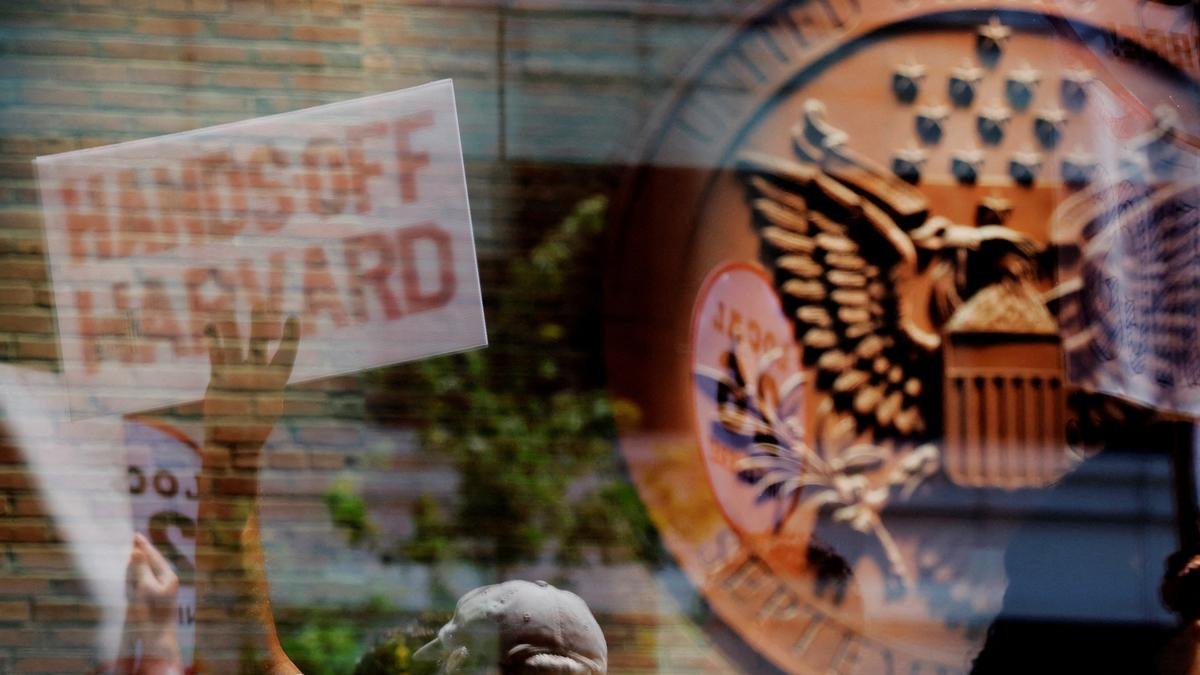
From the start of Trump’s second term, American universities have seen a withholding of federal funds, including those funnelled into important research projects by bodies such as the National Institutes of Health (NIH) and National Science Foundation (NSF).
More than half of the research spending of universities comes from federal sources. Each year, universities spend at least $102 billion on research, while an additional $102 billion is given by Federal Student Aid in the form of grants, loans and work-study programmes. Federal cuts had gutted at least $3.7 billion by mid-year, with potential fallouts for hundreds of American universities.
Among the many cuts made by the Department of Government Efficiency (DOGE) across sectors, many targeted academic research which included terms associated with diversity, equity and inclusion (DEI). Climate change and environment-related research too faced the axe.
Also read: Self-inflicted wound: On higher education and Trump administration’s move
The Department of Education (DOE) has taken the lead in making several cuts, but some changes have also emerged from the Justice, Defense, Energy and Health and Human Services departments. Further, the NIH as well as the Department of Energy have both sought to bring in caps for reimbursement for any costs indirectly related to research.
Rescinding of DEI policies and Social Justice grants
DEI policies, long the subject of Republican ire, saw quick rollbacks after Trump’s second term started. Offices related to DEI in the DOE were dismantled. At the university level, there have been calls for changes in school curriculum and allegations that universities were not following the Supreme Court’s ruling gutting affirmative action in the case Students for Fair Admissions v. Harvard.
In February, Trump’s interim U.S. attorney for the District of Columbia Edward Martin demanded Georgetown University’s law school eliminate DEI from its curriculum or lose Department of Justice career opportunities for students. Mr. Martin’s nomination was later pulled.
Research grants tied to various federal sources were cut, if they were linked to diversity, equity, inclusion and accessiblity. For example, the NSF cut several grants following a review of those which contained keywords related to DEI. Similarly, the National Institutes of Health have cut at least 900 active research grants related to studies involving LGBTQ+ issues, gender identity and DEI..
On March 19, 2025, the University of Pennsylvania was stripped of $175 million in Department of Defense and Department of Health and Human Services funding, due to its “failure” to bar transgender athletes from women’s sports. UPenn, meanwhile, said it followed NCAA and Ivy League Policies, and noted that policy revisions had been introduced by the two in response to Trump’s executive order in February. This funding was later restored following an agreement with the White House.
Office of Civil Rights investigations are also putting forth conditions pertaining to change in the syllabus, review of Middle-East related studies and incorporating anti-Semitism.
45 universities which partnered with The PhD project, which supports Black, Latino and Native American students pursuing doctoral studies in business programmes, are now being investigated by DOE for allegedly using “racial preferences and stereotypes” in education programmes and activities.
On November 19, 2025The Guardian reported that the State department was considering cutting 38 universities from a federal research partnership programme called The Diplomacy Lab (which pairs university researchers with state department policy offices to work on foreign policy related challenges for a semester) if they engaged in DEI hiring policies or set DEI objectives for candidate pools. On the block are universities like Harvard, Yale, Stanford, Duke, American University and George Washington. The changes were to go into effect on January 1, 2026.
The determination is based on a colour-coded system that evaluates where 75 universities stand on a four-point scale, with institutes whose hiring policy has evidence of DEI measures marked in red, and others with non-DEI, merit-based hiring marked in green. Universities such as Columbia, MIT, University of Michigan, UPenn, UT Austin, and University of Virginia are on the green list, as are universities like Liberty University and Brigham University.
Science
Several grants from the Department of Health and Human Services, NIH and NSF have been cut. Multiple grants (at least 400) were axed by NSF following a review of research containing words related to DEI, and those looking into misinformation and AI.DHS grants (around 700) investigating HIV/AIDS, cancer, COVID-19, and Alzheimer’s disease have also been cut. Many of these grants are given to research centres hosted in universities. For example, at the UPenn, the largest HHS grant in fiscal 2025 was worth $54.1 million, and awarded to the Perelman School of Medicine’s Center For AIDS Research, according to The Daily Pennsylvanian.
In UCLA, cuts to medical research grants by the NIH have impacted research into Parkinson’s disease, cancer recovery, and cell regeneration in nerves.
Also read: The race for global leadership in science
Harvard, at the epicentre of the storm, has witnessed cuts in several crucial wings, per a report by CBS News. Funding for research at the Ludwig Cancer Center at Harvard Medical School was halted, including for a team that had identified the earliest precursors of breast cancer. Harvard chemist and molecular biologist David Liu, a winner of the 2025 Breakthrough Prize, who works in the domain of gene editing, has found it difficult to attract and retain talent. Also impacted is work at the Wyss Institute, including research into organs on chips.
Bioengineer Don Ingber, the founding director of Wyss Institute, told CBS that the country was “truly putting the brakes on scientific innovation in this country at a time where our ostensible adversary, China, is just going faster and faster and faster.”
Those whose research lies at the intersection of health and equity have also been impacted. For example, the NIH grants of a trio of researchers affiliated with the LGBTQ Health Center of Excellence at the Harvard T.H. Chan School of Public Health were terminated.
Additionally, funding for grants pertaining to climate initiatives has been cut. For example, $4 million was cut from Cooperative Institute for Modeling the Earth System, Princeton’s climate research lab, which also hosts Nobel prize-winning meteorologist Syukuro Manabe.
Even fields not at odds with the policies of the Trump administration have been impacted; the Department of Commerce stepped back from a multiyear research project about semi-conductors in August, which had seen the participation of universities across States.
In a Working People Podcast episode for In These Times, NYU Assistant Professor Chenjerai Kumanyika, said: “This is ideological. They want to replace public science with corporate science and they want to defund fields that they can’t control, especially ones that address systemic health disparities or things like the social determinants of health, reproductive research, things like gun violence, climate health, mental health.”
“They received stop work orders to stop cancer research. So when we say these cuts kill, it’s serious. It’s not hyperbole,” she added.
Interestingly, the cuts may also impact research in other countries. For example, University of Toronto gets up to $20 million from U.S federal agencies or American partner universities. Transnational campuses of American universities, such as those in Qatar, may also see a dip in their research prospects.
New rules and proposed caps
Some grants, particularly those at the DHS, have been hobbled by a new rule that requires grant spendings to be approved by a senior appointee.
Other restrictions have been imposed in the form of caps on fund use. The Trump administration had placed a 15% blanket cap on the use of federal grant research funds for indirect costs of medical research, such as administrative overhead and facilities. The national average now is almost 30%, and major research universities such as Harvard, Johns Hopkins and Yale have long gotten indirect cost reimbursements in excess of 60% of the value of the underlying research grant.
Agencies like NSF and NIH announced such caps. NIH announced in February 2025 that it was cutting its indirect research cost outlay by more than $4 billion. District court judge Allison Burroughs from Massachusetts on April 16 temporarily blocked the Energy department from a similar 15% cap for indirect cost reimbursements.
A federal appeals court handed down a ruling on January 5, 2026, stating that the Trump administration could not slash federal grants from the NIH to universities conducting research in science and medicine. It upheld an injunction granted earlier after 22 Democratic state attorneys general, universities and medical associations like Association of American Medical Colleges and Association of American Universities approached the court about NIH cuts in February 2025.
Several academic organisations and 13 research universities had also filed a similar lawsuit against NSF, which funds basic research in non-medical fields of science and engineering like chemistry. Many of the cuts have been blocked in courts.
But the administration has other tools at its disposal. In September 2025, Trump issued an executive order directing agencies granting awards to prefer institutions with lower indirect costs.
Humanities
Cuts to various humanities departments took place under the aegis of DOGE, in addition to those pertaining to DEI. The Department of Defense saw several cuts in their college-aligned programmes. Funding was cut for the Department of Defense Language Institute’s overseas immersion programmes, which helped prepare students for duty abroad with intense training in foreign languages
Other cuts emerged from a different quarter. Numerous grants pertaining to culture and history were cancelled from the National Endowment for the Humanities, some of which were linked to university research programmes. Coordinated cuts also affected the Smithsonian Institution, Institute for Museum and Library Services, Fulbright Programmes, Woodrow Wilson Institute, U.S. Institute of Peace, and the Kennedy Centre.
Further impacts emerged from a March executive order titled “Restoring Truth and Sanity to American History,” which cut funding for exhibits or programmes that “degrade shared American values, divide Americans based on race, or promote programs or ideologies inconsistent with Federal law and policy.” This led to institutions such as the Smithsonian and National Park Service reviewing and removing sections of exhibits which do not conform to these standard. For example, some items pertaining to slavery were removed.
Loss of patents and other intellectual property
Besides reviewing all federally funded research programmes at Harvard, the Trump administration also sought to examine the University’s patent portfolio, threatening to take over ownership under the federal Bayh-Dole Act. According to the University’s Office of Technology Development, Harvard reportedly holds more than 5,800 patents and 900 technology licenses with over 650 industry partners.
The bipartisan Bayh-Dole Act, signed into law by former President Jimmy Carter, was to strengthen “the effectiveness of the patent incentive in stimulating innovation in the United States.” In August, U.S Commerce Secretary Howard Lutnick had issued letter directing Harvard to submit a list of all patents which emerged from federal research grants.
Introduction of new grants and programmes
In June 2025, the DOE announced a new American History and Civics (AHC) Seminars discretionary grant programme in honor of America’s 250th celebration, providing grantees with “an opportunity to celebrate the roots of our constitutional republic and teach students about America’s Founding principles and the responsibilities of citizenship.” Course material must study the American political tradition, texts and history including the Founding principles of the nation and their inclusion in the Declaration of Independence, the U.S. Constitution, and the Bill of Rights. Further, the grant terms stipulate that priority would be given to those applicants from institutions “that have established independent academic units dedicated to civic thought, constitutional studies, American history, political leadership, and free market economics.”
Further, the DOEannounced a coalition of 40 groups—including the conservative Heritage Foundation, Turning Point USA, Hillsdale College and the American First Policy Institute—to spearhead the America 250 Civics Education Coalition, which is “dedicated to renewing patriotism.”
Some changes emerge from a different quarter. For example, Mr. Trump signed an executive order for an AI project called Genesis Mission, which directs the federal government to combine forces with tech companies as well as universities to convert government data into scientific discoveries.
Changes in discretionary grant priorities
In May 2025, Secretary McMahon announced her first three proposed priorities for the Department’s discretionary grants: evidence-based literacy, expanding education choice, and returning education to the states. In July, the fourth was introduced: advancing AI in education
On September 17, the fifth grant priority was unveiled: prioritising patriotic education. Per the press release announcing this, this priority would guide determinations in grant competitions across the Department “to promote a civic education that teaches American history, values, and geography with an unbiased approach.”
An executive order from August 7, 2025, directed political appointees at federal agencies to review grant awards to ensure they align with the administration’s “priorities and the national interest,” with funding likely for research likely to “produce immediately demonstrable results.”
Some advantages did emerge: the order directs federal agencies to simplify the language in funding opportunity announcements to minimize “the need for legal or technical expertise in drafting an application.” Further, language in the order called for awarding research grants to a mix of recipients — instead of mostly institutions with strong track records.
The DOE also released a set of seven priorities under the Fund for the Improvement of Postsecondary Education (FIPSE) for the FY 2025 competition, supporting four areas of national need: expanding the use of artificial intelligence (AI) ($50M) , protecting and promoting civil discourse on college and university campuses ($60M), encouraging accreditation reform ($75M), and building capacity for high-quality short-term programmes ($50M). On January 5, 2025, the DOE announced that $169 million had been released from the fund in new grants.
Research priorities have changed over history
At various times, universities have fallen prey to efforts to control how the nation remembers its history, including campaigns by the United Daughters of the Confederacy in the late 19th and early 20th centuries and the Red Scare spearheaded by U.S. senator Joseph McCarthy in the 1950s.
The McCarthy era saw professors being subpoenaed from both private and public universities – including Harvard, Columbia, and the University of California – to testify before the House Un-American Activities Committee (HUAC). Individuals were suspected of sympathy to socialist or communist ideology and of harbouring anti-American sentiment, and were made to take oaths reaffirming their values.
Research prerogatives at universities were also guided by defense requirements. Around World War II, the government increased its funding for scientific research, with a jump from $29 million in 1938 to more than $197 million in 1945 (The Atlantic.) After US universities significantly contributed to the American war effort in World War II, Harvard President Vannevar Bush, an MIT engineer who co-founded Raytheon, proposed creating permanent arrangements for the federal government to subsidize university research.
Successive governments under former Presidents Eisenhower, Kennedy, and Johnson funneled investments of at least $12 billion into universities. While colleges formed only 5.3% percent of research and development in 1953, this increased to 10% by 1975. (The Atlantic). A part of this outlay emerged from the National Defense Education Act of 1958, which was passed after USSR launched Sputnik and edged ahead in the space race.
In 1980, the Bayh-Dole Act allowed universities to retain ownership of patents created using federal funds. From 1996 to 2020, academic research led to 141,000 U.S. patents, resulted in the creation of thousands of companies and jobs, and enhanced the GDP by $1 trillion.
However, “we’ve never seen anything quite this sweeping in the United States,” says James H. Finkelstein, Professor Emeritus of Public Policy at George Mason University in an email response. “The closest analogues are moments when federal or state governments sought to impose ideological conformity—such as loyalty oaths during the Cold War or the post-9/11 pressures on research involving national security. But even then, universities retained significant autonomy.”
”The big difference from the early Cold War was that the federal funding of research played a smaller role in university budgets than it does now. so the administration’s defunding of research is having a much greater impact than it did during McCarthyism,” says Ellen Schrecker, author of The Lost Promise: American Universities in the 1960s.
In an email response, she also highlights the difference in the mechanisms of restriction. “During McCarthyism the main attack on universities was on individual professors who had once been in or near the Communist Party and refused to cooperate with the anti-Communist investigations they were facing. Though some 100 faculty members (and probably more we don’t know about) lost their jobs and were blacklisted, the main impact on the universities was the self-censorship by professors and students — both with regard to their teaching and research and their political activities both on and off the campus.”
Simon Marginson, Professor of Higher Education at University of Bristol and University of Oxford, is clear about the capricious nature of the current cuts. “You do not make research, scientific decisions on the basis of politics. But let’s look at the Nazi Party in Germany in the 30s. They did that, you know? I mean, you don’t do that, but Trump’s doing it,” he said over a Zoom interview.
Universities battling the cuts/making up for the shortfall
Universities have been fighting back, with varying degrees of success and compromise. Harvard recently won a major legal battle, allowing federal funding worth $2 billion to flow to the university. Northwestern University and its board of trustees committed to sustaining critical research after federal funds were frozen, a commitment it reiterated in September 2025 before it arrived at an agreement with the government. The efforts are grounded in “core principles we share as an intellectual community: the preservation of academic freedom and the independent operation of our University,” it said in a statement.
“In our view, America’s leadership in science and innovation depends on independent thinking and open competition for excellence,” MIT president Sally Kornbluth wrote in a public statement rejecting the The Compact for Academic Excellence in Higher Education. “Therefore, with respect, we cannot support the proposed approach.”
Some universities are looking to industry as well as their home State legislatures and governors to bolster their research, “not with a federal government that discards years of investment in a bout of dyspeptic partisan spite,” as an article in The Atlantic expressed it. It cites the example of Massachusetts Governor Maura Healey, who in July introduced a law proposing to direct $400 million of State funds into research at universities and other academic or research institutions. Even if only Harvard is considered, the State sees over $2.6 billion at risk.
“More broadly, State governments should increase public investments in all parts of the higher education environment – arguably with a focus on institutions that tend to be underfunded and are more likely to serve students of color and students from low-income families (a category that of course includes students of all racial and ethnic backgrounds),” said Jonathan Feingold, Professor at the Boston University School of Law, in an email reply.
As Dr. Angel Pérez, CEO of the National Association for College Admission Counseling, points out, some States are more willing than others. ”Some States have said, okay, well, the federal government isn’t going to give us the funding. We are going to try to make up for that funding. Depending on where you live, for example, the governor of California has said, well, the State can’t afford to make up for all of the funding they’re losing from the federal government, but they’re certainly able to help particularly their minority serving institutions.”
He cited the California State University system— the largest in the country— as an example. “They serve about 500,000 students in their system. The majority of those students are students of color, which means that the funding has been taken away because they are minority serving institutions, and so the governor has said he’s going to try to support (them.)”
(Note: This article is current as of January 30, 2026)
