



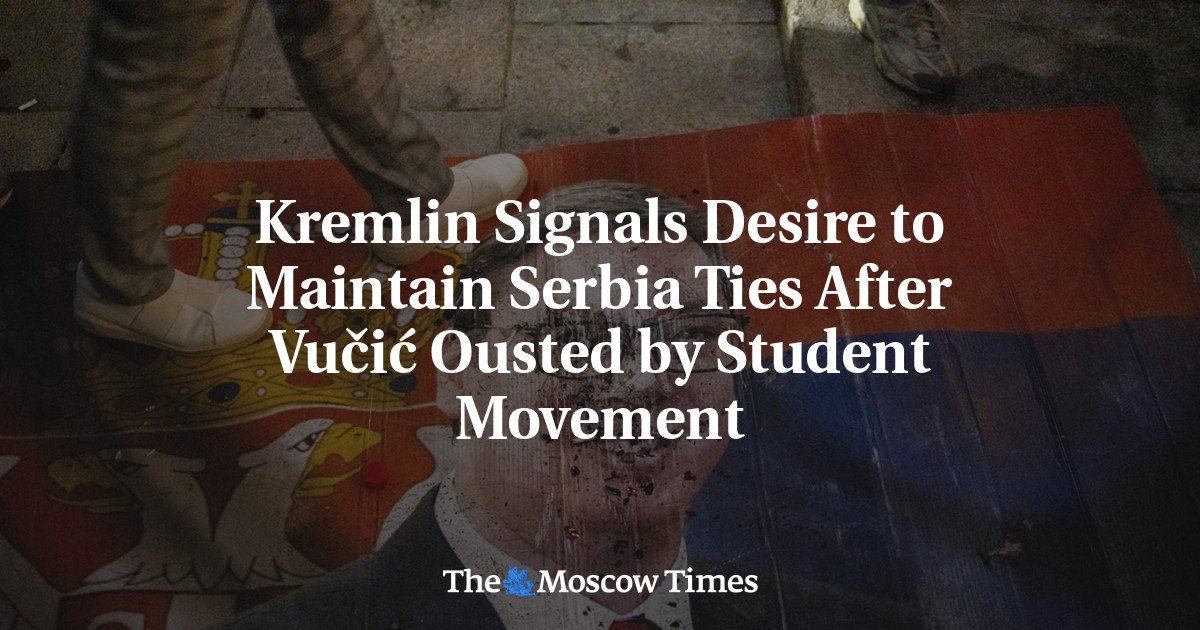
The Kremlin said Monday that it wants to maintain and develop ties with Serbia despite the defeat of former President Aleksandar Vučić’s ruling coalition in this weekend’s parliamentary elections, while noting that building those relations will require effort from both sides.
“We deeply value the contribution that Mr. Vučić has made to the development of our bilateral relations,” Kremlin spokesman Dmitry Peskov told reporters at a daily briefing.
“We know that he will remain on the political stage, and we hope that even in opposition, he will continue to contribute to advancing our ties,” Peskov added.
Vučić, who dominated Serbian politics for more than a decade as prime minister and then later as president, conceded defeat on Sunday night following a historic snap election. The vote pitted his ruling coalition against a student-led movement that had spent months protesting against his government.
“Based on a stratified sample, it is clear that we lost these elections,” Vučić told supporters at his party headquarters in Belgrade.
The defeat followed Vučić’s resignation as president in September, a risky political maneuver intended to allow him to reclaim the prime minister post. It also came after nearly two years of anti-government demonstrations triggered by the November 2024 roof collapse at the Novi Sad railway station, an accident that killed 16 people and sparked widespread outrage over state corruption.
During his tenure, Vučić balanced Serbia’s candidacy for EU membership with a refusal to join Western sanctions against Russia over its 2022 invasion of Ukraine. He had remained one of the few European leaders to maintain direct contact with the Kremlin and make official visits to Moscow.
Peskov said Monday that Moscow hopes the incoming government in Belgrade will work “constructively” to preserve bilateral relations since, in its view, doing so would bring “tangible benefits to Serbia itself.”
“For our part, we intend to continue doing everything possible to foster our relations with Belgrade. But as you know, it takes two to tango,” he said.
Jovo Bakić, a representative of the Student List, told the Kremlin-backed broadcaster RT Balkan that the incoming government would not impose sanctions on Moscow or abandon Russian gas supplies despite pressure from the European Union.
He argued that sanctions imposed by a country of Serbia’s size would change little but would send a negative signal symbolically.
“We respect Russia as a great power and as a historically important partner, and in many cases as a protector,” Bakić said. “There will be no changes on this issue.”
Reuters and AFP contributed reporting.
