



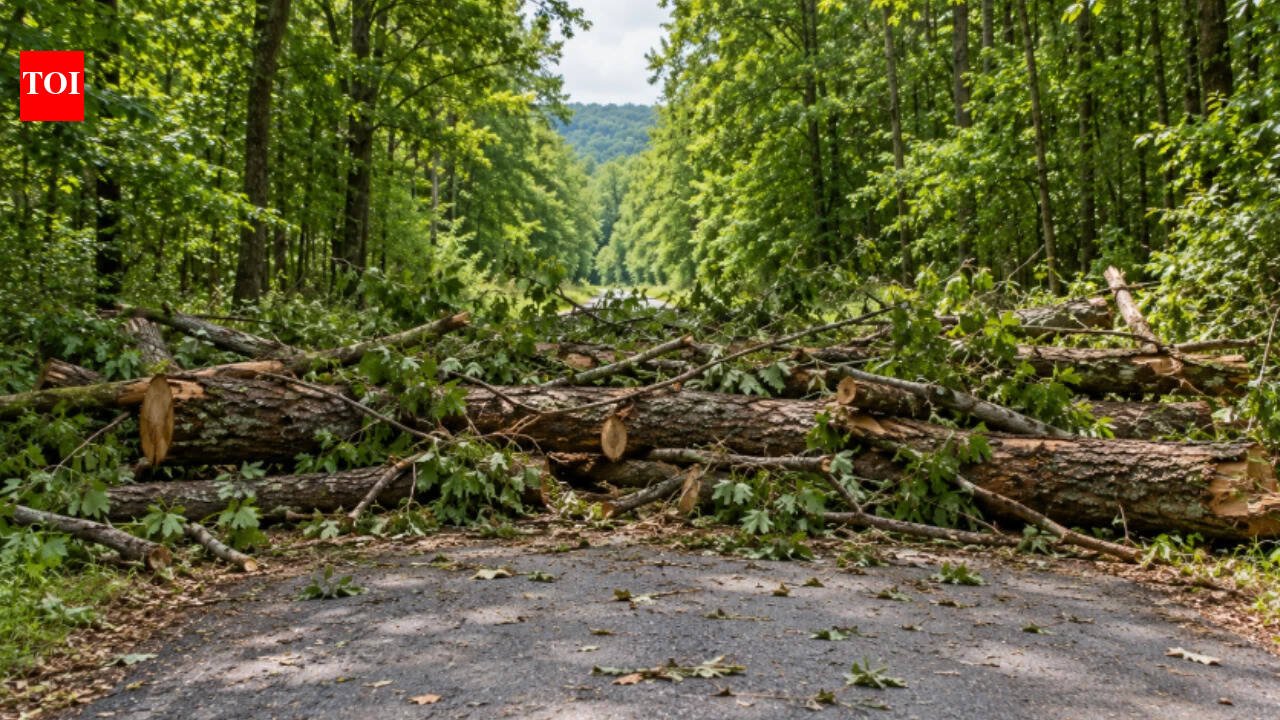
A New York family that owned half of a private road beside its 45-acre property has lost ownership of that portion to a neighbouring recreational club with around 1,500 members. The two sides had shared the road for decades, but their relationship deteriorated in 2021 when members of the family blocked part of it with tree trunks. The disagreement eventually reached New York’s highest court, which ruled on Thursday that the club had gained ownership because it had used and maintained the road for many years.The dispute concerns Godfrey’s Pond Road in Genesee County, which runs between two properties. According to details of the case available on Justia, one belongs to the Genesee County Fish and Game Protective Association, a club established in 1909 that owns around 200 acres. The other is a 45-acre property belonging to Capri Dix and her husband, William Dix, who use their land for recreation.The road had an unusual ownership arrangement. The club had owned its western half since 1932, while the Dix family and earlier owners had held the eastern half since at least 1949. Despite this division, both sides had used the road for years. For the club, it was particularly important because it was the only route available to its members, emergency vehicles and delivery services.For much of that time, the relationship between the neighbours had been friendly. Capri Dix was once a member of the association, and several of her relatives had also belonged to it. The families had a long history of sharing the road and using the surrounding area. However, disagreements over access to the Dix family’s land eventually brought that relationship to an end.
Tree trunks turn disagreement into court battle
The trouble began when the Dix family reportedly became concerned that club members were entering their property without permission.By 2021, the disagreement had become serious. Members of the family placed tree trunks across the eastern half of Godfrey’s Pond Road, preventing the association from using that section as it had done previously. Tensions increased further after an encounter between the two sides required police intervention.The club had earlier offered to purchase the family’s half of the road, but the proposal was rejected. With the disagreement unresolved, the association approached the court.Instead of asking only for permission to continue using the road, the club claimed that it had already become the legal owner of the disputed section.
Why club said the road belonged to it
The association’s argument was based largely on what it had done to maintain the road over several decades. According to the court records, the club had regularly cleared snow, repaired damaged sections, patched the surface and carried out paving work across the entire road.Its members had also used the route daily for years to reach the club’s property. Twenty-one association members lived permanently on the grounds, while others visited for recreational activities.The club argued that its long history of maintaining and using the road showed that it had treated the entire route as its own.Under New York law, someone can sometimes become the legal owner of land that originally belonged to another person if they have openly used and controlled it as their own for a long enough period.This rule, called adverse possession, does not mean that anyone who regularly uses another person’s property can claim it. The nature of that use, including whether it happened with the owner’s permission, also matters.But the Dix family argued that the club had been allowed to use the road because the two sides had maintained friendly relations for generations.
Family’s long connection with the club
The court records showed that the relationship between the Dix family and the association went back many years. Capri Dix’s grandmother, great-aunt, and great-grandmother had regularly ridden horses along the road and on trails within the club’s property. Her great-grandfather, Vincent Frens, was also described as a close friend of several association members.There was evidence that Frens had allowed the club to collect gravel from his land for road repairs. He had also permitted members to hunt on his property.The Dix family also maintained that they and their relatives had regularly used the entire road, including the section now claimed by the association.The club, however, argued that its years of maintaining the route and using it as its own were sufficient to establish ownership.
What New York’s highest court decided
The association initially won its case in a lower court. The Dix family challenged that decision, but an appeals court also ruled in the club’s favour.The dispute then reached the New York Court of Appeals, the state’s highest court. On Thursday, the court upheld the earlier decision, ruling that the association had established its ownership claim.Five judges supported the outcome, while two disagreed. The majority considered the club’s decades of maintaining and using the entire road sufficient to support its claim. It also found that the family had not presented enough evidence to require a trial.However, Judge Jenny Rivera disagreed. In a dissent supported by Chief Judge Rowan Wilson, she argued that the long history of cooperation between the neighbours raised questions about whether the club had used the road with permission.She believed those questions should have been examined at trial before ownership was transferred. The majority nevertheless upheld the ruling in the association’s favour.
