



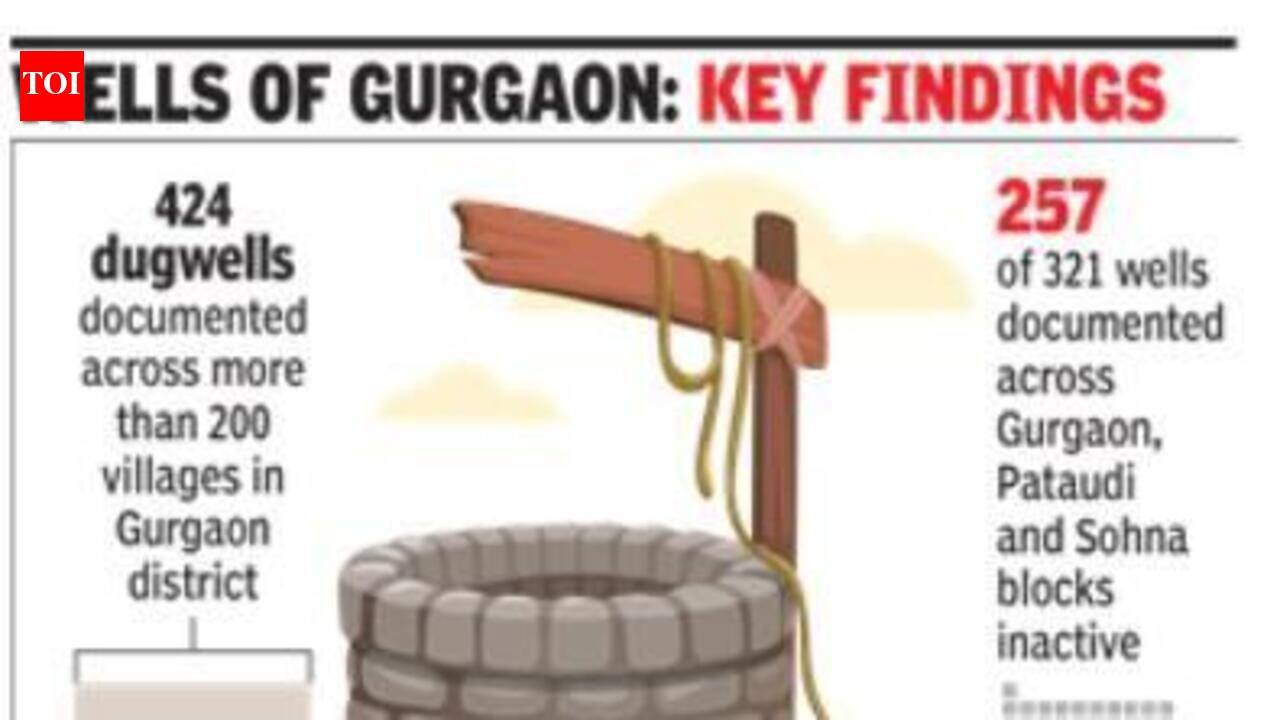
Gurgaon: Hundreds of traditional wells across the city have fallen into disuse. Choked with silt, debris and waste, many of them no longer are serving the communities that once depended on them. According to a survey, 257 of 321 wells — 80% — documented across three blocks were inactive.The survey conducted in 2025 over a year found that Pataudi had the highest proportion of inactive wells, with 84 of the 88 documented structures lying unused. In the city, 100 of 136 wells were inactive, while Sohna had 73 inactive wells among 97 documented.The study has raised questions about whether these neglected structures can be revived to help recharge groundwater. Besides the three blocks, Farrukhnagar has 103 wells, of which 74 are inactive, according to an expert with whom TOI spoke to. The survey by GuruJal is part of Wells of Gurgaon: Echoes of water, echoes of time.Water expert Dr Fawzia Tarannum — who was also part of the survey — said GuruJal’s project had inventorised 424 dugwells and 278 borewells across more than 200 villages. According to her, 331 of the 424 — 78% — dugwells were inactive, while only about 3% had rainwater-harvesting linkages. This points to an opportunity for decentralised groundwater recharge, she said, adding, “Combining traditional knowledge with scientific safeguards could turn abandoned wells into functional assets for the city’s groundwater security.”The study has recorded the location, condition and cultural significance of the wells, as well as their potential for revival. The report attributes the decline of traditional wells to the shift towards borewells and piped water, falling groundwater availability and concerns over water quality. While some wells remain structurally sound, others are heavily silted, filled with waste or in a dilapidated condition. The report also records differences in local communities’ willingness to support restoration.The GuruJal report recommends assessing wells individually, incorporating suitable structures into district and panchayat water-security plans and assigning responsibility for their long-term maintenance. Community participation, water-quality checks and groundwater monitoring would also be needed to ensure restored wells remain functional.Tarannum said traditional dugwells were designed to access shallow aquifers and could offer significant potential for groundwater recharge. “Rather than investing exclusively in new percolation structures, we should explore reviving these existing water assets,” she said, adding, “Many of these wells can be repurposed through relatively simple interventions — removing accumulated debris and silt, repairing damaged structures, installing appropriate filtration media, and directing clean rainwater from nearby rooftops and catchment areas into them.”At Khandewla in Farrukhnagar block, GuruJal demonstrated this approach by restoring an abandoned dugwell. Tarannum said approximately 46.8 cubic metres of accumulated waste was removed and rooftop runoff from four neighbouring households, with a combined catchment area of 603 square metres, was connected to the well. The system has captured approximately five lakh litres of rainwater since it was commissioned in 2025.The report separately documents the Khandewla well as a rainwater-harvesting structure with estimated annual groundwater recharge of around 190 kilolitres. At Daulatabad, another restored well is being used for community activities and to familiarise school students with traditional water sources, rainwater harvesting and groundwater conservation. Tarannum said such structures could offer cost-effective, decentralised recharge solutions, provided their hydrogeological suitability, water quality and recharge capacity were scientifically assessed.The need to improve recharge is underscored by the scale of groundwater extraction. Figures cited in court proceedings put the city’s annual extractable groundwater resource at 20,333 hectare-metres, against annual extraction of 43,263 hectare-metres. This puts the extraction stage at about 213% of the annual resource.The city’s water demand is also projected to rise. Court submissions put the city’s potable water demand at 770 million litres per day (MLD) in 2026, against GMDA’s treatment capacity of around 670 MLD. The remaining gap of about 100 MLD was being met through MCG and private-builder tubewells. Demand is projected to reach 1,170 MLD by 2031.In an affidavit before Punjab and Haryana high court, GMDA CEO P C Meena said an inter-departmental meeting held on Oct 5 discussed measures to address groundwater depletion. These included restoration of ponds and water bodies, rainwater harvesting, scientifically suitable recharge structures, enforcement against unauthorised borewells and greater reuse of treated wastewater.The affidavit records that agencies were asked to identify natural ponds and water bodies for restoration and prepare action plans. Authorities were also asked to compile an inventory of registered and unregistered borewells and examine the possibility of reducing groundwater extraction where a reliable piped-water supply is available. The affidavit records these as proposed measures; it does not establish how much work has been completed.
