



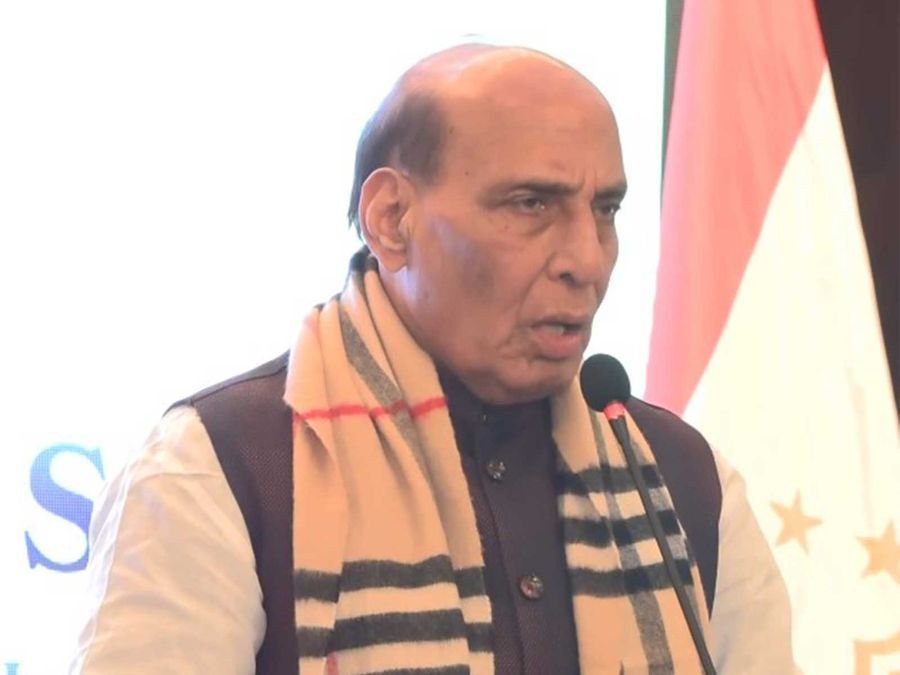
Dushanbe [Tajikistan], October 20 : Even as the West Asia conflict continues to impact the global economy, India continues to grow at 7.2 per cent, Defence Minister Rajnath Singh said on Tuesday as he attended a cultural event organised by the Indian Diaspora in Tajikistan.
Addressing the community during his second visit to the Central Asian nation since 2021, Singh said India remains among the world’s fastest-growing economies despite adverse circumstances. “There was a time when the world claimed that India’s economy was a lost cause,” he said, adding that the “strength and determination of the Indian people” had made the difference.
Singh said India contributes 16 per cent to the global economy while accounting for 18 per cent of its population. He said India’s standing in the international community has grown under the present NDA government.
Contrasting the present with the past, he said the people called it an era of “policy paralysis”, but it had been transformed through reforms under the current government.
“Since our government took office, India’s standing within the international community has grown. Today, when India speaks on the global stage, the world listens with seriousness. India’s economy has seen rapid improvement; it is now among the fastest-growing economies in the world. We contribute 16 per cent to the global economy, while our population accounts for 18 per cent. Despite the challenges arising from conflicts in West Asia, our economy continues to grow at a rate of 7.2 per cent, even in such adverse circumstances,” he said.
Singh said India has signed Free Trade Agreements with about 38 countries, keeping in view “uncertainties” in global trade over the last few years. He further said that Defence production stands at Rs 1.8 lakh crore, and India is now manufacturing submarines. A semiconductor ecosystem is taking shape, with the country “set to build both ships and chips.”
He said India now has more than 2,50,000 startups, over 45 per cent of which have a female director or partner. India has also lifted 250 million people out of poverty over the last decade, he said.
He also hailed the success of UPI in India, stating that in August alone, it saw 23.66 billion transactions worth Rs 29.88 lakh crore, ten years after its inception. He also said that 12–13 years ago, India’s Current Account Deficit was over 4 per cent of its GDP. Last year, it declined to about half a per cent, specifically, 0.61%.
“Now our country has signed FTAs with about 38 countries, which is a unique milestone in India’s trade history. These FTAs have opened up the markets of large economies for India’s manufactured products. Currently, our defense production stands at 1.8 lakh crore rupees, and we are now manufacturing submarines. A semiconductor ecosystem is taking shape in India. The country is set to build both ships and chips. India has become a global hub for real-time digital transactions. In the month of August alone, there were 23.66 billion UPI transactions, amounting to 29.88 lakh crore rupees. It has been ten years since the inception of UPI, and it has shattered all previous records,” he said.
Highlighting the growth in the last decade, he said, “In the past, there was talk of policy paralysis, but today, reforms are taking place everywhere. Our foreign exchange reserves have now surpassed $7 billion. We are reforming with a clear policy direction. I do not need to go into great detail regarding the changes we have introduced in the GST. However, I would only like to say that whatever reforms are taking place, all these reforms are not out of compulsion; this is our conviction.”
Singh said that until 12 to 13 years ago, access to mobile phones and the internet was considered a position of great power, and after 2014, under Prime Minister Narendra Modi, the government focused on making mobile data affordable.
“Until 12 to 13 years ago in India, there was also a time when access to mobile phones and the internet was in itself considered a position of great power. It was thought that simply having access to mobile and internet was a massive achievement. Whoever had access possessed information, possessed knowledge, and along with that, also had opportunities. After 2014, when the NDA government was formed in India under the leadership of Prime Minister Modi and we were given the opportunity to serve, India placed a special focus on making mobile data affordable. This means that in India, connectivity didn’t just connect people, it also worked to connect opportunities. This miracle has taken place in India,” he said.
Singh urged Indians in Tajikistan, whether students or workers, to act with the utmost care so that India’s credibility is never questioned. “A gap between one’s words and actions leads to a crisis of credibility,” he said, while noting there had been no complaints against any Indian. He described the diaspora as “India’s cultural ambassadors and an extension of our family.”
Singh, who said he has addressed the diaspora in 30–35 countries, called the cultural program “unlike any I have seen.” (ANI)
